By David Gosselin
In the following poem, Friedrich Schiller turns his thought-poetry towards the question of Genius. The question of what constitutes Genius remains even more elusive in our modern age than it was at the time of Schiller’s writing in the 18th century. In his time, the classical wisdom of previous ages had already suffered significantly from the restrictive nature and methodology of Enlightenment thinking. Among other issues, Enlightenment thought led to the artificial division between the arts and sciences, from which our modern world has yet to recover. Despite the disenchanted age described by the poem’s narrator, Schiller’s spirit of Genius reminds us that the real thing continues to exist, only now it dwells within “those quieter souls” on whom Nature still confers “the sweet wisdom of ages.” But before we take a closer look at the poem and the history underpinning its many ideas, we provide a new original translation. Genius“Have I faith,” you inquire, “in the words which the wise masters teach, Can the pursuit of knowledge alone offer one lasting peace, Must I doubt what a deep stirring sense already intimates, ‘Till the schools can approve what was writ on the scroll with their seal, Tell me then, you who once crossed the depths of that dark, chasmic world You have fathomed the wisdom concealed by those darkly writ sayings, I shudder, knowing I might get lost on that dark thoroughfare, “Oh, my friend, have you heard of the great Golden Age, These were times when pure, bright holiness still inhabited earth, When the glorious law still directed the sun in its course, These were times when Necessity ruled with a mystical grace When the mind, ever constant, like hands of the dial, There was none to profane, no initiate to coax or impress, The eternal idea was still clear in the hearts of all men, But that fortunate era of gold has departed from earth! That now profaned emotion’s no longer the voice of the gods, Now that listening spirit but lurks in those quieter souls, There the searching soul may still uncover its untainted form, If you, fortunate soul, never forsook your guardian angel, And within your eyes shimmers still vividly the sweet, blessed truth, And if doubt’s harsh rebellion’s still quelled in your breast, Then no judge will be needed when the sentiments clash, Oh, then make your own way in your innocent and precious state. And the law which must quell raging crowds with the wrought iron rod Generations to come will be moved by the same godly rule: Will astonish the mind with an awesome and hidden power, Nor the force of the signet that frightens the clamoring mass, For you blindly achieved what the rest of us missed in the light, Translation © David B. Gosselin Genius ShackledThe narrator begins by asking, “Have I faith in the words which the wise masters teach?” Right away, the teachings of the supposedly wise men of the age are called into question. Chief among the “wise masters” alluded to is Immanuel Kant, one of the dominant philosophers during Schiller’s lifetime. Kant is often considered the pinnacle of 18th century Enlightenment thinking, having developed a methodical system that confines human reason and creativity to a set of artificial categories and axioms. The sciences, Naturwisshschaft, represented the quantitative or natural sciences, and the arts, Geiteswissenschaft, represented the domain of human creativity and imagination. Schiller’s narrator asks whether the prescribed Enlightenment wisdom even leads to happiness, or if Fortune and Law remain its only true keepers? Kant elaborated a rigorous system for determining the proper moral and rational operations of man, but he failed to demonstrate how man could successfully develop his rational and moral nature without bringing him into conflict with his sensual nature. Kant simply provided an exhaustive system of procedures and logical arguments to demonstrate why man should act morally. But in what amounts to an act of spiritual sabotage, Kant’s own logical system rejected the idea that art and beauty, or matters of aesthetic judgement, are subject to the same laws which govern the moral and rational universe, or that art and culture play a decisive role in developing man’s powers of reason. Schiller addresses the major implications of this denatured view of science and art in his series of Letters on the Aesthetic Education of Man. He argues that the moral principles described in his work are in essential harmony with Kantian principles, however, that’s because no one really disagrees with the basic assumptions of what constitutes ethical human behavior. “Only the philosophers disagree concerning the ideas which prevail in the practical part of the Kantian system,” argues Schiller, “but men, I am confident of proving, were always in agreement on them.” In the same way no one really disagrees with moral principles like the Golden Rule (do unto others as thou woulds’t have done unto thee), Kant’s famous “Categorical Imperative” (performing one’s rightful duty regardless of consequence or desire) was never really in contention among men. What has always been in contention is the approach to realizing the ideal of man. And that’s where Schiller and Kant fundamentally differ. Schiller argues that Kantian principles need to be freed from their “technical form,” which is a polite way of saying that the clear and simple aims of Kantian philosophy require a completely different approach to bear fruit. Schiller writes:
This is where Schiller and Kant prove to be two completely different kinds of human beings and two fundamentally different kinds of philosophers. Our Western society as a whole continues to favor the Kantian approach, which is attested to by the near universal mandatory nature of learning about Kantian philosophy in Western academia, while Schiller is treated like a footnote, if he’s even mentioned at all (unless one is in Germany, where Schiller is simply taught through the Kantian lens). The promise of rewards or threat of punishment are still the main drivers for 99% of the population, and all other “subjective” aspects of the human being are left to matters of pure chance and personal taste. Much in the same way an artist’s treatment of his material determines whether his art appears natural or contrived, and a scientist’s methodology determines whether he makes genuine discoveries or simply invents new useless theories and formulas, the approach to the cultivation of man’s higher faculties determines whether the principles elaborated not only take root in man’s mind, but in his heart. Said otherwise, in the same way a child can (or a pet) can simply be taught “correct behavior” using a system of reward and punishment, without the trainee ever coming to acquire the virtues, desires and reasoning capacity of a moral and rational being, so Kant’s system prescribes correct behavior without in any meaningful way of demonstrating why anyone would be convinced to adopt such behavior. Despite all the elegant syllogisms and rational argumentation, Fortune, Force and Law remain the only true enforcers of Kantian logic in the real world. On the other hand, Schiller’s wisdom echoes the Biblical proverb, “Where thy treasure is, there is thy heart” (Matthew 6:21). Unless things are referred back to the heart, reason will never find a firm foundation for its fruits to fully mature. So, the narrator in Schiller’s poem “Genius” asks:
Said otherwise, Kant’s system offered no means of beautifying man’s instincts; Schiller’s system is all about educating the subjective emotional part of man, in order to strengthen the rational part, lest “the formula’s rule” be the only thing which can tame “the truant soul.” The Beautiful SoulHaving made the case that the rational and sensual instincts of man need to be developed in some harmonious way, Schiller introduces the concept of a third instinct which has to first emerge if the two basic natures are to be united: “Reason has done all it can, by discovering and establishing the law; it must be executed by the courageous will and living feeling. If truth is to be victorious in the struggle with force, it itself must first become a power, and appoint an instinct as its agent in the realm of phenomena; since instincts are the only motive powers in the world of sense. If it has given little evidence of its conquering power so far, this is not the fault of the understanding, which did not know how to unveil it, but of the heart which remained closed to it, and of the instinct, which did not act on its behalf.” The solution to resolving the paradox of man’s subjective sensual drive and his objective rational drive depends on the emergence of a “third character,” which Schiller attributes to the aesthetic or “play instinct.” Only a true aesthetic education, argues Schiller, can artfully unite man’s seemingly paradoxical nature. In an age not unlike our own, Schiller addresses the natural doubts his readers might have about dedicating so much time to the question of aesthetics:
For Schiller, a beautiful society requires beautiful souls. “The Beautiful soul” is the finished product, which is the precondition for creating “the greatest of all works of art, the creation of true political freedom.” Unless society becomes capable of producing “Beautiful Souls,” logicians, philosophers, and lawmakers can do everything in their power and still fail to create a society where justice, truth and goodness can tame the raw power of man’s instinctual forces. Force and law will remain the only powers holding them at bay, but even then, society will remain in a very fragile condition. It also means society will never truly flourish, since all the noblest emotions and faculties in man can never be commanded or forced, but only emerge as the free choice of cultivated souls. Writing in “The Legislation of Lycurgus and Solon,” Schiller reminds us:
Neither rational arguments nor the strictest laws have any meaningful sway when it comes to the art of creating beautiful souls. Savages and BarbariansThe two alternative states of society devoid of true political freedom are those of the savage and barbarian. In the former, man is essentially a blind servant of his animal instincts — instincts which have only been placed there by Nature until man can justly act according to his own free will. “But,” says Schiller, “just this makes him man, that he doesn’t remain what simple nature made of him, but possesses the ability to retrace the steps, through reason, which nature prepared for him, to transform the work of need into a work of his free choice, and to elevate physical necessity to a moral one.” The natural blind instincts in man are only there to preserve him until the time when his higher faculties can emerge. The other extreme which uncultivated man tends towards is the barbarian state. Barbarian man operates with a strict code of law which marshals and subdues the blind forces in man, but it can only do so with brutal and inhumane means. The savage state denies man is capable of developing his sovereign powers of reason; the barbarian state can only subjugate man to a higher law using brute force and unnatural means. Both systems deny the possibility that man can educate his heart and cultivate his noblest emotions. Schiller sums up the paradox as follows:
The key becomes that man must make the leap from a state which is ruled by force and law alone to a state which reflects man’s own highest potential as a free and creative being of reason. However, the state can’t risk abandoning its laws on the promise of an independent moral man, which hypothetically first has to emerge — since it initially only exists as an ideal. Schiller clarifies his meaning with the following metaphor:
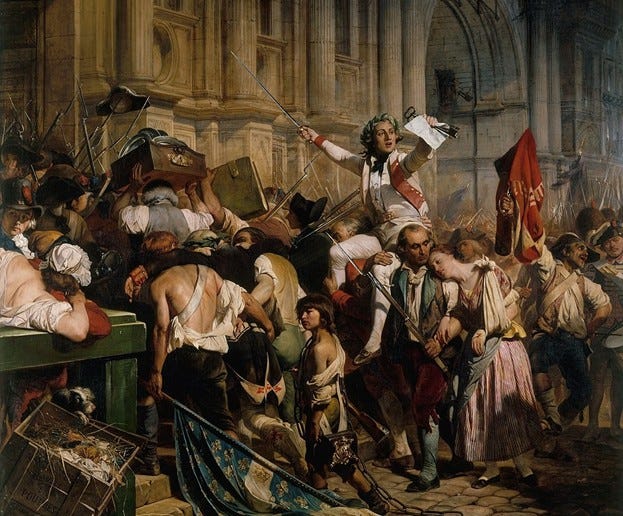
This “support” is what most idealists across the ages almost always fail to consider when pursuing their grand designs for reforming society. They naively believe they can change society without having an effective and practical theory for reforming and fully developing man. Said otherwise, man can’t just be changed, he needs to be developed. And that is a question of education. Schiller observed the consequences of undeveloped human beings waging a revolution during the French Terror. Under the French, the attempt to create the kind of republican form of government established by the young United States devolved into a blood-soaked spectacle. After the failed revolution, France emerged with new emperor who embarked on a series of imperial wars that plunged the entirety of Europe into chaos. These wars in turn made possible the consolidation of Europe’s old hereditary power structures with the 1815 Congress of Vienna — a system that rules Europe to this very day.
Having observed the tragic developments in France, along with many republican-minded thinkers who had high hopes of reproducing the great American experiment in Europe, Schiller concluded that “A Great moment had found a little people.” The French masses were prone to anarchy and lacked the kind of discerning culture that had taken root in the young American colonies — colonies that had been established at a safe distance from the “Old Europe” and its imperial traditions. America could boast of the “Latin farmer,” regular everyday farmers who knew Latin and had access to a classical education. America had visionary leaders like Benjamin Franklin and Alexander Hamilton, individuals of the highest intellectual caliber and foresight. France was a different kind of nation with many conflicting sympathies: its chief republican leader and visionary, Marquis de Lafayette, still ended up compromising and supporting a monarchical government, only to see it torn apart by the Jacobins, and then come full circle with the crowning of Napoleon Bonapart as a new emperor. In light of these events, it became clear to Schiller that the true difference lay in the character development of the citizens. The question therefore became: how does the ideal state emerge out of the existing state, which at present is governed by a confluence of corrupt, chaotic and irrational forces, without at the same time seeing everything torn down in the process? That would all depend on the successful development of the character of a people, which would in turn determine their ability to respond to a higher form reason. Schiller puts it this way:
Schiller argues that art is that necessary “pledge” needed to create a “third character” because it remains independent from the arbitrary judgements and irrational tastes of the age, and can therefore develop independently, without disrupting the vital mechanisms of the state. Schiller writes:
Naturally, the kind of art described by Schiller is not the degraded, decadent or commercialized art which often becomes the slave or pacifier of a declining nation. Schiller refers to the “Fine Arts” proper. For no change in taste or morals dictates the beauty of Fine Art, rather such art serves as the universal standard against which all art and culture can be universal judged. In a word: only through the development and sustained exposure to the Fine Arts does man gradually learn how to translate the principles of aesthetic beauty into moral beauty, and transform the state based on necessity into a state based on freedom. A Golden Age?Schiller’s spirit of Genius reminds us of a “Great Golden Age, of which rhapsodes and bards once movingly told.” These were times, explains the spirit, “when pure, bright holiness still inhabited earth, and a virginal sense still kept guard over our young race.” In this era of gold:
The necessary cultivation of both the emotions and reason, which was supplanted with a lifeless system of formulae and procedures during the Enlightenment, wasn’t needed in past ages. Men were still able to recognize the moral and the true in their own hearts, without needing the stamp of the “signet.” In a word: their system more closely resembled Schiller’s aesthetic theory of Fine Art in practice. The essential difference between the problems of the modern world and this “Golden Age” lay in the art and culture. Man’s emotions were already educated through drama and poetry, such that one was naturally more inclined to the conclusions of reason. Duty was a hallowed thing which the heart took great pride in; it didn’t need to be justified by formulas. Necessity ruled with a “mystical charm” and naturally entailed faith in a higher divine will. As a result, the clash of emotions and reason characteristic of modern man was in many ways much more foreign and alien to the hearts of these ancient people. That’s why historians and poets like Schiller and Alexander Humbolt, Shelley and Keats, and many other visionaries and free thinkers sought to study Classical Greece and prized that young civilization over all others in recorded history. Although still imperfect, in this infancy of civilization one still saw of glimpse of the ideal, where full-grown adults still maintained a naïve and innocent disposition in the face of the divine order of things. Knowledge and experience weren’t yet so differentiated and dichotomized as to be fragmented into a myriad of categories and specializations, where feeling and thought were only further estranged with each new degree of complexity. One could still find all the pressing matters of the age represented on the stage in a single dramatic work; the laws of Solon were still preserved and revered as poetry. As Schiller puts it:
The lost innocence and enchantment of early man can only be regained through culture, argues Schiller. Without it, Man is destined to either revert to savagery or devolve into barbarism. Stay tuned for part IIDavid Gosselin is a poet, researcher, and translator in Montreal, Canada. He is the founding editor of The New Lyre. His personal Substack is Age of Muses, where he publishes historical deep-dives, original poetry and a variety of writings for a new renaissance. His new book A Renaissance or New Middle Ages: Magic, Mystery, and the Trance Formation of the West can be purchased here. The Rising Tide Foundation (RTF), a non-profit based out of Montreal, Canada, dedicated to the rigorous re-examination of Universal History and the principles governing the cyclical appearance of Renaissances and Dark Ages in human civilization. Consider supporting our work by subscribing to our substack page and Telegram channel at t.me/RisingTideFoundation.
You're currently a free subscriber to Rising Tide Foundation. For the full experience, upgrade your subscription.
|
Sunday, 15 March 2026
Towards a Culture of Genius





Subscribe to:
Post Comments (Atom)
Legacy is built in ordinary moments
What you do daily becomes what you leave behind. ...

-
Rex Sikes posted: " Take this quote of William Atkinson Walker's to heart. Understand it and apply it in your life. ...


No comments:
Post a Comment