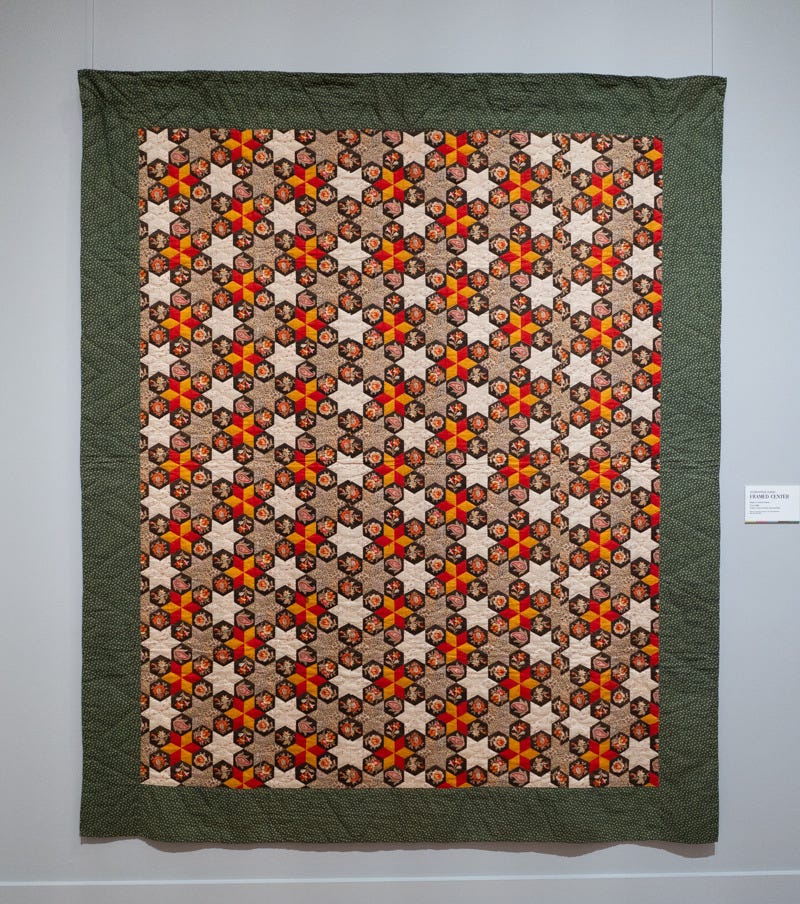
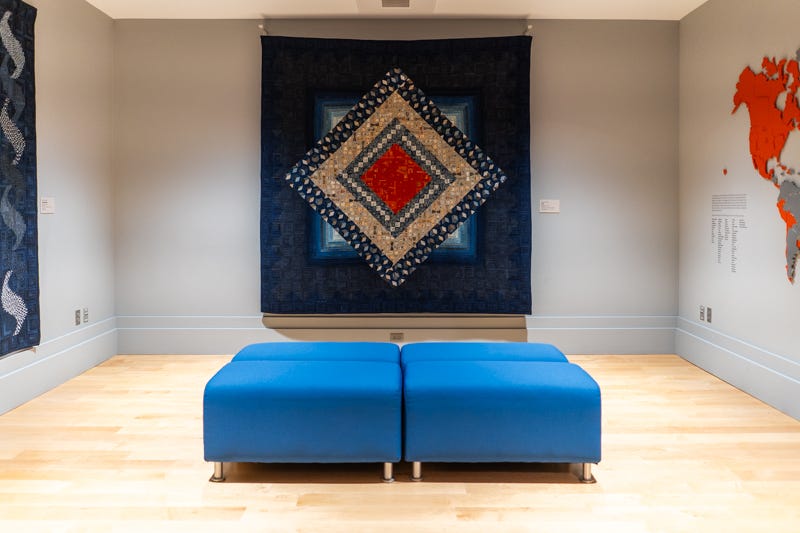
Another week, another museum. This time, I went to the International Quilt Museum. This museum has a large collection of quilts and quilted things from the nineteenth century and on. About two thirds of their items are from the US and the remaining third comes from all over the world. The exhibits change regularly and are always full of the most amazing craftsmanship. Some of the quilts were made by ordinary sewists making utilitarian blankets for the household, while others are works of art made by artists whose medium happens to be fabric, needle, and thread rather than oil paints or watercolor.
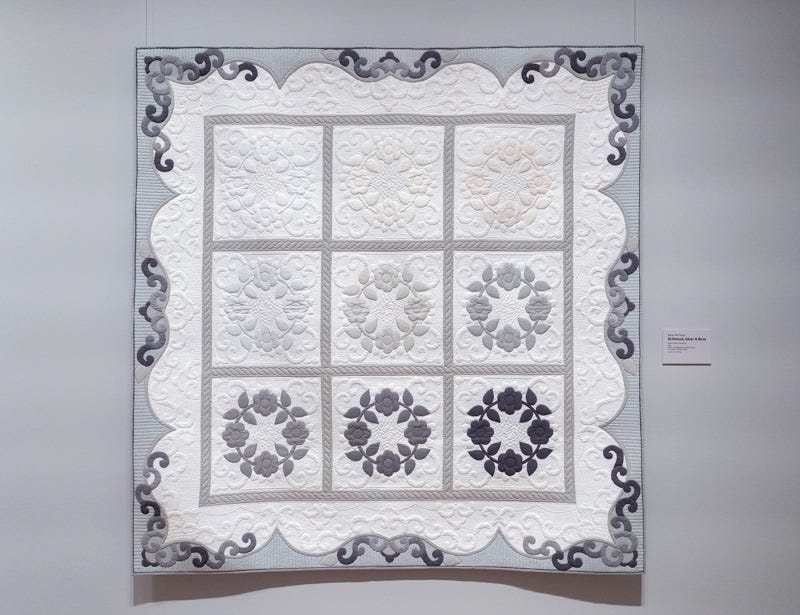
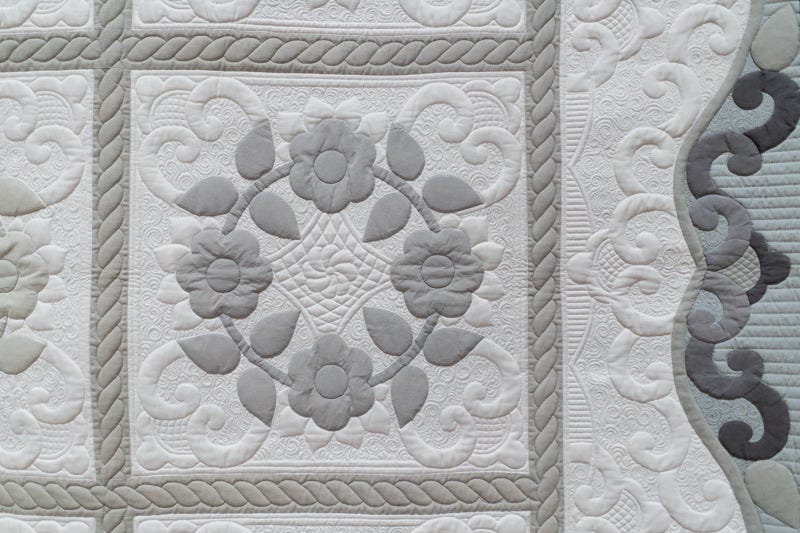
Karen McTavish’s work involves copious amounts of intricate machine stitching that would take ages to complete if you were doing it by hand. Though machine work like this has been controversial in the quilting community in the past, it has largely been accepted now. The quilts in this part of the exhibition were gorgeous and so intricate, but you wouldn’t notice it if you didn’t look closely. When I walked into the gallery I just saw a series of beautiful quilts. It wasn’t until I stepped up to the first quilt to see the stitching that I noticed all the intricate machine work. It’s a little like viewing a pointillist painting from afar, then walking up to it. From a distance, you see the full picture; when you look closely, you start to see all the little dots that make up the image. The same is true with the quilts made with McTavish’s technique. You can admire the design from afar, and also admire the tiny, intricate parts that make up the whole.
The McTavish exhibition included a couple of double wedding ring quilts, which reminded me of my grandmother. She sewed and made quilts until her arthritis and failing eyesight forced her to stop in her early nineties. I own three of her creations; one, she made for me for my high school graduation; I got another one several years ago when she was giving away her remaining quilts to her family; and I got my favorite of the three after her death about three years ago. This last quilt is a double wedding ring pattern with a scalloped edge, and it’s so beautiful and intricate– but there is one little problem: One of the patches is made of loosely woven cloth and the stitching came out so there is a little hole in the quilt. I took it to a quilting shop, and the woman I spoke to said that all I needed to do was cut some new fabric in the same shape and replace that patch. She sold me some beautiful cotton fabric by a Norwegian designer, but I’ve been putting off fixing the patch because I worry that I will mess up and ruin my grandmother’s beautiful quilt. The evening after I got home from the museum, though, I was ironing the linen kitchen towels I made a few years ago, and I realized that while I’m far from being an accomplished sewist, I’ve made plenty of simple things and those seams have held up through a lot of wear and tear. Replacing this one little patch probably isn’t nearly as difficult as I’m imagining it to be, and my stitchwork is good enough for this mending job. It helps that one of the other exhibitions at the museum called ‘Boro’ showcased a Japanese tradition of mending and patching clothing and blankets over and over again. It was originally a completely utilitarian craft meant to make fabric goods last as long as possible for the working class people who couldn’t afford to go out and buy new things when the old ones started wearing out. These goods weren’t thought to be worthy of preservation until the 1980s when the tradition, craft, and care that went into their making over the years began to be valued for what it was. The worn, patched, and mended nature of the garments and blankets in the show were beautiful despite their wear and tear. So even if my mending job is not as good as my grandmother’s would have been, that’s alright. It will be neat enough, and even if I do manage to screw things up completely, I know people I can take my quilt to to get it mended.
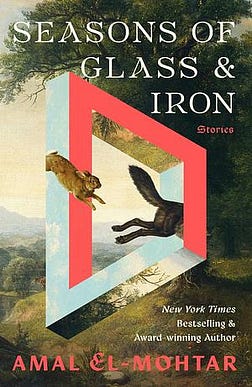
What I’ve Read Seasons of Glass and Iron is a collection of Amal El-Mohtar’s short stories ranging from 2008 to 2023. They were written for other publications and gathered for this collection. They are, according to El-Mohtar, stories about the myriad ways that women love, and each of them is a little marvel. The collection opens with the titular ‘Seasons of Glass and Iron’, in which two women– one cursed to wander the earth until she wears out seven pairs of iron shoes, and the other sent to live in a house on a glass mountain– encounter each other and face the truth about their circumstances. The collection and ends with ‘Pockets’, in which a woman begins finding unlikely things in her pockets. Somewhere in the middle, we are treated to ‘The Truth About Owls’, where a refugee girl finds something familiar and comforting in the harsh nature of owls and the Welsh folktales about them. I could go on, but it would be like listing off all the flowers in a garden and then trying to explain how beautiful they all are. El-Mohtar’s 2025 novella The River Has Roots was one of my favorites of the year thanks to its gorgeous writing and the depths it digs into where it comes to the joys and perils of love and sisterhood. You wouldn’t think that a short story could contain a story as wide as even a short novel’s but that’s the thing about Amal El-Mohtar’s stories: They are deceptively simple and contain depths you won’t always notice at first. These stories expand with further thought and may have their greatest emotional impact after you’ve let them work on you for a while. ‘Pockets’, for example, is a story of unexpected and apparently random connections between people and how even unintended meetings and messages can bring comfort to those who need it. Every time I think about that final paragraph, it brings tears to my eyes. I don’t usually read short story collections. I read primarily fantasy, and it is difficult to build a world and characters in as few words as a short story requires, but I sought out Seasons of Glass and Iron specifically because I knew Amal El-Mohtar’s stories would be these perfectly cut and crafted gems, and I was right. If you only pick one short story collection this year, make it Seasons of Glass and Iron. Thank you to NetGalley and Tordotcom for the free advance copy for review
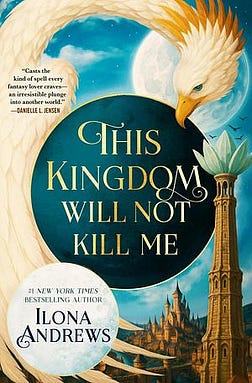
The Kingdom Will Not Kill Me is the first in writing duo Ilona Andrews’ high fantasy/portal fantasy trilogy entitled Maggie the Undying. Maggie is an ordinary twenty-six year old woman living a constrained but comfortable life where she gets to spend her weekends on her cozy couch reading her beloved fantasy novels– especially her favorite unfinished trilogy about the political machinations in the city of Kair Toren. Her happy life is completely upended when she wakes up cold and naked outside of Kair Toren itself. With no way home, she must use her encyclopedic knowledge of the plot, geography of the world, and the characters’ own thoughts and histories to find a way to survive and prevent the horrific future she knows is coming. As she learns to navigate her new reality, she finds the typical fantasy companions: a former lady’s maid, an assassin, and a skilled warrior she shouldn’t be attracted to, along with a growing menagerie of fantastical creatures. Though she would rather not be noticed by the powers that be, it’s not long before Maggie’s abilities get her noticed by those who want her knowledge for themselves and by those who would stop at nothing to destroy her and everything and everyone she is growing to love. Though I’m not the biggest fan of portal fantasies– in which a character from our ordinary world is magically transported to a fantasy world– several of my friends were excited about this book, and when I saw there was a StoryGraph giveaway for an advance copy of the audiobook, I entered. A few weeks later I received an email saying that I had won a copy. Hooray! So as soon as my download showed up I started listening and overall, I had a great time with this book. Ilona Andrews have written plenty of books together before, so they know how plot and pacing work, and how to create characters you’ll cheer for and others you’ll want to hit with a hammer. They’re also aware of the archetypes and tropes that have been woven into the fabric of popular fantasy novels over the past several decades. Thanks to her extensive history with fantasy novels, Maggie knows about these tropes, too, and she uses this knowledge to her advantage. It’s a common thing in a lot of romantasy novels from the past ten to fifteen years to have a female main character who is said to be smart but proves to not be very bright in the actual text. Maggie is not that kind of character. She can think her way through a problem whether she’s hungry and shivering or being threatened by most of the most dangerous people in the kingdom. She has a lot of knowledge, and she puts it to good use. There is a point in the story when it starts to feel like it’s just repeating itself, but Maggie recognizes that, too, and changes her tactics to adapt. While I thought the book did drag a little bit at certain points, those points were not overlong and things started moving along again fairly quickly. My main gripe came at the very end– I would have picked up the next book regardless. It didn’t need to end like that. But overall, I’m invested in Maggie’s story and there are certain characters I hope we see a lot more of in book two. Thank you to The StoryGraph and Tor Books for the giveaway copy.
Some other interesting things I saw on Substack this week:    Traveling in Books is free today. But if you enjoyed this post, you can tell Traveling in Books that their writing is valuable by pledging a future subscription. You won't be charged unless they enable payments.
|
Sunday, 15 March 2026
Recently Read #7




Subscribe to:
Post Comments (Atom)
Legacy is built in ordinary moments
What you do daily becomes what you leave behind. ...

-
Rex Sikes posted: " Take this quote of William Atkinson Walker's to heart. Understand it and apply it in your life. ...


No comments:
Post a Comment