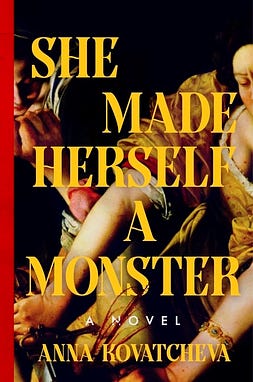
She Made Herself a Monster In novels, superstition is often used to showcase a character or group’s desire to cling to the past and the backward ideals that were once commonly held, but have been disproven and superseded by better, more modern ideas. This holds true in real life, as well. Despite the superstitions we still cling to– wearing a lucky shirt when your team is in the championship, for example– the folktales our superstitions are derived from are viewed as silly stories we’ve rightfully left behind, markers of a bygone age when people were foolish enough to think that demons might possess you if someone didn’t bless you after you sneezed. But superstition does more than make you knock on wood or toss salt over your shoulder. It can give you a sense of control over the forces in your life. Fans who wear their lucky shirts during the championship game might feel like they are helping their team to victory. Say ‘bless your’ to your friend after they sneeze, and you might feel as though your good wishes help them to get well. Superstition has its place in our lives, and in her debut novel, She Made Herself a Monster, Anna Kovatcheva makes use of the many-faceted nature of superstition. Set in the Bulgarian village of Koprivici in the nineteenth century, She Made Herself a Monster is the story of three young people: Yana, a fraudulent vampire hunter who travels from one village to the next, putting on grisly displays of “vampirism” and then slaying the “vampire” before moving, planting seeds of hope that things will improve for the people there; Anka, a teenager who has been groomed since childhood to marry the Captain who effectively runs Koprivici, and who always brings Anka back no matter how often she runs away; and Kiril, a young man who went to the city to learn medicine and has come home to serve as Koprivici’s new doctor. The story begins with Yana and Kiril’s separate arrivals in Koprivici. Kiril finds that many things have changed, though one thing has stayed the same: Anka does not want to marry the Captain, a man more than twice her age who was in love with her mother. Though Kiril thinks he is a man of science with progressive ideas, he fails to see why Anka would not want to marry the Captain. He refuses to accept the reality of Anka’s situation or face the violence of their past. When Anka realizes that Kiril will not help her, she flees to Yana’s camp in the woods to make a bargain with her: Anka will help Yana conjure a horrific creature to slay and maintain her facade as a vampire hunter, and Yana will give Anka a chance to escape her horrific future. As they carry out their plan, they begin to expose the corruption at the heart of Koprivici and unleash a real monster. Inspired by Slavic folklore and set during a time of rapid change in Bulgaria and elsewhere, She Made Herself a Monster is a brilliant debut novel about the stories we tell ourselves, the lies we use to make ourselves feel better about the truths we don’t want to face, and the monsters who walk among us. Though this is her first novel, Kovatcheva writes like she has half a dozen books to her name already, confidently telling her story with elegant prose and characters who feel like real, flawed human beings. You may not like them at points– or ever– but you can understand why they do what they do. In just 288 pages, Kovatcheva does more than some authors can manage in 500 or more pages. She Made Herself a Monster is sometimes hard to read, but is impossible to turn away from. It is a dark gem of a debut that brushes against gothic horror and is always clear-eyed about the truths that lay behind the stories we tell. Thank you to NetGalley and Mariner Books for the advance ebook for review. Traveling in Books is free today. But if you enjoyed this post, you can tell Traveling in Books that their writing is valuable by pledging a future subscription. You won't be charged unless they enable payments.
|
Sunday, 25 January 2026
Book Review: She Made Herself a Monster




Subscribe to:
Post Comments (Atom)

-
Rex Sikes posted: " Take this quote of William Atkinson Walker's to heart. Understand it and apply it in your life. ...


No comments:
Post a Comment