
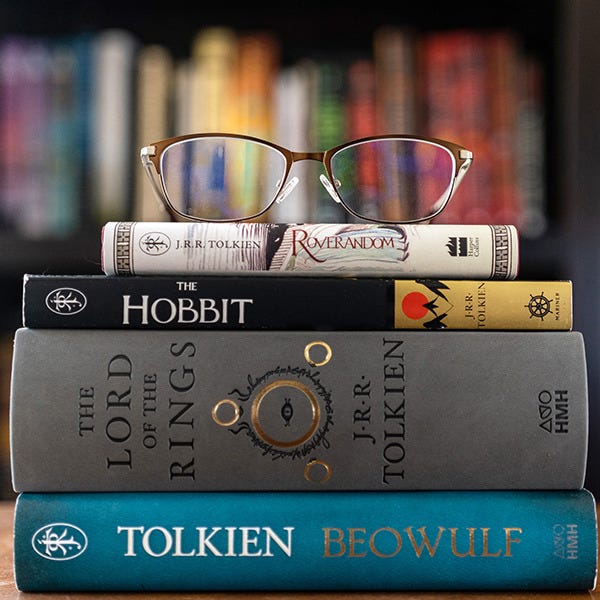
Has anyone ever asked you this: If you could erase all knowledge of a book so you could read it again for the first time, which book would it be? People have asked me this several times through the years, and I used to say The Lord of the Rings. But not anymore. I first read The Lord of the Rings when I was eleven years old. A friend told me about a book he was reading and how much he loved it and I, a bookworm, wanted to know what this amazing book was. He held up a copy of The Hobbit, and the next time I went to the school library I dutifully checked out a copy. It was love at first read, and the next week I went back to the library to see what else this Tolkien guy had written. The only book available was a mass market paperback with a plain library binding that said nothing except The Return of the King by J.R.R Tolkien. Not knowing any better, I checked it out and started reading. This was the early 1990s, before the Peter Jackson films and before widespread home internet gave people greater access to fandoms, and young as I was I didn’t know the importance of things like title pages. I had no idea this was the third book of a trilogy, so I took it home, started reading, and was incredibly confused. Who was Pippin? What was Gondor? I kept reading anyway. I figured I would get less confused as the story progressed, and I ended up falling in love with it, despite not really knowing what was going on. It speaks to the power of Tolkien’s writing that a confused child could love his story, despite her confusion. When The Two Towers and The Fellowship of the Ring came back to the school library, I read them, too– in that order. After that I reread the books, in the correct order, and then read them again. And again. The following Christmas, I unwrapped a shiny new boxed set of The Hobbit and The Lord of the Rings, and I was thrilled, and read them all again. Given the size of my little hometown, it wouldn’t surprise me to find out that the school librarian had called my parents to ask them to buy me my own copies of the books so I would stop checking them out so other kids could read them. It’s been more than thirty years since that fateful trip to the school library. Since then I have, to the best of my knowledge, read The Lord of the RIngs at least once a year ever since. My total number of rereads might not be fifty, but it’s close enough. Rereading it is a September tradition, though I’m happy to read it any time of the year. Despite those fifty or so rereads, I haven’t memorized all the poetry, and I can’t write or speak any form of Elvish. I know a lot more about Middle-earth than the average person, but it’s not my entire world. I’m happy to hang out at the edges of the fandom, listen to a couple of podcasts, read other books by and about Tolkien, and read the occasional article about one interpretation of a character or another. I’ll never know all the things about Middle-earth, but I know enough to appreciate the depth of its history and languages, which gives me a greater understanding of my favorite book. All this knowledge, as shallow as it sometimes feels when I see the in-depth conversations in my Tolkien-based Discord server, is why I would never want to forget what I know about Middle-earth, even if it meant I got to experience the wonder of reading The Lord of the Rings for the first time again. It’s like coming back to your favorite vacation spot every summer. You know the place so well–there’s your favorite tree and over there is the best place to watch the sunset, and that mom-and-pop stand has great ice cream. You have all the nostalgia that comes with visiting a beloved spot across the years along with the ability to see how age changes your perspective of it. Maybe you didn’t appreciate the gardens full of native flowers when you were ten, but as an adult you appreciate their beauty. So it goes with The Lord of the Rings. I didn’t even read the poetry when I was a teenager, but now I love most of it (sorry, but I’m still not a fan of Sam’s troll song). The beauty of Tolkien’s landscape descriptions didn’t affect me until I was in my forties, and I didn’t understand the full, tragic consequences of Arwen’s choice until then, either. It’s this deeper knowledge of the world that adds to my appreciation and keeps me coming back year after year. As Tolkien himself said in the Foreword to the Second Edition, “This tale grew in the telling”, and it’s one that grows along with the reader, too. Teenage me thought it was a wonderful adventure story, while middle-aged me appreciates the moments of comfort it provides. It is, and always has been, a source of escape and restoration from the stresses of life. Frodo, Sam, and all the others always hold onto hope, even in the face of despair. I’m only being a little facetious when, during a dark time, I tell myself that if Frodo could get the Ring to Mordor, I can face this trial, too. All my knowledge of Middle-earth’s history, people, and languages serve as the icing on top of the best cake ever, and the coffee on the side. Though I’ve read The Lord of the Rings fifty times or so, I have no plans to stop reading it or learning about it any time soon. It is a story with depths I have yet to plumb, and I have friends to read it with who will provide new insights I’d never considered. The roads through Middle-earth go ever on and on and I will follow them as long as I can because there is so much beauty and wonder to find around the next corner. Traveling in Books is free today. But if you enjoyed this post, you can tell Traveling in Books that their writing is valuable by pledging a future subscription. You won't be charged unless they enable payments.
|





No comments:
Post a Comment