
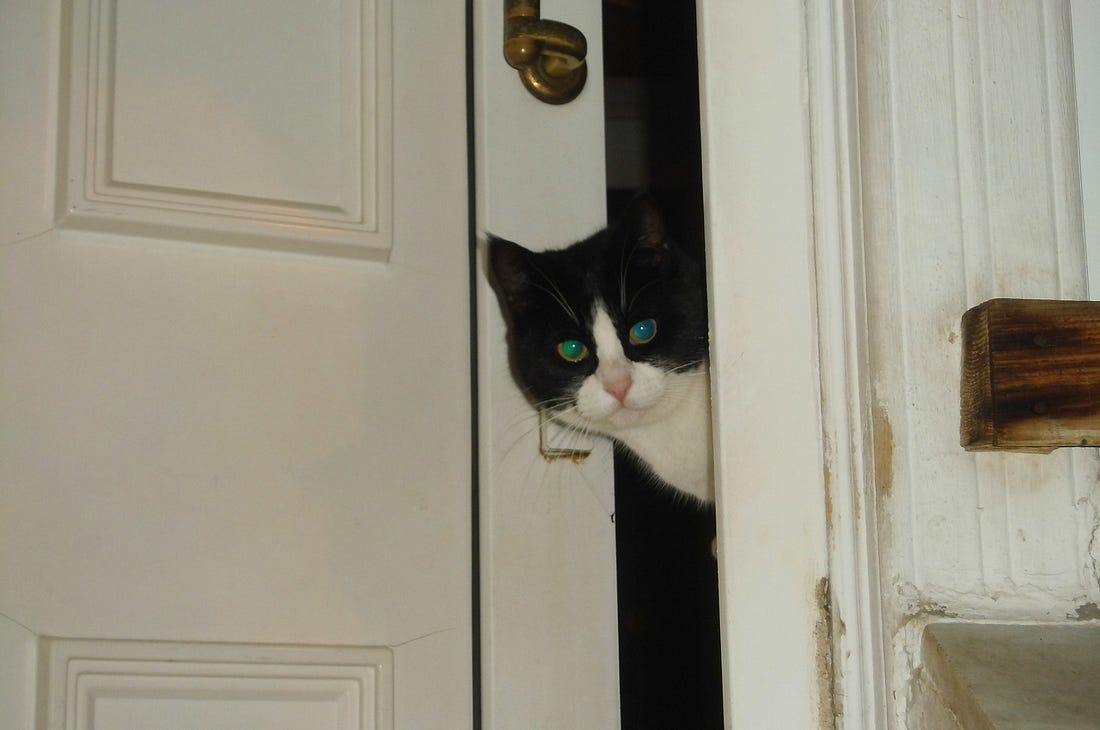
If you’re going to meet your feelings, the best feeling to meet first would be the one that can introduce you to the rest. It’s like when you go to a party. If you want to get to know everyone at the party, you should hang with the social butterfly, perhaps the host, and not the wallflower who was dragged there and spends the whole night checking his phone. At a party of your feelings, the one feeling that will introduce you to everyone is Curiosity. Centuries ago, Curiosity was a shameful feeling, but now it’s everyone’s best friend. It’s said to be the engine of personal growth. When we’re curious, we seek out new experiences, learn new things, and challenge ourselves; leading to greater creativity, better problem-solving, and a broader perspective on the world. Curiosity keeps us engaged and motivated. When we’re curious about something, we put in the effort, leading to a sense of meaning and fulfillment. Curiosity also improves relationships. When we seek to understand others, we can build stronger connections and have empathy for those around us. Nonetheless, you can recognize Curiosity by the blood on its hands, for it’s just come from killing the cat. I asked it, what do you have against cats? But Curiosity has no answers, only questions. If I want answers, I must turn to its companion, Knowledge. Curiosity and Knowledge are like a pair of explorers. Curiosity is a scout, always wanting to find out what’s over that next ridge. Knowledge is a mapmaker who follows close behind, trying to make sense of everything Curiosity finds, how one thing is related to everything else. I believe this relationship between Curiosity and Knowledge is an answer to Meno’s Paradox. How can you look up the spelling of a word in the dictionary if you don’t know how it’s spelled? Partial Knowledge is how. Curiosity takes it the rest of the way. Curiosity starts with the blank spots on Knowledge’s map, filled with suppositions and hypotheses and fills them in. I was struggling to find a way to illustrate this, so I decided to take a break by going on a hike. As I walked through some woods, I saw a clearing up ahead and started to think I might find raspberries there. Curiosity was aroused. The clearing was just beyond the range of my Knowledge, but I did know raspberries grow best where there’s sun, so I would find them in a clearing. Furthermore, they become ripe this time of year and they taste yummy. That was enough. Based on partial Knowledge, Curiosity drove me to test a hypothesis. Once I got to the clearing, sure enough, there were ripe raspberries near the trail. Once I ate them, I became curious whether there were more, deeper in the raspberry patch. Partial Knowledge told me when there are berries on the edge, there might be more berries in the middle. Curiosity drove me to venture further in. Knowledge might have spoken up at this point to tell me there would be prickers in the patch, for I already knew that raspberries had thorns. Maybe Knowledge did try to warn me, but Curiosity was so single-mindedly focused on berries that it was unmindful of the dangers. I found a handful of berries but got scratched up and tore my clothes in the process. Then I hurt myself some more when I tried to get out of the bramble. For the sake of a few berries, I looked as though I’d been in a knife fight. That’s how cats get killed by Curiosity. It narrows the field of inquiry so it can penetrate the unknown and misses the big picture. I could have avoided that trouble had I read Thomas Aquinas before taking my hike. He had a dim view of curiosity, or curiositas, as he called it, in Latin. He thought it would be better to cultivate studiositas, or intellectual rigor, which is what you get when Knowledge, rather than Curiosity, is put in charge of exploring the unknown. Remember, Knowledge is the mapmaker, while Curiosity is the scout. Exploration should be done at a pace that allows the mapmaker to keep up, for the mapmaker examines all the features of the landscape, not just the ones Curiosity is interested in. The mapmaker lingers to integrate each new discovery into what was known before. A little knowledge is a dangerous thing. The person who masters a specialty and doesn’t see how it fits in with everything else thinks that she knows more than she does. That’s what many are afraid of with the advent of artificial intelligence and genetic engineering: scientists who are so intent on getting answers to their specific questions that they miss the broader implications. That’s what’s behind what I call the nerd’s curse. When you acquire so much knowledge in a specialized subject that you become a nerd and people cannot relate to you. Curiosity’s gone wild. I sometimes see clients who are so interested in exploring the contents of their psyche that they use psychedelics to do so. It’s fine with me if they do, provided they have a safe source and take the time to process their experiences. Psychedelics are agents of Curiosity; they may open you up to new vistas you never imagined. Processing afterwards is the mapmaking. Unfortunately, I find the very people who are the most open about using psychedelics are often the most closed about processing their experiences afterwards. They’re afraid making sense out of it all will render their extraordinary experiences ordinary. I try to tell them I don’t intend on taking all the color and life out of their psychedelic experience; I only want to make it useful in their daily life and help them avoid a derangement that occurs when some elements of experience are not integrated with the rest. Of course, things don’t always go horribly wrong when Curiosity leads the way. I don’t always bleed when I pick raspberries. Most of the time, Curiosity yields positive results. Disaster doesn’t happen often, but it’s still a disaster, so you may want to take out some insurance against it. Curiosity should be praised for its openness to new experiences and willingness to experiment, but it also should be restrained. Like a bloodhound when it picks up a scent, intellectual rigor should keep it on a leash. Bloodhounds can still sniff perfectly well when leashed, but the leash allows their handlers to keep up. With this in mind, let’s look at the map before we plunge into the thicket of feelings, if only so we can define our terms so you and I have the same things in mind as you read. ReferencesCenturies ago, Curiosity was a shameful feeling, but now it’s everyone’s best friend. For most of Western intellectual history, curiosity was treated as a vice rather than a virtue — Augustine worried about it as a distraction from God (concupiscentia oculorum, “the lust of the eyes,” in the Confessions), and medieval thinkers generally agreed. The standard scholarly account of this shift is Barbara M. Benedict, Curiosity: A Cultural History of Early Modern Inquiry (University of Chicago Press, 2001) A book for the general reader is Mario Livio, Why? What Makes Us Curious (New York: Simon & Schuster, 2017) The cluster of claims about curiosity improving creativity, problem-solving, engagement, and relationships George Loewenstein’s “information-gap theory” of curiosity can be found in “The Psychology of Curiosity: A Review and Reinterpretation,” Psychological Bulletin, 1994) Todd B. Kashdan, Curious? Discover the Missing Ingredient to a Fulfilling Life (William Morrow, 2009) is a book for the general reader. Meno’s Paradox Comes from Plato’s dialogue named Meno, where Socrates and a young nobleman named Meno get tangled up trying to figure out how you could ever go looking for something if you don’t already know what it is you’re looking for. Thomas Aquinas Split curiosity into two in his book, Summa Theologiae. You're currently a free subscriber to The Reflective Eclectic. For the full experience, upgrade your subscription.
|





No comments:
Post a Comment