
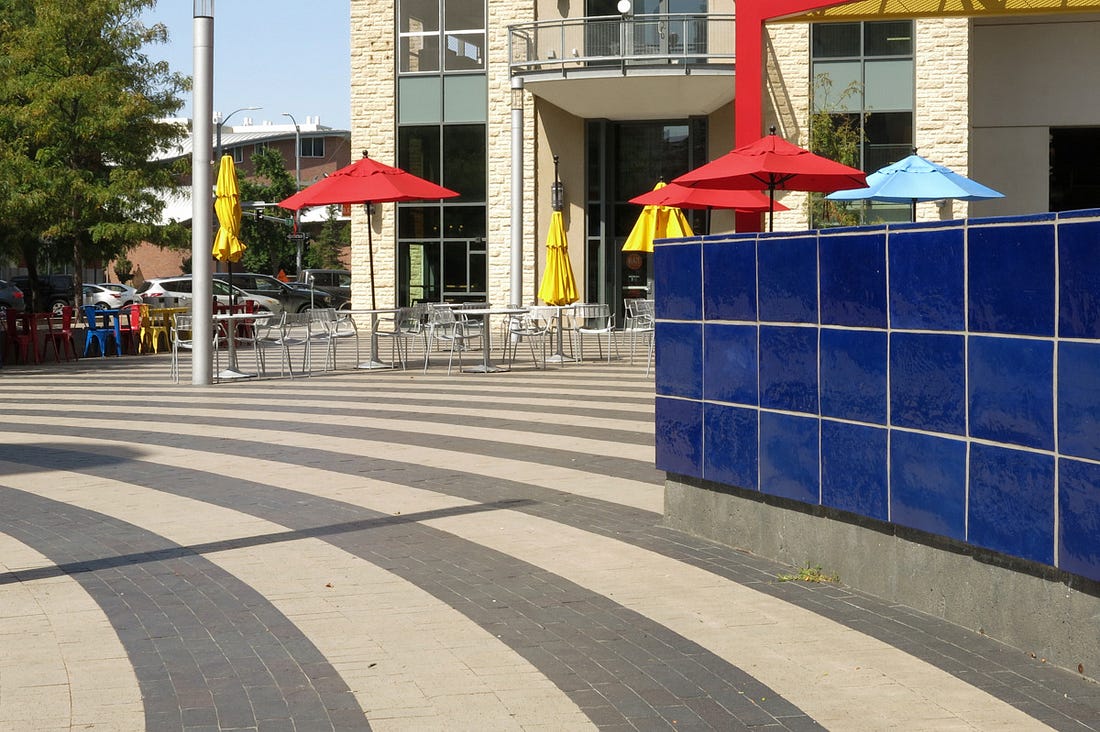
I’m still waiting for the fall vibes to show up. They are absent. Summer keeps hanging around, and I am well and truly sick of it. There is a light at the end of the torrid tunnel, though, as the forecast for the second half of this week is predicting temperatures around 85F/30C. They will not be the cool, crisp autumnal days I’m longing for, but it’s better than 99F/37C. In other news, I was given an old Canon G15 point and shoot digital camera. I am planning to carry it out and about to use as a sort of photographic sketch with little to no post-processing. So far, I’ve only taken a few pictures with it. I went downtown to run a few errands on my day off, but given that the heat index was around 104F/40C, I didn’t stay out for very long. I am crossing my fingers that going outside will be more tolerable soon.
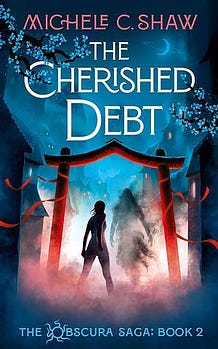
A few things I finished reading last week: The Cherished Debt (The Obscura Saga #2) by Michelle C. Shaw The Cherished Debt picks up a little while after the first book, The Honorable Con, left off, with everyone looking for someone or something. Ailyanna and Benjie are searching for his missing nephew as well as looking for a new path together, even as Ailyanna keeps pulling away from him. Kresta must find a lost heir or watch her family fall to an assassin’s blade- but that heir is Ailyanna herself, and with the new understanding between the two, Kresta will not give up Ailyanna’s secrets. Meanwhile, Morgane, a new mother, is trying to find her way back to a new normal with her baby and higher rank in society, but the city she is returning to is different from what she remembers. She and her family must decide if they will turn a blind eye to what is happening, or if they will go in search of a better way forward. Where The Honorable Con was a fantasy heist novel with a cast of motley characters who didn’t quite trust each other, The Cherished Debt is more of a quest- everyone is searching for something, and that something is what pulls the plot forward. Whether they are looking for family or security, the emphasis is on the characters and how they respond to their respective situations rather than being a plot-forward book. While certain events may feel like they happen very quickly, I’m not bothered by that. There are enough fantasy series that are bogged down by logistical questions, and finding a book that just lets things happen without making you watch the entire setup is honestly a relief. Sometimes you just want to read about the characters without keeping track of every single thing they do. Once again, Shaw has delivered a fast-paced, character rich story that keeps you engaged throughout and doesn’t overstay its welcome. The Cherished Debt makes you wonder what sort of trouble everyone will get into next time, how they’ll get out of it, and, more importantly, how their relationships will develop as their adventures continue. Thank you to NetGalley and the author for the advance copy for review.
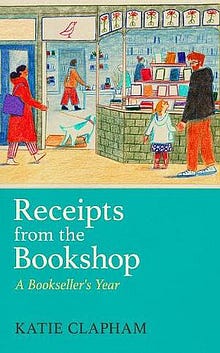
Receipts from the Bookshop: A Bookseller’s Year by Katie Clapham For many readers, the dream of opening their own little bookshop in a little town is an unrealized goal, but about fifteen years ago, Katie Clapham and her mother went and did it, opening their little bookshop, Storytellers, Inc., in their hometown of St Anne’s on Sea on the English coast. A few years ago, Clapham started sharing her observations and jokes about her days working in the shop on her Substack, Receipt from the Bookshop, and a year’s worth of those observations became this book. I have followed Receipt from the Bookshop on Substack for a while now, and though I remember reading some of these posts when they first came out, it was a delight to revisit them. Good, funny writing is evergreen no matter how often you come back to it. Clapham’s anecdotes about her customers are humorous, but not mean-spirited— even when she is faced with the baffling sorts of questions retail workers often get. Hearing about mishaps (forgotten keys, oh no!), averted tea crises, and local goings-on, such as when the local kite festival was bedeviled by a sudden lack of wind, and about the regular customers, the neighboring patisserie, and Mrs. Lemon Cake’s lemon drizzle cake all make me wish I could take a quick trip to Storytellers, Inc. to have a look at the window display, buy a book or three, and hopefully not end up in the Receipts for being completely ridiculous. Alas, I am on the wrong side of the Atlantic Ocean for that, so I will have to content myself with a visit to my local indie bookshop and with reading Receipts from the Bookshop, both the book and the still-ongoing series on Substack. Clapham’s stories always brighten my day and make me glad that independent bookshops exist, no matter where in the world they are. Thank you to NetGalley and William Morrow for the free advance copy for review.
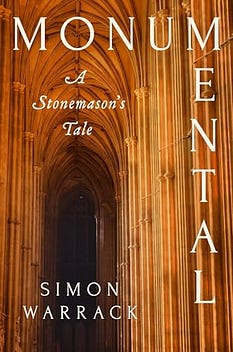
Monumental: A Stonemason’s Tale by Simon Warrack Part memoir and part discussion of stonemasonry, Monumental is a fascinating look at a subject many would probably think is a bit boring. What, they might ask, is exciting about stacking stones up? Given that stone buildings are a profound part of the history and culture of people around the world, the subject of stonemasonry is a more relevant– and sometimes more contentious– thing than we give it credit for. But Simon Warrack provides an eye-opening account of historical stone buildings, their construction techniques, and developments in conservation that seek to keep these ancient buildings from deteriorating so they can continue to keep us in awe. Warrack begins by describing how he got into stonemasonry in the 1980s. He had a history degree but wasn’t sure of what to do with himself when a chance encounter sent him to Canterbury where he began to learn the mason’s trade at the cathedral. One he’d completed his apprenticeship he traveled to Italy where he fell in love with Venice, helped restore damaged fountains and churches in Rome, then ended up on a team that went to Cambodia to restore sculptures in Angkor Wat. There, he learned that working with the local people about their culture and religion was just as important to the conservation of a site as the stone itself– a philosophy he carried on to his work in Lalibela in Ethiopia, to Zimbabwe, the United Arab Emirates, Syria, and then into his teaching work as he began training a new generation of masons who will help keep the trade– and our architectural heritage– alive. Though the discussions of building and conservation materials and techniques is very technical in nature, Warrack presents it in such a way that even someone like me, who knew absolutely nothing about stonemasonry, could understand it and gain a new respect for the people who figured out how to construct these monumental buildings and deal with the unique challenges their environments provided. Our ancestors were intelligent and fully capable of creating these incredible buildings, and thanks to people like Simon Warrack and the teams he has worked with throughout the years, we have the ability to preserve them and ensure that they can last for many, many years to come. Monumental is a fascinating book written by an expert in his field who loves what he does, cares deeply about all the sites he has worked on, and has the ability to communicate it all to the layperson. Thank you to NetGalley and W.W. Norton and Company for the free advance copy for review.
In other reading news, I have started The Children’s Book by A.S. Byatt thanks to Simon Haisell’s slow read at Footnotes & Tangents. We are three chapters in, and I am already enjoying this book and the many little rabbit holes it has already taken me down. I started Byatt’s more famous book, Possession, on audiobook awhile ago, but I quickly decided that it was a book I wanted a physical copy of. I picked up the paperback at my local used bookshop, but I haven’t gotten around to it yet. I think I will try to read it in the new year, once the slow read of The Children’s Book is finished. I was amused to discover that while A.S. Byatt wrote historical fiction, she did not like it when authors wrote novels about actual historical figures. She preferred the freedom of developing her own characters without being beholden to a strict timeline. This is especially interesting, given that The Children’s Book was nominated for the 2009 Man Booker Prize alongside Hilary Mantel’s Wolf Hall (which went on to win), a book that delves deeply into the life and mind of the very real historic figure of Thomas Cromwell and the court of Henry VIII. I don’t know if Byatt made any public remarks about this or not, but I do wonder what she thought of it. If you want to join the slow read of The Children’s Book, you can find the reading schedule and other information at Footnotes and Tangents. 
Traveling in Books is free today. But if you enjoyed this post, you can tell Traveling in Books that their writing is valuable by pledging a future subscription. You won't be charged unless they enable payments.
|




No comments:
Post a Comment