
I have been seeing so many other people on Substack celebrate seeing the first signs of fall, but around here it’s just been more of the same summer nonsense I’ve been dealing with for the past few months. This coming week, the temperatures have been forecasted to be around 95F/35C. I am well and truly tired of it. I want cooler weather to come back as soon as possible. Hot weather is fine for a while, but I have had too much of it. I want it to go away now.
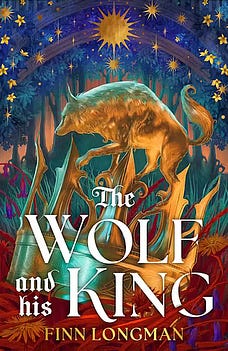
Though retellings of myths and legends have been popular for years, Greek mythology and Arthurian legends get the most attention. Other tales from northern Europe have gotten a bit of notice; I thoroughly enjoyed Genevieve Gornichec’s books The Witch’s Heart and The Weaver and the Witch Queen, which are based on Norse mythology and history, and Katherine Arden’s The Unicorn Hunters, which is based on Breton history and legend. Aside from the Arthurian tales, though, I’ve only come across a handful of books based on non-Arthurian tales. Two of them were abysmal but Finn Longman’s novel, The Wolf and His King was thoroughly engaging. Longman is a medievalist and is currently at Cambridge University, working toward a PhD in medieval Irish literature, so they are very familiar with medieval stories and the tradition of storytelling, in addition to being a good storyteller. The Wolf and His King is based on the twelfth century Breton story of Bisclavret, one of the twelve tales of the Lais written by Marie de France. Bisclavret is the story of a young, charismatic baron who is cursed to become a wolf for three days each week. When he returns to his human form he must quickly find his clothes to avoid losing his humanity. When his wife learns of this, she conspires with a knight who loves her to hide Bisclavret’s clothing so he will be forced to remain a wolf, and she can marry the knight. After more than a year, the king goes hunting and comes across a strange wolf that is docile and follows him back to court. The wolf lives in the palace until his wife and her new husband arrive, at which point the wolf recognizes her and, after a bit of violence, everything is ultimately set to rights. In the foreword, Longman addresses the fact that Marie de France’s story adheres more to the general idea a medieval court rather than being specific to any one time or place and states, “But if I have occasionally indulged in anachronisms… for the sake of plot or aesthetics, I have done so safe in the knowledge that medieval authors would never have hesitated to do the same”. This, I think, is an excellent way to look at retellings of legends– not as stories bound to a fixed point in history, but as tales that evoke an idea of its time. The Wolf and His King is a wonderfully strange book. The only character given a name is Bisclavret, part of the story is told in second-person perspective, and part of it is told in verse. All of these things are part of what makes the story so interesting, though. Longman’s prose is elegant, which helps to give the book a timeless and compelling quality. I’ve read novels by other medieval historians that were very well researched and also very clunky. It was a pleasure to find a book by a medieval historian that is so beautifully crafted and compelling.
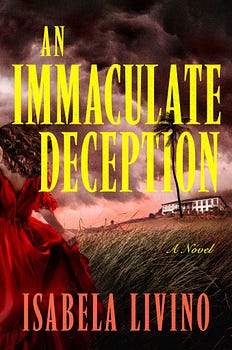
The next book I finished last week was Isabela Livino’s An Immaculate Deception. In it, a young woman named Madalena learns she is pregnant with her lover’s child. When her mother threatens to take the baby away if she does not marry the man, Leandro, Madalena sets out to tell him everything and secure his promise of marriage. But after she has told him and they are leaving the festival, they are in a carriage accident and Madalena is injured. When she wakes, she is in a strange house, being tended to by Dr. Lobos, whose friendly facade seems to hide ominous intentions. Worst of all, Leandro has changed. He is hollow-eyed and does not want to acknowledge their relationship. As Madalena begins to recover her strength, she wanders through the neglected house in search of answers and finds layers of mystery she cannot plumb the depths of. I’ve complained many times about mis-labeled gothic novels. The genre’s popularity has been on the rise again, and so many novels tagged as ‘gothic’ are really just set in an old house and otherwise have nothing to do with the conventions of the gothic. Fortunately, Livino knows what she is doing and gives us a story of two young people trapped in an ominous situation at the mercy of an uncanny doctor who may not have their best interests in mind. While I didn’t find the first section as engaging as the second, I was never bored by it and grew more interested the further I got into it. I had so many questions by the midpoint, and by the end I was satisfied by the ones that were answered– and with the answers themselves– and unbothered by the questions that were left unanswered. This might seem strange, but Livino does her story a service by not trying to tie up all the loose ends. To do so would have required awkward or unlikely plot contrivances, and while other authors might have tried to shoehorn those answers into the book, Livino was disciplined enough to keep her focus on what her viewpoint characters would have realistically known and not sent them in search of answers neither they nor the story needed. An Immaculate Deception‘s mystery, unsettling atmosphere, and sensory detail add a richness to a plot that is relatively straightforward. Livino doesn’t add convolutions that her story does not need. It is a compelling story that is beautifully written, has intriguing characters, and more than earns its status as a proper gothic novel. Thank you to NetGalley and Dutton for the free advance copy for review.
Traveling in Books is free today. But if you enjoyed this post, you can tell Traveling in Books that their writing is valuable by pledging a future subscription. You won't be charged unless they enable payments.
|





No comments:
Post a Comment