
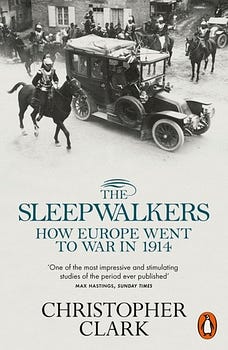
It’s been a humid week around here. Honestly, the past six weeks have been extremely humid– to the point where everything feels damp all the time thanks to the storms that seem to roll through almost every morning around four or five o’ clock. As much as we needed the rain at the beginning of the summer, we’ve gotten enough. We could use a break from rain storms. Or at least a break from the humidity. Otherwise, not much has been going on in my little corner of the world. I have been reading a lot and knitting a little less. I’ve also begun watching HBO’s A Knight of the Seven Kingdoms by viewing one episode each night. I’ve only seen the first episode, though, so while it was enjoyable I have to withhold judgment in general. I have five more episodes to get through before I can really decide if I like it or not. I finished two books this week, the first of which I had been working on for a while on audio, as it is a long, dense book and also the Hoopla app kept rewinding and started from points I had already passed. My problems with Hoopla aside, The Sleepwalkers: How Europe Went to War in 1914 by Christopher Clark was a fascinating look at a part of history I don’t know very much about. Clark examines parts of European history from the 1880s until the outbreak of World War i in 1914 and posits that, rather than being inevitable as many narratives suggest, the war could have been avoided even into the final days before the fighting first broke out that August. I first heard about this book in Jennifer Jelinkova’s video in which she compared Clark’s The Sleepwalkers and Barbara Tuchman’s popular The Guns of August. In her video, Jelinkova discusses the differences between these two books, namely that Clark is presenting a version of events grounded in evidence with very little supposition, and what supposition there is has qualifiers attached to it. Tuchman, on the other hand, published The Guns of August in the early 1960s and, though she was a sound researcher, she was more interested in telling a story about the first weeks of WWI. Sometimes she makes assumptions and leaves major things (like all of Serbia) out of the book for the sake of the narrative. I will probably not read The Guns of August, but Jelinkova makes a case for its relevance, even if she, a scholar of eastern European literature and history, is not thrilled with how Tuchman disregarded Serbia. I am glad I made it through The Sleepwalkers. Usually when I’d heard about the origins of WWI, they were presented as these events that inevitably led to war, that the European countries had been on edge since the 1890s and were just waiting for the spark that would set the continent ablaze. But once Gavrilo Princip assassinated Archduke Franz Ferdinand and his wife Sophie, then it was just France and England versus Germany until the United States showed up late in the game. Clark walks the reader through documents, telegrams, diary entries, letters, and a variety of other sources to show that, while governments were on edge, war was not a foregone conclusion. I’m sure other writers disagree with this assessment, but I wouldn’t know where to go from here. I have a few other WWI narratives on my TBR, such as Robert Graves’s Goodbye to All That, but it is probably not something I will pursue much further.
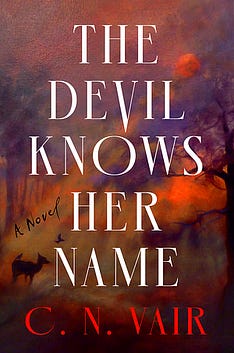
It’s strange to me how small towns are represented in popular culture. They’re generally seen as idyllic places where traditional values rule, everything is beautiful, everyone is happy, and no one locks their doors. Sometimes we’re shown some of the downsides– the poverty and isolation– but so often it’s quaint bed and breakfasts, antique shops, and county fairs celebrating a very simple life. But life anywhere is rarely simple, even in the truly tiny towns and villages that are often overlooked by pop culture and the news. In C.N. Vair’s The Devil Knows Her Name (Fawn in the UK), the Appalachian community of Burrsville is just such a town: small to begin with and dwindling due to a lack of opportunity for its children and dwindling services. What’s left is held together due in large part to the efforts of Tess Wynne. Nearly a hundred years ago, Tess made a bargain with the devil to survive an attack from the man she desired. Now, tethered to the land she was born and raised on, and possessing the magic she needs to make the valley a sanctuary shielded from climate change and other problems, she works as a wildlife rehabilitator, helping the area’s animals and hosting her friends for celebrations throughout the year. It’s hard and thankless work, but Tess has made her peace with it. Burrsville is struggling, but the land itself is thriving. One day, though, a new pastor comes to town and soon he has the community under his thrall, convincing them that Tess is an enemy bent on the town’s destruction. As the pastor begins his plans to reshape Burrsville to his liking, Tess’s sanctuary is under attack from every side. With her magic and influence dwindling rapidly, she must make a choice: endure her destruction, or sacrifice what she loves most to try to save it. Witchcraft aside, the story has a ring of truth to it. Plenty of small towns in the US are struggling with the same problems as Burrsville. Industries flee to find cheaper labor elsewhere, leaving the towns high and dry. With no jobs available, people leave. As people leave, more businesses close and cause even more people to leave. As the population dwindles, services like libraries and hospitals close and regional schools consolidate. Soon, the town is a shadow of its former self, and though residents might try to find ways of revitalizing the community, they face an uphill battle. The worse things get, the easier it is to find a scapegoat to blame the struggles on, whether it’s industry, government, a minority group, or even an individual– as in The Devil Knows Her Name. It’s fairly easy to see why the other residents turn against Tess, but her point of view is easy to understand, too. Her methods are extreme to be sure, but if you truly love a place and you don’t want to see it destroyed for the sake of parking lots and big box stores, it’s hard to blame Tess for the lengths she goes to to try to save it all. A key part of the story I haven’t touched on is the animal that is the book’s UK namesake: the fawn. Early on, Tess takes possession of an out of season fawn born with teeth and unnatural appetites. The local sheriff claims the fawn is a danger to the community and should be put down, but the more he insists on it, the more protective Tess grows of the fawn. She has seen strange behavior from animals before. Nature, after all, does not confine itself to the distinct categories humans like to impose upon things. ‘”She was born with teeth. Why shouldn’t she use them?” Tess decides after a while. It’s a maxim that applies to the fawn as well as Tess herself (and could be advice for all women, if we chose to take it). Her mother decided that hiding her abilities and appearing pliable and nice to those around her was the best way to live her life, but it got her nothing but loneliness in the end. Tess has no intention of ending up like her mother, and even if it costs her everything she will defend her sanctuary until her last breath. A predatory fawn is a strange creature to learn from, but Tess learns her lessons well. The Devil Knows Her Name is a dark tale of community, the effects of being exiled from that community, and the price of fighting to save a community that might not want to be saved. In so many ways, it feels achingly true to the struggles faced by so many towns across the country. Though it was sometimes hard to face what would happen next, I couldn’t put it down. I will be thinking of Tess, the fawn, and the rest of this book for a long time to come. Thank you to NetGalley and Berkley Publishing for the advance copy for review.
Traveling in Books is free today. But if you enjoyed this post, you can tell Traveling in Books that their writing is valuable by pledging a future subscription. You won't be charged unless they enable payments.
|





No comments:
Post a Comment