
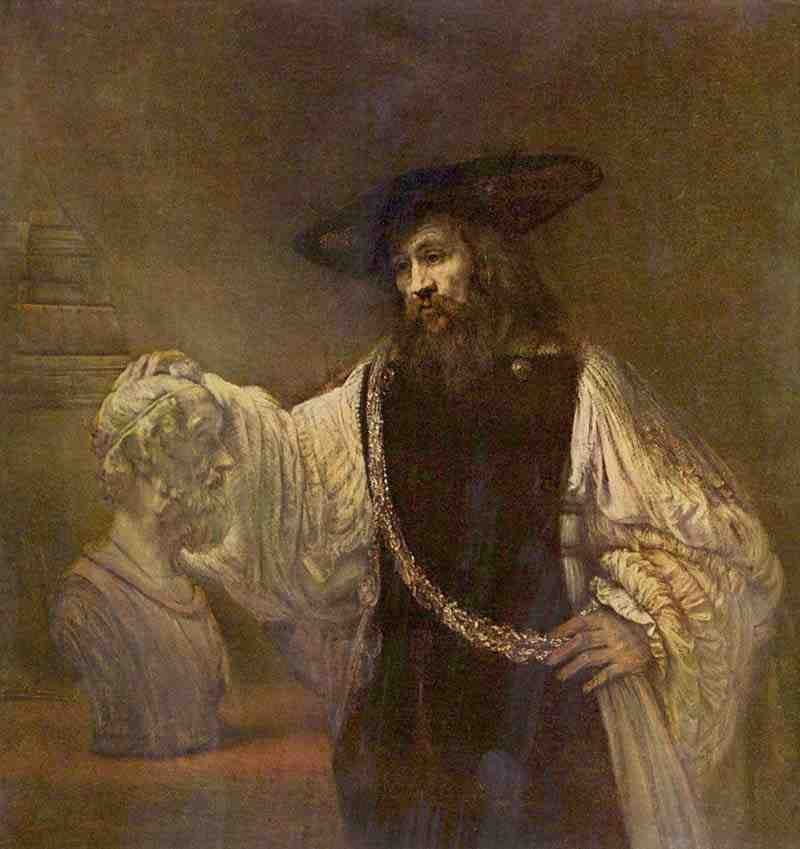
By Gerald TherrienWith all the hoopla about a new movie on Homer’s Odyssey, I decided it was time to correct certain errors in my presentation of Homer’s Odyssey first presented to The Rising Tide Foundation in 2022. In that earlier location, I had attempted to sort out all the different questions about whether or not Odysseus had sailed to the Americas, and this presupposed the question of the location of Atlantis – whether it was in the Americas or in the Atlantic in the Azores or in Spain. However, all that dizzying speculation came to an end when I read the amazing book by Jack Kelley – ‘The Atlantis Puzzle’, and the ground-breaking work of Professor George Sarantitis, that finally proved the location of Atlantis to be in Africa – along the great river systems of the Green Sahara, that would empty out into the Mediterranean Sea at Gades (in present-day Tunisia). While I found that I was correct with my earlier locations of ‘the Lotus-Eaters’, ‘the Cyclopes’, ‘Aeolia’, ‘the Lestrygonians’, ‘Circe and Aiaia’, and ‘Scylla and Charybdis’, I wished to correct my wrong locations of ‘Thrinacia’, and ‘Ogygia’ and of course ‘Scheria’ (Atlantis). Here is my revised edition of ‘Re-discovering the Odyssey of Homer. Was it History or a Myth?’ 1. Homer and VirgilOne way of looking at Homer is shown by Rembrandt’s painting of ‘Virgil contemplating the bust of Homer’ – Virgil vainly trying to figure out how Homer was able to compose his poem.
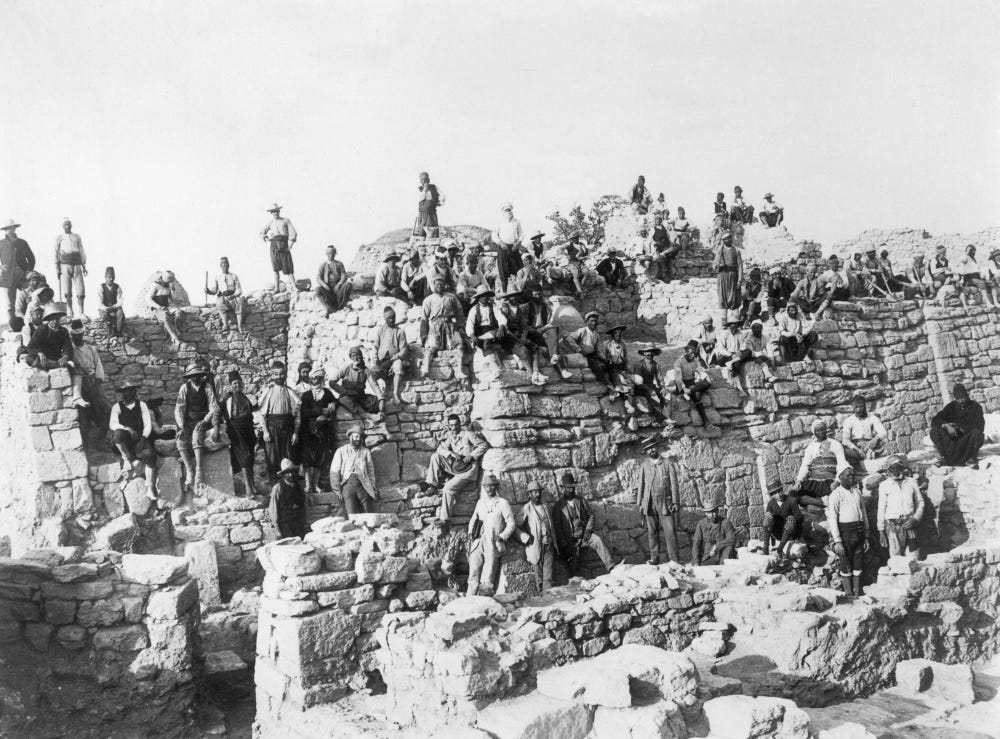
Rembrandt has the light shining on the bust of Homer in such a way that it looks like the light is instead coming from Homer and shining outward, and he has Virgil placing one hand on Homer’s head while his other hand is holding his nice shiny gold chains. So, Rembrandt contrasts Homer, who is Plato’s Aristocratic man who is motivated by discovery and creativity, against Virgil, who is Plato’s Timocratic man who is motivated by power and by the appearance of honor. Rembrandt so poetically shows this conflict in Virgil with one hand on Homer and the other hand on his gold. Virgil, who lived 70 – 19 BC, was commissioned by Caesar Augustus to write an epic that would legitimize the duty and obedience owed to the ‘pax romana’ of the new Roman Empire. Virgil spent over 10 years writing the ‘Aeneid’ when he died in 19 BC – in which he never once mentioned Homer, but he did show how he despised Odysseus, calling him a ‘heartless schemer’, a ‘master-craftsman of crime’ and the ‘double-talking Ulysses’. Unfortunately, Dante never read Homer (the first translation of the Odyssey into Latin wasn’t done until 30 years after Dante’s death), and he had to rely on Virgil and other Latin writers for the story of the life of Odysseus, which is why Dante places Odysseus in the 8th circle of Hell. However, Dante still must have come to understand the problem with Virgil, as he wouldn’t let Virgil enter Paradise – only Purgatory and Hell. Some people believe that Homer’s poems, the Iliad and the Odyssey, were not true history but were simply myths that he concocted, just as Virgil concocted his myth of the ‘Aeneid’. But that was until Heinrich Schliemann’s defiant discovery of the ruins of Troy in the 1870’s, changed peoples’ minds and proved that the ‘Iliad’ and Trojan war did happen.
But what about Homer’s other poem, the Odyssey? Was that based on true events, or was it just a myth or a fable? Now, some of you may have read Homer, and some may not have. So, first, who was Homer? 2. Life of HomerAccording to Herodotus in his ‘Life of Homer’, Melesigenes (his real name) a teacher at Smyrna, decided to join Mentes, a shipowner, to visit different places – to see the world while he was still young. On one trip on their way back from Spain and Etruria, he became very ill with an eye disease, and was left at Ithaca at the home of Mentor, a friend of Mentes, and while recuperating, he researched and learned the story of Odysseus. Later, he rejoined Mentes to sail with him, until his eye disease returned, but this time he didn’t recover and became blind. In the Odyssey, Homer repays his friends by having Athena take the guise of Mentes (book 1) and take the guise of Mentor (book 2) – so he’s already changing history a little bit! Melesigenes returned home to Smyrna and decided to try his hand at poetry. Later, he decided to go to Cyme and asked the city, if they supported him at public expense that he would bring great glory to their city. However they decided that if they would support all of the ‘homeroi’ (what the Cymaeans called the blind) then the city would have a large and useless multitude. That name, ‘homeroi’, stuck with Melesigenes, and from then on, he was called Homer. He travelled and performed his verses in salons in different cities, and eventually he arrived in Chios and there set up a school, settled down, married, had two daughters, and it is here that he most likely composed the Iliad and Odyssey. Perhaps, it had been possible for Homer to have heard some tales or stories about some voyages of discovery, and for the Odyssey to contain some of these tales. Perhaps, it may be possible that it was just a tale, that it was meant to show us the change in character that Odysseus needed to lead such a voyage of discovery? Or, as I will try to show – that it’s both, and is like the way that Strabo views Homer. According to Strabo (who lived 64 BC – 24 AD), he writes this:
So now, we’re going to look at Homer’s Odyssey the way that Strabo says: that Homer took actual events, heightened them with fiction and gilded them with the beauties of fancy, but never without the stamp of truth. The Odyssey is really a story within a story. There is the outer story of Odysseus returning home after ten years of the Trojan War and finding his family and home under an invasion and destruction caused by the many suitors who wished to take over his kingdom. Within this is an inner story of another ten years of wanderings of Odysseus trying to reach home. We’re going to look at this inner story of his wanderings – his Odyssey. 3. Troy to IsmarosAt the end of the war, Odysseus, his men and 12 ships finally left Troy, and travelled to Ismaros, where they sacked the town, killed its men, took their wives and possessions, and divided the loot equally among themselves. The people, the Cicones, called together all their neighbours and the next morning attacked Odysseus and his men, and forced them to flee. Following ten years of a devastating war, the first thing that Odysseus and his men do, on their return home, is to sack and pillage a town! What is wrong with these people, you ask? Hadn’t they learned anything about war? Or, after 10 years of war, they might think that the world is motivated by power. Homer is showing us how Odysseus and his companions were thinking, at the start of the Odyssey. And because of their actions, their destinies would be punished by ‘an evil fate of Zeus’. But before we blame all this on Zeus, let’s hear what Zeus has to say about it. At a meeting of the gods Zeus said this:
Perhaps, instead of being a punishment, Zeus was steering them onto a path for changing their way of thinking. Zeus raised a ‘North Wind’ and an ‘immense storm’ against them, and, as they were rounding Malea, the southern-most point of Greece, they were driven by destructive winds, away from their return to Ithaca, and after nine days, they reached the land of the ‘Lotus-eaters’. 4. Ismaros to the Lotus-EatersWe can assume that the Lotus-Eaters lived along the coast of Libya, because according to Herodotus, (who lived 485 – 425 BC) in describing all the inhabitants along the coast of Libya, he wrote this:
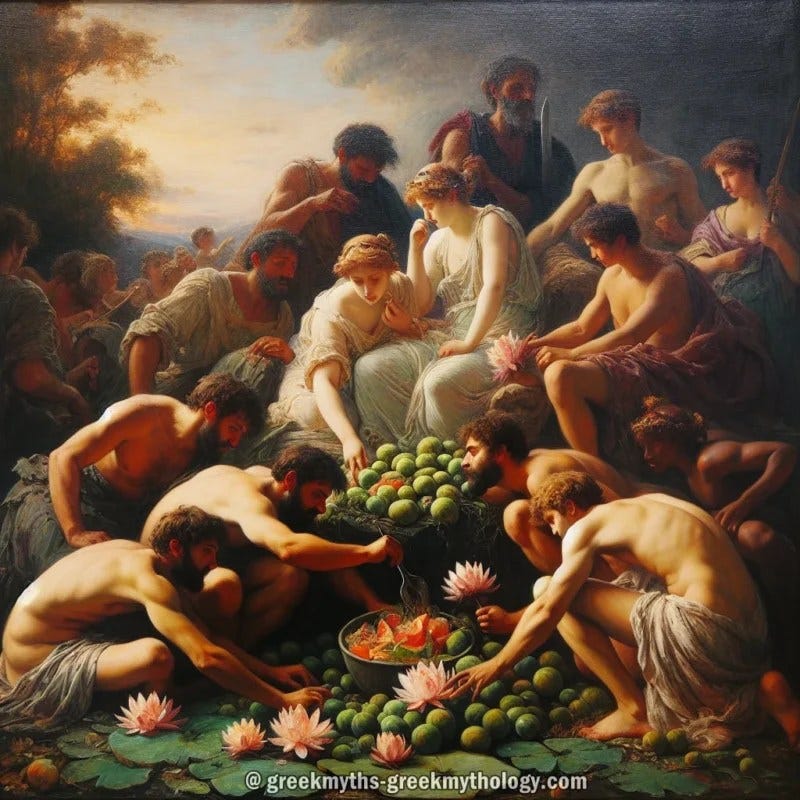
After landing, Odysseus sent three of his companions to find out who these people were. The Lotus-eaters gave the three men some lotus fruit to eat. But when they ate the lotus fruit, they didn’t want to bring back any word to Odysseus, but just wanted to stay there and eat the lotus fruit, nor to even think of their return to Ithaca. Odysseus had to force his three weeping companions back to the ship, dragging and binding them under the benches, and then he called the rest of his men back to the ship, in case someone else ate the lotus fruit and forgot about returning. They fled from the Lotus-eaters and sailed away – to reach the land of the Cyclopes.
5. the Lotus-eaters to the CyclopesWe can assume that the Cyclopes lived in Sicily, and that Odysseus had sailed across the Strait, from the land of the Lotus Eaters, to the land of the one-eyed Cyclopes near the great (one-eyed) volcano at Mount Etna in Sicily, because according to Thucydides (who lived 460 – 400 BC), in discussing the expedition of the Athenians against Sicily, he wrote this:
The Cyclops were an uncivilized people who “do not sow plants with their hands and do not plow but everything grows for them unplowed and unsown… they have neither assemblies for holding council nor laws”. After landing, Odysseus took twelve of his companions with him, and went to inquire about the inhabitants to see “whether they are proud and savage and without justice or are friendly to strangers, and have a god-fearing mind”.
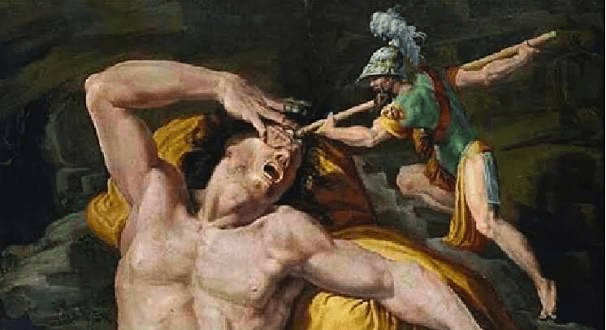
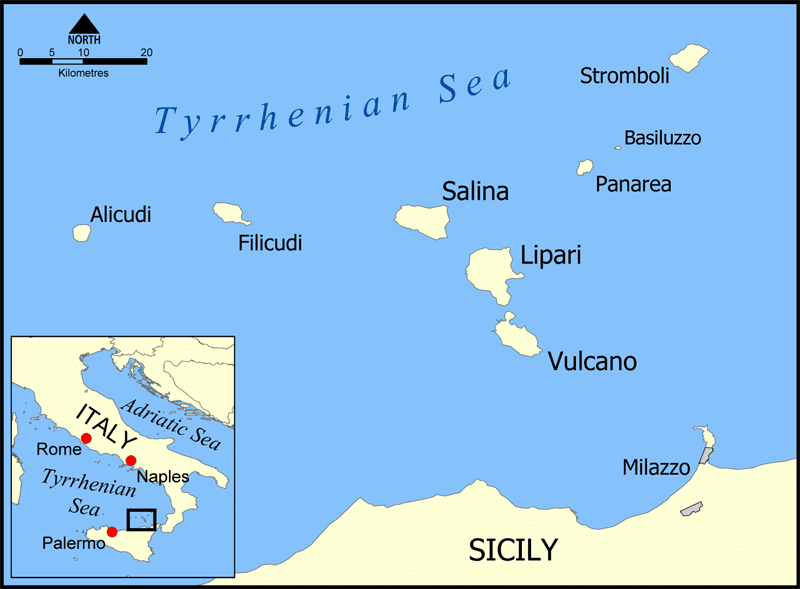
They found and entered the unattended cave of Polyphemos, the giant Cyclops, and son of Poseidon. While his men wished to take away some of the cheeses and sheep back to the ship and then to sail away, Odysseus wished instead to stay and receive a gift from him – since it was the custom at that time for hosts to give gifts to the guests. But the pitiless Polyphemos trapped them in his cave and devoured six of them before Odysseus devised a plan to blind the eye of the Cyclops and to hide under the bellies of the sheep, and make their escape back to their ships. After finally escaping from the Cyclopes, Odysseus and his companions sailed to the island of Aeolia. 6. The Cyclopes to AeoliaWe can assume that Aeolia was one of the volcanic islands of Lipari lying off Sicily’s north-eastern coast, and that Odysseus had sailed from the land of the Cyclopes, around the coast of Sicily, to the island of Aeolia. According to Strabo, in his book ‘Geography’, he wrote this:
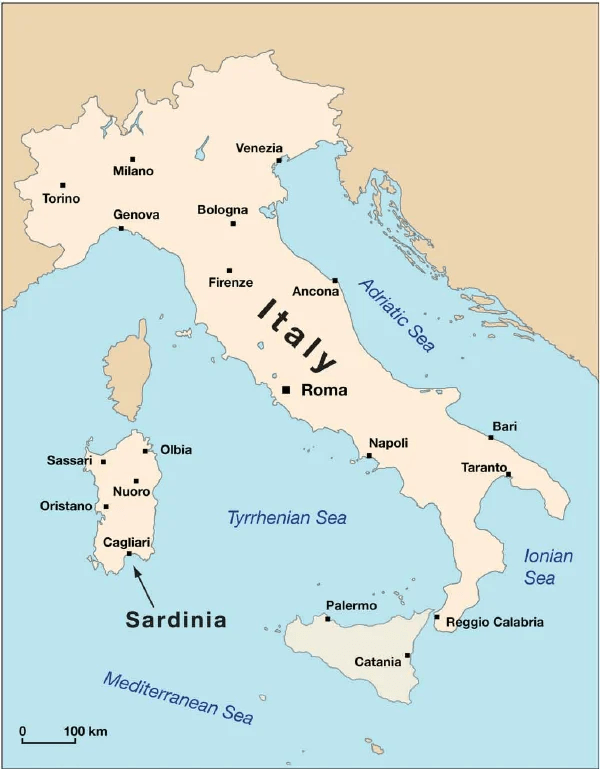
Odysseus and his men stayed there with king Aeolos, the lord of the winds, for a month as guests before seeking to leave. To help them, Aeolos gave Odysseus an ox-hide, inside of which he had bound up all the blustering winds, so that they would not blow at all, and then he sent a gentle breeze to carry them and their ships home, and after ten days, they could finally see their homeland. But, because of the foolishness and greed of the men who wanted to see how much gold and silver Aeolas had given to Odysseus, while Odysseus was asleep they opened the ox-hide, all the winds rushed out and a storm then carried them all the way back to Aeolia. The men do not seem to have learned anything or to have changed at all, since their actions at Ismaros when Zeus sent the North Wind to change their destiny. Back at Aeolia, Aeolos would not help them since they thought that they must be ‘despised by the gods’, and he sent them away. Leaving Aeolia, Odysseus and his companions sailed for six days until they arrived at the land of the giant Lestrygonians. 7. The Nuragic stone sculpturesWe can assume that the Lestrygonians lived on Sardinia, and that Odysseus had sailed from Aeolia, one of the Lipari islands, to the land of the Lestrygonians, on Sardinia, because of the Nuragic statues. Some historians relate that the legend of the giants may be the result of the Greek sightings of the ancient stone sculptures of the Nuragic culture, like those found at Monte Prama – some of them 8 feet tall.
8. Aeolia to the LestrygoniansOdysseus sent three men to see who lived here, and they found the glorious hall of the king, who was not happy to see them however, but was planning a woeful destruction for them, and then the king snatched one of them and made a meal of him, as the other two rushed back to the ships. But the two men were followed by the giants who attacked all the men and all their ships, of which Homer said this:
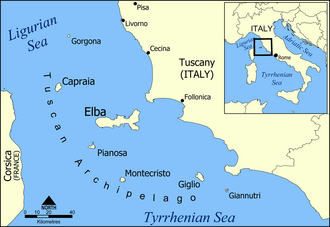
Only Odysseus and his lone ship’s companions were able to escape the destruction, since they had tied up their ship outside of the harbour, but all the other men and the other ships were lost. After fleeing from the giants, Odysseus’ ship landed at the island of Aiaia, the home of the goddess Circe. 9. the Lestrygonians to AiaiaWe can assume that Aiaia is the isle of Elba, because according to Apollonius (who lived 295 – 215 BC) in his poem ‘Argonautica’, Jason landed first at Aethalia and then at Aiaia, and he wrote this:
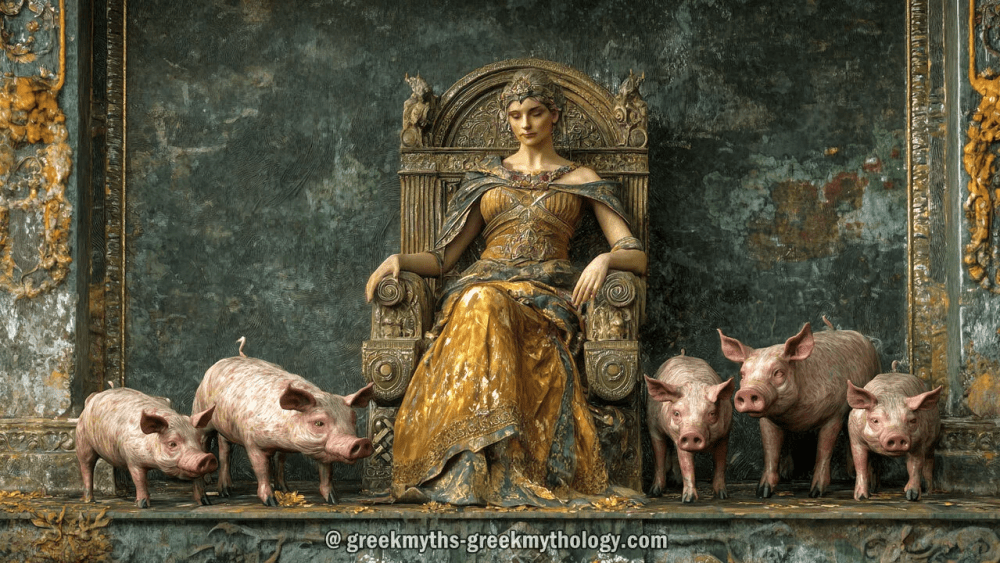
After Jason had circum-navigated Europe and entered the Mediterranean sea, he sailed past the ‘line of islands’ to Aethalia that we assume to be Corsica, and then towards the Etruscan shore to Aiaia that we assume to be Elba. Odysseus’ men, remembering the Cyclops and the giant Lestrygonians, were fearful of searching the island for any inhabitants. After drawing lots, Eurylochus led forth twenty-two men and they found the hall of Circe, who invited the men into her hall to eat and drink, but she stirred a drug into their food, that turned them into swine.
With the help of Hermes, who made him immune to Circe’s drugs, Odysseus was able to free his companions, and they were turned back into men and invited back into her hall to eat and drink (but without any drugs this time) – “until you have taken the spirit into your breast again, as it was when you first left your fatherland”. They stayed for a whole year until they finally wished to return home. When Odysseus asked Circe to show them how to return, Circe wouldn’t tell him how, but she said that they must enter Hades – where our souls go after we die, and to ask this of the soul of Tiresias, the blind prophet who possessed the gift of ‘Foresight’ – not that of predicting the future from a crystal ball but that of foreseeing where the course of events will lead. Circe gave instructions to Odysseus about how to prepare a sacrifice for the dead, and how to journey to Hades – don’t worry about a guide, stretch out your sails and let the ‘North Wind’ bring you there – remember how Homer earlier had used this metaphor of the ‘North Wind’ sent by Zeus, that had started Odysseus on his voyage. 10. HadesAfter arriving at Hades, Odysseus followed the instructions of Circe, prepared a sacrifice and met the soul of Tiresias, who told Odysseus that, first, he will have a disastrous return because of Poseidon:
Tiresias forecast that IF you check your spirits that you MIGHT get home. Secondly, he spoke of the sheep and cattle of Hyperion, the god of the sun:
Tiresias forecast that IF you leave Hyperion’s animals unmolested that you MIGHT reach home. Thirdly, he spoke of making a sacrifice to Poseidon:
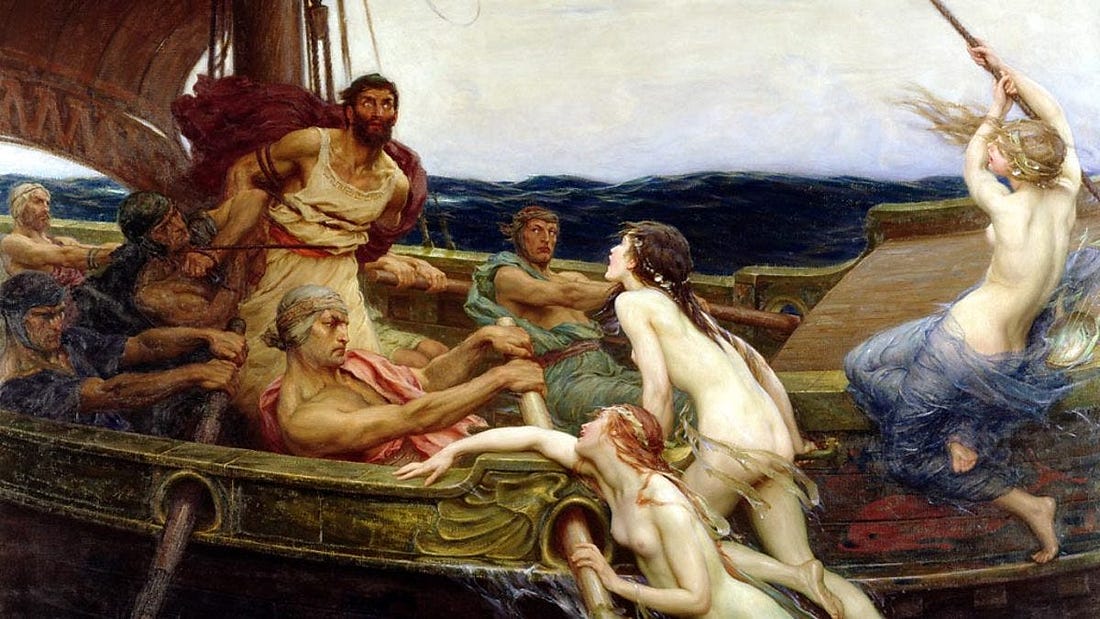
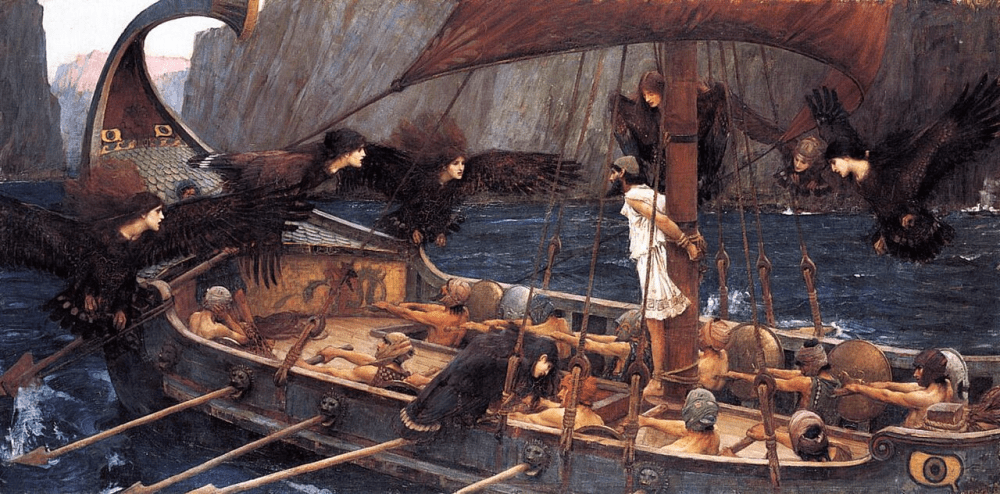
Tiresias forecast that IF you finally do reach home, how you would offer a sacrifice to Poseidon and the gods. Tiresias then showed Odysseus how he could speak with other souls of the dead. Odysseus met the soul of his mother, Anticleia, and spoke about his family. Odysseus next met the soul of Agamemnon, who told him of how he was killed by his ‘cursed wife’ and he asked if Odysseus had any news of his son, but Odysseus had none. Odysseus then met the soul of Achilles who asked about his son, and Odysseus spoke of his son’s courage at Troy. Odysseus also saw the ‘difficult pains’ of three other souls – of Tityos, who was being punished by having his liver eaten by two vultures each day, while it grew back each night; and of Tantalos, who was being punished by standing in a lake beneath fruit trees, but the lake would dry up when he tried to drink, and the wind would blow away the fruit whenever he tried to pick any; and of Sisyphos, who was punished by rolling a monstrous stone to the crest of a hill, before it would roll back down, only to have to push it back up again. Then not wanting to stay any longer, he called his men back to his ship and they sailed away from Hades. Perhaps, the idea of having to go to Hades, is to reminisce with those who have died – those who were relatives or dear friends or companions – in making your fateful decisions; or to see the punishments of others who did not have good intentions in their fateful decisions. But Odysseus didn’t talk to them – his ‘bold spirit’ talked to their souls. And, perhaps, this metaphor of going to Hades, is trying to indicate that if you wish to discover new worlds, you have to have a bold spirit, to have the courage to be willing to face the great unknown, in order to get there. 11. The SirensSo, Odysseus and his companions returned to the island of Aiaia where they rested. Circe took Odysseus aside, away from his companions, and again did not tell Odysseus how to return home, but told him how to escape from the next challenges he was to face – first, the Sirens, and then Scylla and Charybdis. Odysseus told his companions that Circe had said that they must not listen to the voices of the Sirens, or they’ll become enchanted and stay there in the meadow full of flowers and never leave, until their bodies had rotted away. So Odysseus took softened wax and smeared it into the ears of all his companions, so they would not hear the singing. Odysseus alone was allowed to hear their song, and he ordered his men to bind him, hand and foot, to the mast, so that they’d be able to escape the Sirens. And what was it that the Sirens sang that so enchanted Odysseus?
The Sirens tempted him with flattery and sang that they could predict his future (unlike the forecast of Tiresias), but Odysseus, being tied up, was able to ‘check his spirit’ and his companions, unable to hear them, were able to sail past the Sirens towards Scylla and Charybdis.
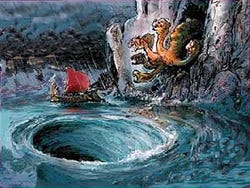
12. Scylla and CharybdisCirce had told Odysseus that if his companions got past the Sirens, that at that point she couldn’t tell him which of two ways he should take – he, himself, must decide ‘in his heart’. One way was by the ‘Wandering Rocks’, where all other ships were destroyed by sea waves and storms of destructive fire. The other way was by two crags – Scylla and Charybdis. On the first crag lives Scylla, who has six very long necks, each one with a terrible head, each head having three rows of teeth, and from every ship that tries to pass, she will snatch a mortal from that passing ship with each of her six heads. On the second crag lives Charybdis, who three times a day will suck back the water terribly and three times a day will send it back – but if you are there when she sucks the water up or sends it back, nothing could save you from evil.
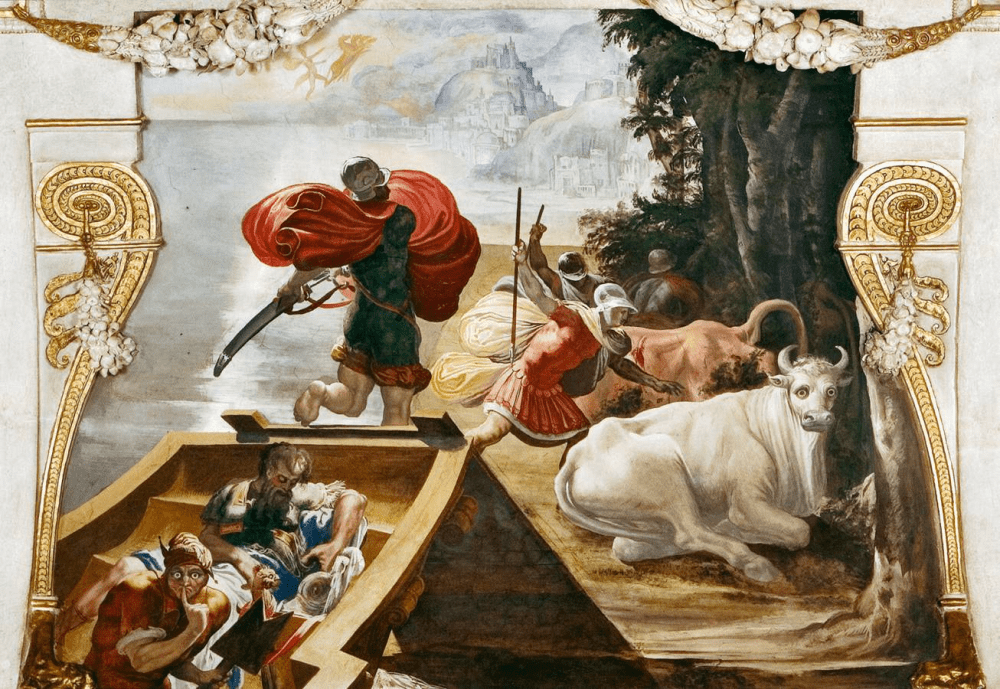
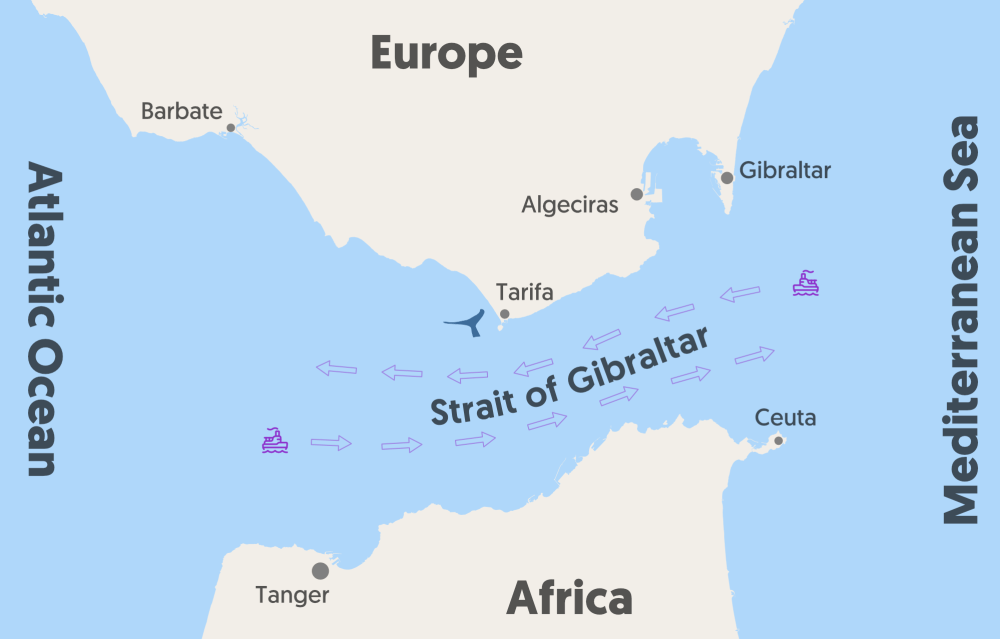
Circe told him to sail by the crag of Scylla – ‘since it is better by far to miss six companions, than all at once’. Odysseus urged his men to row hard against the waves and he urged the pilot to steer towards the crag of Scylla (but he didn’t tell them any more – fearing that if he did, in their fear of what would happen, they’d cease rowing). They were able to escape past the two crags, but were helpless as Scylla snatched away and ate six of the men – ‘the most piteous thing I saw with my eyes of all that I suffered as I sought out the paths of the sea’, and they sailed to the island of Thrinacia, where the god Hyperion kept his beautiful herds of cattle and flocks of sheep. Metaphorically, sailing past Scylla and Charybdis, was like venturing out into the vast unknown. If we assume that sailing past Scylla and Charybdis, was sailing past the Strait of Gibraltar, then Odysseus must have sailed out into the Atlantic ocean. And this is where there is so much controversy, as some people refuse to admit that Odysseus could have sailed out into the ocean. But in the ‘Life of Homer’, Herodotus wrote that young Homer had sailed to Spain. It is here that we must pause and learn the lessons of ‘The Atlantis Puzzle’ by Jack Kelly. 13. PontosLike Plato, when Homer wishes to talk about the Atlantic Ocean, he uses the word ‘Oceanos’, when he wishes to talk about the Mediterranean Sea, he uses the word ‘Thalassa’, and when he wishes to talk about other smaller seas, like the Black Sea, he uses the word ‘Pontos’. Therefore, the sea from eastern Spain, southern France, western Italy, northern Tunisia, northern Algeria, and north-eastern Morocco, that we would call the western Mediterranean sea, is a ‘Pontos’. And Homer does not equate Scylla and Charybdis with the Pillars of Hercules, although many others do. 14. ThrinaciaAs one of his ten labors, Hercules had to steal the magnificent red cattle of Geryon, the three-headed giant, on the island of Erytheia. Although Herodotus mistakenly assumes the Pillars of Hercules are at the Strait of Gibraltar, he writes that:
Perhaps, Erytheia is the same island as Thrinacia – perhaps referring to the three-headed giant, Geryon, and we may assume that Thrinacia is Gades, Spain. As they were near Thrinacia, Odysseus remembered the warning he received from Tiresias, and he told his companions that a terrible evil would happen to them there, and he wanted to sail on past the island. But his companions said they were worn out with fatigue and sleepiness, and were afraid that a storm might come up during the night and destroy the ship, and that they therefore wanted to stay only one night on the island and then to leave in the morning. Odysseus agreed but made them swear an oath not to slaughter any of the cows or sheep. But that night a storm arose and the wind blew steadily for a whole month, keeping them on the island, until their provisions from the ship were all gone.
While Odysseus was gone away from his companions, to pray to the gods to show him the way to leave and return home, the men unfolded a bad plan – to kill some of Hyperion’s cattle:
Not trying to come up with some kind of a way out, the men listened to their despair, instead of relying on hope and they made that bad decision – they slaughtered the cattle, both to make a sacrifice, and to prepare a meal – all to Odysseus’ horror when he returned. When the storm finally ceased, they boarded the ship and fled Thrinacia. The story of Thrinacia unfortunately shows that Odysseus never reached America. If you read the ‘Life of Christopher Columbus’ by Washington Irving, how Columbus kept two sets of books, one true set for himself alone, and another false set that he used to show his men that they weren’t about to sail off the edge of the flat earth, it shows that while dealing with the problems of wind, weather and provisions, the hardest part of the voyage in crossing the Atlantic ocean was controlling the spirit of his men – the same problems faced by Odysseus at Thrinacia. Odysseus’ men showed that they weren’t capable of a trans-Atlantic voyage. This isn’t to say that there wasn’t trans-Atlantic commerce, but just not by Odysseus. After they fled from the island, Zeus sent the shrieking West Wind in a raging tempest and threw a thunderbolt at the ship. The ship whirled around and filled with brimstone and sank, as all of Odysseus’s men were thrown from the ship into the waves – ‘they lost their own lives because of their recklessness’. Only Odysseus, who wasn’t part of the decision of despair, was able to survive, by holding on to part of the keel of the wrecked ship as he was carried away by the wind – back through the Strait of Gibraltar!
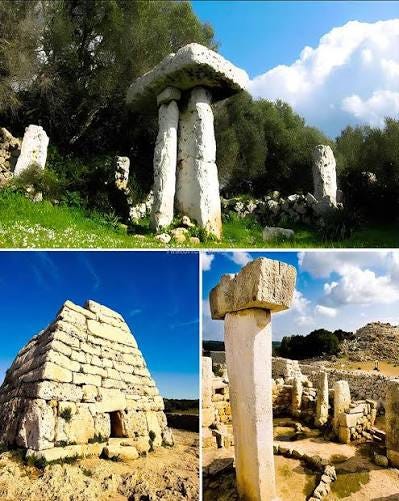
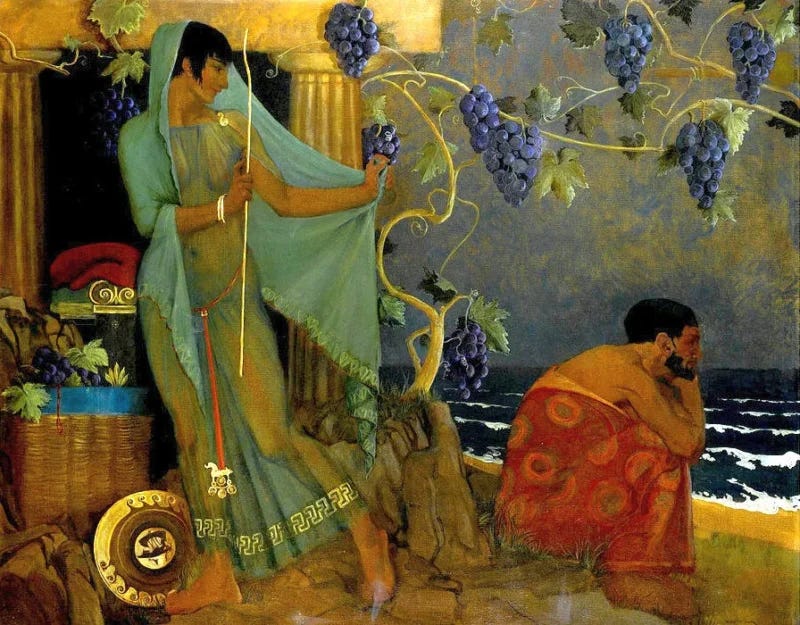
15. OgygiaOdysseus was blown by a westerly wind, back through the Strait of Gibraltar and back into the Pontos – the western Mediterranean Sea. After being borne on the waves for ten days, he was brought to Ogygia, ‘the flood-circled island where the navel of the sea (pontos) is’, and where lived the goddess Calypso, daughter of Atlas. There is much confusion about the location of Ogygia, but if we look for a middle (navel) of the western Mediterranean Sea (pontos), I think we can assume that Ogygia is Minorca – especially because of all the megalithic structures that can still be found there.
Calypso wished for Odysseus to remain with her on Ogygia, but Odysseus was not persuaded and wished instead to return home, of which Homer says this:
While Odysseus waited there for seven long years, finally at the urging of Athene, Zeus sent his messenger to tell Calypso to allow Odysseus to leave. Calypso instructed Odysseus to build a raft with a mast and sail, and with a rudder to steer straight. And Odysseus, ready to bear whatever should happen to him, replied that:
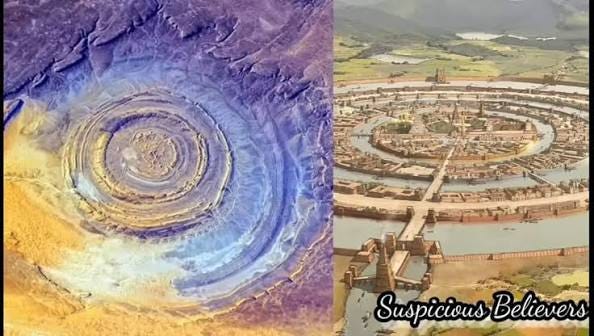
This is different from his companions who said they’d rather die quickly of drowning than slowly of starvation. Unlike his men, Odysseus was still hoping and not despairing, and ready to meet his fate, whatever may happen. So he sailed as Calypso had bid him, watching the Pleiades (that was used to show the start of sailing season), and the Wagon (that was used to find the North Star), and keeping the North Star on his left, he sailed east. After seventeen days he finally saw Scheria, the land of the Phaeacians, but Poseidon, still angry at Odysseus, stirred up a violent storm against him, breaking the mast and tossing his raft about, as he held on – ‘shunning the end of death’. He was helped by the goddess Leucothea, and after three days, he came ashore at Scheria. 16. Green SaharaHomer may have described the city of the Phaeacians as an ideal city, a kind of a utopia, and some people assume that the Phaeacians were the descendants of the Atlantians, and so they try to place Atlantis at Scheria – somewhere on the edge of the ocean, either at southern Spain, or northern Morocco, or at the Azores, or in the Americas. But Scheria is most likely east of Ogygia and on the edge of the Pontos. And since, because of the work of Jack Kelley and George Sarantitis, we now know that Atlantis was located in Green Sahara with an entrance at the Gulf of Gabes, Tunisia, we may assume that Scheria is Gabes.
17. ScheriaOdysseus met the king, Alcinoos, and attended the assembly of the Phaeacians, who are ‘famous for ships… as swift as any wing or thought’, and Alcinoos summoned the singer Demodocos, of which Homer says this:
When Demodocos sang tales of the Trojan war, king Alcinoos saw that this caused Odysseus to cover his head and shed tears, and so he asked Odysseus this:
Odysseus would tell them who he was and where he was from, and then he would tell them of his journey, from when he had left Troy until he had arrived there. After this, Alcinoos agreed to send him home. While they sailed in one of the Phaeacian ships, Odysseus fell asleep, and when the ship reached Ithaca, they set him down on the shore, while still asleep, with his gifts, and they started back homeward, before he woke up. 18. A new OdysseyAfter returning home, getting rid of the suitors, and reuniting with his family, there was still one more place where Odysseus had to travel to, as he remembered what Tiresias had told him:
Now, when I thought of this scene, it really became most important, because if Odysseus followed this final advice from Tiresias, then those people that he found, far away and land locked, would ask him ‘what is that oar?’ And Odysseus would have to explain about ships, and about sailing and travelling to other parts of the world, and also about how the world really was. And then they would ask him why – what is the reason for your travelling? And Odysseus would tell them, well… take a seat… do I have a story to tell you – a story about an ‘Odyssey’. Homer was showing us that it’s not enough to make a discovery, but that it has to be explained or taught, that it has to be passed on to others. And we can see how Homer changes Odysseus – from steering his ship, to learning how to steer his thoughts. And that this is the real purpose of colonization – not subjugating populations to become part of an empire, but sharing in the discoveries of human civilization. And that brings us back to Homer’s metaphor of the North Wind – that changed Odysseus’ course that began his Odyssey and that later steered him to Hades, and whether it led to more troubles or to a solution to his troubles. So, what if fate gave us an obstacle that blew us off course? Would we act like Odysseus’ companions and despair, or instead would we be like Odysseus and let our Muse show us how to ‘steer our thoughts’ to try to effect a new discovery. The Rising Tide Foundation (RTF), a non-profit based out of Montreal, Canada, dedicated to the rigorous re-examination of Universal History and the principles governing the cyclical appearance of Renaissances and Dark Ages in human civilization. Consider supporting our work by subscribing to our substack page and Telegram channel at t.me/RisingTideFoundation.
You're currently a free subscriber to Rising Tide Foundation. For the full experience, upgrade your subscription.
|




No comments:
Post a Comment