
Have I mentioned yet how much I hate summer? Sure, I have air conditioning (though I have made it through a couple of midwestern summers without it), but still. A Reel Feel temperature of 116F/47C is hot, even if you don’t have to be out in it for very long. We’ve had two whole days of cooler, cloudy weather this month, and both of them were last week. It was wonderful, and then they ended and it was back to the heat dome. Don’t mind me, I’ll be hibernating inside until the heat goes away. Whenever that will be. On one of our two nice days this week, I ventured out to a local ramen place to have dinner with my nephew, who is moving away soon. He and his partner are going to the desert southwest where she will be attending an excellent graduate program for her master’s degree. It’s strange to see these two all grown up and going out into the world to live their lives when it feels like my nephew was a little kid playing with Bionicles just last week, but here we are. We had a good time and ate good food. I hope they have a great time and that the move-in process goes smoothly.
I did not need to go to the bookstore. I definitely did not. I have plenty of books at home to read. Books that heave a sigh every time I bring home new books when I haven’t read what I already own. But what else are you supposed to do when it’s too hot to do anything outside? You go to the bookstore. I seem to be approaching another classics era, though this time it’s from the perspective of “old books are great, and there’s a reason they’ve stuck around this long”. I read a bunch of classics in my late twenties out of a sense of literary duty. I had a good time, I guess, but it makes a difference when you’re approaching old books with a sense of curiosity rather than duty. I’m not picking up classics because I’m “supposed” to be reading them; I’m reading them because they’re interesting, and that makes a world of difference.
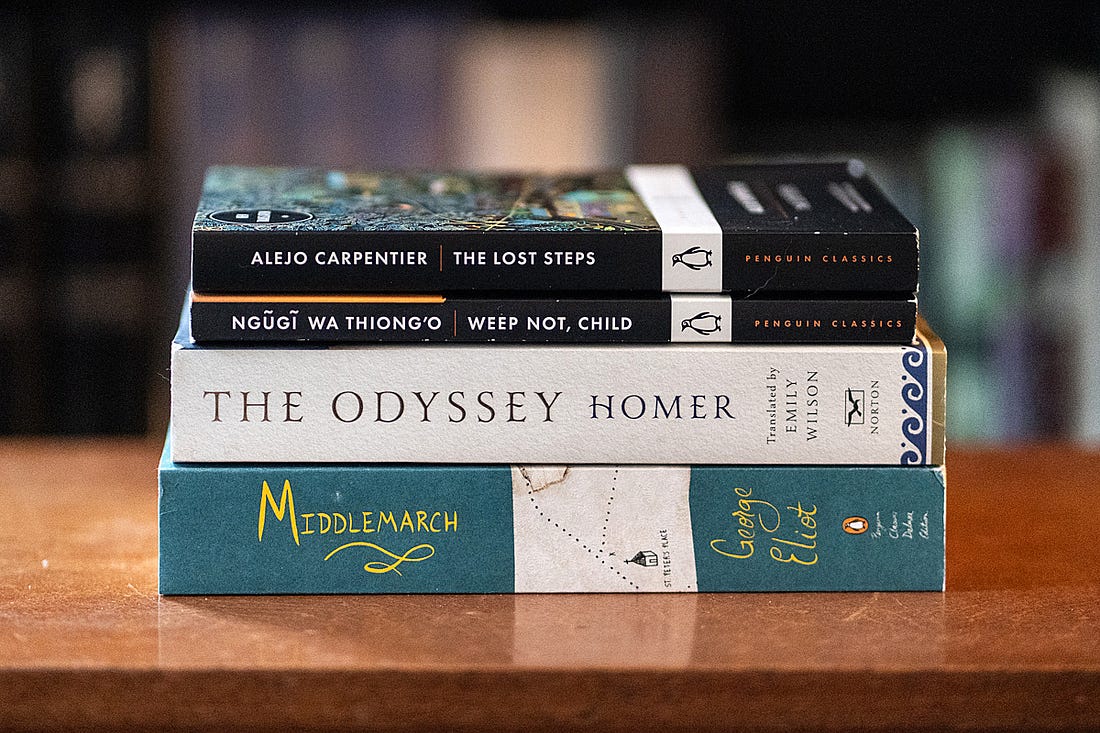
I will admit to looking through the fiction section at Barnes and Noble specifically for the black-spined Penguin classics and picking the ones that sounded most interesting to me at the time. I hadn’t heard of Weep Not, Child before, but a friend recently read and enjoyed Wizard of the Crow, which is also by Ngũgĩ wa Thiong’o. I’d thought about getting that one, but it is nearly 800 pages long so I decided to start with something a little shorter by Ngũgĩ wa Thiong’o to find out what his writing is like before I leap into a big book. Weep Not, Child, is about two Kenyan brothers who take differing paths in life during the Mau Mau uprising in the 1950s. I hadn’t heard of Alejo Carpentier’s The Lost Steps, either, but its premise sounds so interesting: an aspiring composer is unhappy with his position at a corporate advertising firm in New York. He makes his escape thanks to a university-led mission to South America that is searching for indigenous musical instruments. As they leave modernity further behind, the composer begins to develop a clearer picture of who he is and what he wants from life. I’ve read The Odyssey at least once. I think we read it in high school, but it’s been long enough that I can’t remember for sure. I know we read the Fagles translation in my Epic Tales class in college, but I’ve heard good things about Emily Wilson’s more recent translation and several bookish friends have told me that Wilson’s 100-page introduction alone is worth the price of admission. I have almost no interest in seeing Christopher Nolan’s film version of The Odyssey, but it’ll be good to re-familiarize myself with the story. It’s always interesting to see different translations of the stories you think you know so well. Whenever I hear about people arguing over the “best” translation, I think back to Daniel Hahn’s If This Be Magic: The Unlikely Art of Shakespeare in Translation, where he discussed the complexities of translating texts from one language to another and how different people will emphasize different elements of the text. I’m also reminded of Maria Dahvana Headley’s translation of Beowulf, which incorporates late 2010s slang and internet memes to a bizarre but wonderful effect. I know a lot of people have had a lot to say about Emily Wilson’s translations of The Iliad and The Odyssey, but I’m not going to go searching for opinions. Every translation is going to have its own take on the nuances of the original text, so I’m going to go and see for myself if I’ll like it or not. Middlemarch is one of those books I’ve heard nothing but good things about, but haven’t gotten around to it yet, and I probably won’t get around to it anytime soon, either. It will likely sit on my shelf for a while until I finish some other books I’ve been meaning to get to. Perhaps I will do as many others have done and read it during the month of March. Because MiddleMarch. I think the process of getting through my TBR will go a smidgen faster once I finish The Count of Monte Cristo, because while it feels like I’ve been reading it for the past twenty-seven years, I still have 364 pages left. That is a whole book still to go! Or two books, if you were to pick up a couple of novellas. I am still enjoying The Count of Monte Cristo, but wow is it a long book. I have been reading things that are not The Count of Monte Cristo, so here is a brief rundown: The House of Boleyn by Tracy Borman. I requested an early copy of this book from NetGalley because it was initially listed in the nonfiction section and I have enjoyed other books by Tracy Borman. I learned later that this is not a nonfiction book about the rise and sudden fall of the Boleyn family, but is, instead, a fictional account of the Boleyns set in Hever Castle. I was annoyed to find out this wasn’t a history book, but I read it anyway and was even more annoyed to discover that it’s not a very good historical novel. Borman’s writing– which is clear and elegant in her nonfiction– was clunky and dull, with many conversations written like, “As you know, sister, Anne is favored by the king”. Plot threads are picked up and dropped at random, leading to an incoherent narrative that might not make a lot of sense unless you’re already familiar with the story of the Boleyns. Throw in some plotlines about servants in the household, add in slut-shaming aimed at Mary Boleyn, and you have quite the mess. If you want to read some historical fiction about Anne Boleyn, I would recommend tracking down a copy of Margaret Campbell Barnes’s 1949 novel, Brief Gaudy Hour instead of The House of Boleyn. I will read more of Borman’s nonfiction in the future, but I think I will pass on her fiction. (Advance copy from NetGalley and Grove Atlantic) The Demon Star is Jesse Aragon’s debut and is a bit of a cross between Dune and the TV show Stargate SG-1, but darker. It is about a group of people who were once devoted disciples of the system that rules their world, but for various reasons they grew disillusioned with it all and are now struggling to survive. When eleven-year old Neri is sent into the desert to find and be possessed by a god-killing demon, his mother Ysira follows behind to try to stop it. Meanwhile, Brother Jacen Kheris is an alcoholic former exorcist struggling to find a purpose as he tries to teach and shelter the new apprentice who has been assigned to him. Neither Ysira or Jacen intend to become part of a revolutionary force that wants to overthrow the gods that have ruled over their world for centuries, but they’re drawn into the fight anyway. Though I found The Demon Star to be a bit predictable at times, it was still a well-written and compelling story with believably flawed characters. I’ll be curious to see how Aragon’s career progresses, because she has a solid start and an excellent voice. (Advance copy from NetGalley and DAW Books) Right now, I’m in the midst of an advance copy of Robert Jackson Bennett’s upcoming A Trade of Blood, which is the third installment of his Ana and Din fantasy murder mystery series set in a world where magical biohacking is common and leads to peculiar situations when one person or faction decides to use those magics for nefarious purposes. In A Trade of Blood, Din and Ana travel to an agricultural part of the empire to investigate the death of the daughter of one of the most prominent families in the area. She appears to have been murdered by the man she has secretly been seeing– the son of her family’s greatest enemy. Din soon discovers that the mystery is much deeper than a simple tale of young love gone wrong. I’m about halfway through, and I have to admit that the shine of this series is starting to fade for me. I enjoyed the first two books, but Bennett’s diatribes about the ills of industrial farming (that’s the topic he is taking on in this book) are heavy-handed. It could just be that I grew up in a farming community and I’m familiar with many of the problems of modern farming, but I can’t help but feel like I’m being whacked in the face by Bennett’s themes. I’ll finish this book, but I’m not sure if I’ll continue on if there is a fourth one. (Advance copy from NetGalley and Del Rey) I will be hiding from the sun the rest of the day and probably for the rest of the week as this heat dome will persist until Friday or Saturday. I’m hoping to get a lot of reading and knitting done, as my TBR never decreases in size, and I have two knitting projects on the needles at the moment. I’ll be back next weekend, assuming I don’t melt first. Traveling in Books is free today. But if you enjoyed this post, you can tell Traveling in Books that their writing is valuable by pledging a future subscription. You won't be charged unless they enable payments.
|





No comments:
Post a Comment