
It has been a while since I lived with a young cat. Merlin is roughly a year old and has an incredible amount of energy. It feels a little like I’d imagine living around fae creatures might be. Every morning I wake to find my shoes have been rearranged, I’ve had to rearrange parts of my apartment to account for the comings and goings of a high-jumping creature, and I can’t leave any aluminum foil or ziploc bags on the counter for any length of time. If I do, Merlin will teleport into the kitchen, grab the foil or bag, and proudly trot into the living room with it like he is the mightiest hunter. He is still unimpressed by thunder and lightning, and has enjoyed sitting in the window and watching the rain.
In other news, this past week I picked up my knitting for the first time in about a month (since I adopted Merlin), and I promptly messed it all up. All I needed to do was complete the heel flap and gusset, but I managed to mess up both the heel flap and the gusset. I finally admitted defeat and frogged the heel back, only to discover a stitch I had dropped five rows earlier. I fixed that, then immediately dropped another stitch. So I took a little break and had a cookie before going back to it. I haven’t made much progress since then, but I have a more correct foundation to work from. It’s a good reminder, as a beginning knitter, to reread the instructions, especially if I think I know what’s going on. Recently Read:
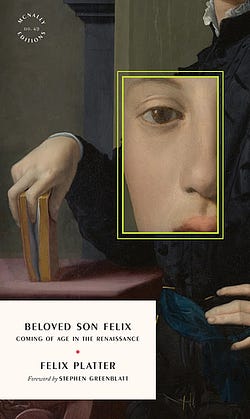
Beloved Son Felix by Felix Platter, translated by Seán Jennet In 1552, sixteen year-old Felix Platter traveled from his home in Basel, Switzerland to Montpelier in the south of France to study medicine. This book is his memoir of the five years he spent in France. It provides an overview of his studies, as well as a look at everyday life in the region, and glimpses of the religious conflict that threatened to plunge France into an all-out civil war. This is a candid and often endearing look at Platter’s teenage years. I love reading about ordinary people’s lives from history, and you don’t often get that chance when it comes to the late medieval and early modern eras. Sure, it’s fascinating to read about the glittering royal courts of kings and queens, but their lives are so outside my frame of reference that it can be hard to think of them as real people. But I can relate to Felix being annoyed at his tailor, or being frustrated by a local transit system, or being completely surprised by regional holiday celebrations. These details and others help to make 1550s France come to life in a way that is relatable to ordinary people today. This is a slender, beautifully designed little book that is a must-read for anyone interested in European history of the 1500s.
Iza’s Ballad by Magda Szabó, translated by George Szirtes Ettie is an aging woman accustomed to her older, more rural way of life. But communist Hungary is rapidly modernizing after World War II, and she feels as though she cannot keep up with it all– especially when her daughter, Iza, brings her to Pest after Ettie’s beloved husband dies. Though Ettie is proud of Iza, who resisted the Nazis and is now a successful doctor, the longer Ettie lives with her, the wider the gulf between them grows. Ettie and Iza might be family, but they are from radically different worlds and though they do their best to accommodate each other, neither woman is able to reach across that gap. I’d had this on my shelf for years and I’d always felt bad for not picking it up, but I’m glad I read it when I did. Sometimes, you need to be at a particular point in your life for a book to really work for you. I wasn’t sure about it at first, since it takes place in such a domestic setting and that is different from most things that I read, but after twenty or thirty pages, I felt so much for Ettie and all the changes she was dealing with. Meanwhile, Iza’s behavior was infuriating. There were moments I wanted to throw the book across the room because of how frustrating Iza was. It was satisfying, though, so see how other characters began to see the truth behind her facade despite how devastating the ending of the book was. I want to read more of Szabó’s work that’s been translated into English, especially if it’s been translated by Szirtes, who did an excellent job of bringing Szabó’s work to an English-speaking audience.
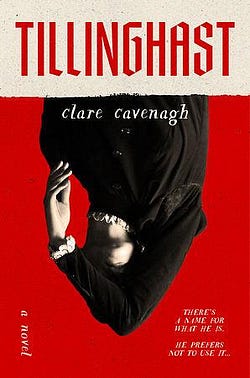
Billed as literary horror, Tillinghast is Clare Cavanagh’s debut novel. It is the story of Stutley Tillinghast, a mysterious man who lives in the woods of Rhode Island– and has lived there for far longer than should be possible– and must kill to continue living. His existence is becoming intolerable and, as the modern world encroaches on him, impossible. He is ready to move on to the next phase when a young woman comes into his life and forces him to reconsider everything. At 256 pages, this is a fairly short book, and yet it felt like the story was treading water thanks to how repetitive it is. It is going for a contemplative tone that brings nineteenth century American history and folklore to the vampire novel, but the ending left me saying, “Okay? What was the point of all this?” Maybe I was just rankled by the ‘literary horror’ tag. Whenever people list a genre work as ‘literary’ or ‘elevated’ it gets under my skin. There’s an air of snobbery that goes along with those labels, as though the author or critic wouldn’t lower themselves to touch one of those shoddy genre novels (like horror or fantasy), but calling it ‘literary’ somehow makes it better because, instead of just telling a silly story like regular genre fiction, it’s exploring what it means to be human and to live in a society. So Tillinghast ended up doing very little for me, but if you like contemplative horror novels, you might enjoy this one. And if you’re looking for unapologetic horror that deals with vampire lore and what it means to be human, also try The Buffalo Hunter Hunter by Stephen Graham Jones. Thank you to NegGalley and Viking Penguin for the advance copy for review. Currently Reading:
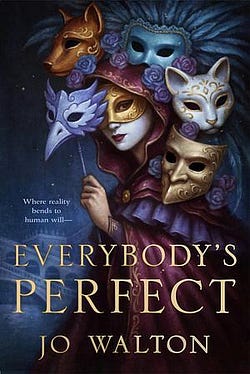
Everybody’s Perfect by Jo Walton The Serenissima is a mysterious world of mist and water. It is a shadow of Venice and a gateway between the nine worlds, where people of all kinds come to trade or live when they can’t remain in their original homes. It is a place of strange magic and beliefs where dreams can change the waking world. One night, Tiry, an ordinary laborer has a dream that The Serenissima will have a doge who will marry the sea, as happens in Venice. He tells this to a fortune teller named Khadsha, who tells her apprentice, who tells Gom, a police officer who has already heard it from many other people that day. And now that so many people believe it’s going to happen, the nature of The Serenissima almost ensures that it will come to pass. I’ve only read one of Jo Walton’s other novels, Among Others, and I adored it. It was a beautiful story of a Welsh girl with magic who just wants to live her life and read her books. It didn’t read like a regular fantasy novel, and Everybody’s Perfect doesn’t either– and this is part of its charm. Each chapter is told from a different character’s perspective so you get to learn their individual stories as well as learning more about The Serenissima as you go along. And the deeper you go, the more you learn about the strange, twisting, and often corrupt nature of the place. Everybody’s Perfect does not have any great action pieces and it sometimes feels like there is no real plot, but I think is part of the book’s charm. I’m about 75% of the way through, and I’m loving exploring this weird city and its occupants who are so drastically different from each other, but still manage to accept their differences and get along. I have no idea how the story is going to end, but I’m going to miss The Serenissima when I’m done. Thank you to NetGalley and Tor Books for the advance copy for review. Traveling in Books is free today. But if you enjoyed this post, you can tell Traveling in Books that their writing is valuable by pledging a future subscription. You won't be charged unless they enable payments.
|







No comments:
Post a Comment