
Five Historical Novels From Off the Beaten PathFive novels to try if you're looking for something that's not yet another Tudor Tale
Historical Fiction is one of my favorite genres– particularly when it’s set in the medieval and early modern eras. I especially enjoy books that are more challenging or weirder than the average bestseller, which makes them hard to recommend. Who can I recommend an 830 page book about a made-up French teenager to? Or a book that is partly told in a modernized version of Middle English? But this is my newsletter, and I can recommend what I want, an just maybe you’ll see something that catches your eye.
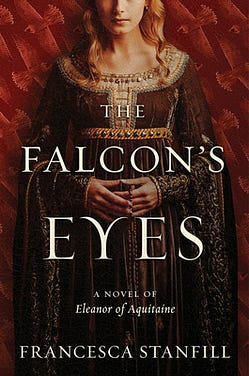
The Falcon’s Eyes by Francesca Stanfill Though her noble family has been impoverished by political circumstances and poor management through the years, young Isabelle is sure that she will marry a handsome and wealthy man and live happily ever after. She is beautiful, after all, and a life of love and luxury are surely due to her for that alone. So when a charming and wealthy nobleman seeks her hand in marriage, Isabelle is thrilled. At first, her new life is as wonderful as she could have hoped for but she soon realizes that her husband is selfish and cruel. With little power to her name, Isabelle finds aid from the servants and villagers she has befriended and through them, she finds her way to a new life. Her travels take her to the captive court of Eleanor of Aquitaine and Fontrevaud Abbey, where Isabelle begins to learn that true happiness can be found in places she never expected to find it. At 832 pages, The Falcon’s Eyes is quite the undertaking. I found it at the library one day, and though the length was daunting I decided to give it a try and was quickly swept away by Isabelle’s story and the wonderful historic details Stanfill wove into the book. I stayed up well past my bedtime on multiple occasions to find out what was going to happen next, and I always thought it was worth it. It’s been a few years since I read it but I still think of it often, and I wish more people would read it. But then, it is very long and it has an ambiguous ending. If you’re looking for a long and dramatic historical novel to get lost in, though, The Falcon’s Eyes is a great one to try.
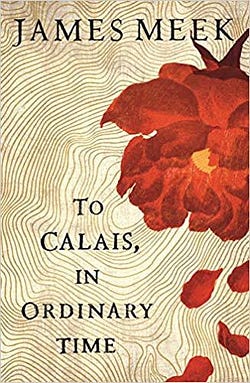
To Calais, in Ordinary Time by James Meek A young English noblewoman flees a marriage she does not want in search of the man she is in love with. A Scottish proctor is on his way back to his bookish life in Avignon. A handsome young farmhand seeks adventure among a company of archers. These three archetypal characters meet on the road to Calais as the plague begins sweeping their way in 1348. As the company begins to see the first effects of the Black Death in the English countryside, they must face the misdeeds of their pasts and confront the truth about their changing world and their own desires. I picked this book up because I heard the author was experimenting with language in it. Having just reread Hilary Mantel’s Wolf Hall trilogy, I wanted another historical novel that played with words and language, and that is exactly what I got in To Calais, In Ordinary Time. With each of the main characters, Meek utilizes various late medieval storytelling modes: the noblewoman’s perspective is a sweeping medieval Romance; the proctor’s style is written like a chronicle; the farmhand has a jaunty, modernized version of Middle English akin to that of The Canterbury Tales. These styles– particularly the Middle English one– feel strange at first, but I quickly adjusted to them and was intrigued by what those styles had to say about each of the characters. It was fascinating how the writing changed along with them. The writing seemed to grow up along with the characters as they began to accept the truths about themselves and looked mortality in the eye. If you’re looking for a book that plays with language and the nature of storytelling, To Calais, In Ordinary Time is an excellent one to look out for.
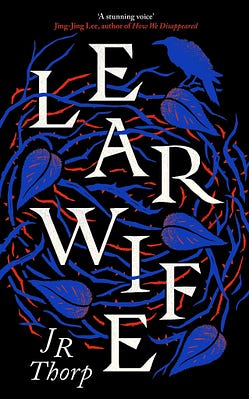
Learwife is not set during a specific time or in a specific place. It is about the Shakespearean King Lear’s wife, who is hardly spoken of in the play. J.R. Thorp gives her a possible story that, in many respects, mirrors that of Lear. In this tale, Lear’s queen has been living in a nunnery for fifteen years, exiled there for she knows not what crime, when word arrives of the death of King Lear and their three daughters. Her grief threatens to break her, but she holds onto the hope that her dear friend Kent has survived. While she waits for word of his survival, the politics of the nunnery flare up around her, and she is forced to make a critical choice for the nunnery’s future. I would not have heard of this book if not for @Simon Haisell, who praised it so much that I had to give it a try. My library had an audiobook of it, and I was immediately enthralled by Thorp’s gorgeous prose and Juliet Stevenson’s brilliant narration. Whenever I had to stop listening, I wanted nothing more than to be able to pick it back up again. I ended up buying a hardback copy of this from Blackwells because I wanted refer back to it whenever I wanted to.
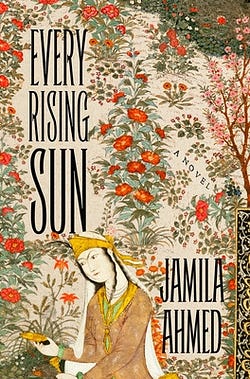
Every Rising Sun by Jamila Ahmed Every Rising Sun is a tale of Shaherazade set during the Third Crusade. In a twelfth century Persian palace of the Seljuk empire, young Shaharazade sees Malik’s wife entwined with another man. She writes the story of it and sends it to Malik, who beheads his wife in his rage. He marries another woman and then beheads her as well, infuriating the people and sending the province to the edge of rebellion. To help keep the peace, Shaharazade decides to marry Malik, who she has loved for years, and sets about telling her stories to keep Malik from killing her, too. When the Seljuks are called upon to help fight the Franks near Jerusalem, Shaharazade’s stories will help guide Malik to a better way of leadership– if he chooses to listen. As her tale unfolds, Shaharazade learns the true power of stories and how she can change history with her tales. I came across this book while browsing at Barnes and Noble and decided to take a chance on it. I’m so glad I did. While the story doesn’t progress like a ‘normal’ historical novel, I loved how Ahmed told this story, weaving the story of Shaharazade and her 1,001 nights with the history of the Third Crusade. The sensory detail was exquisite, too, and brought Shaharazade’s world to life. The writing was beautiful, and the women of the story weren’t just there to be sad and put upon by the men in their life. They made their own decisions, for good or ill, and learned to find their way through the troubles they ended up in. This was an excellent book to read during those hot, drowsy days of August.
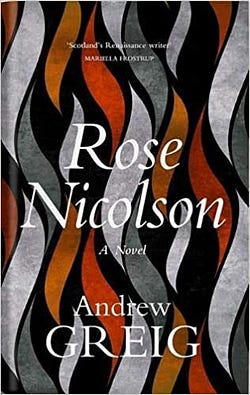
Nothing is going well in Scotland during the winter of 1574. John Knox is dead and Mary, Queen of Scots has long since fled to England, leaving her young son behind as King of Scotland. Conflicting factions are jostling for power, religious conflict is everywhere, and no one knows what will happen next. In the midst of this, Will Fowler is trying to finish out his time as a student and make a career for himself. Though he is short of low birth, Will is clever and ambitious. He befriends an austere philosopher, Tom Nicolson, whose sister Rose is uneducated but just as brilliant as her brother. Rose is a free-thinker and unafraid to speak her mind– a trait that leads to danger when Will and Tom’s circle of friends catches the attention of Water Scott and other powerful men who will draw them all into a conspiracy that will determine Scotland’s future. Scotland is an incredibly popular setting for historical and fantasy novels these days, but many of those books are written by people who are not actually from Scotland. Some of their portrayals of the land and its people are inaccurate at the very least or are straight up offensive, so I’m always happy to find historical fiction set in Scotland that’s written by someone who is actually Scottish. You won’t find a romanticized view of Scottish history in Rose Nicolson. Greig is frank about the history of the 1570s-1580s and the danger people faced for having dissenting religious beliefs. But it’s not a completely bleak novel, either. There is humor and danger around every corner, and Rose herself is a delight to see whenever she appears on the page. Are there any historical novels that you love and wish would be read by more people? Feel free to share them in the comments. Traveling in Books is free today. But if you enjoyed this post, you can tell Traveling in Books that their writing is valuable by pledging a future subscription. You won't be charged unless they enable payments.
|




No comments:
Post a Comment