
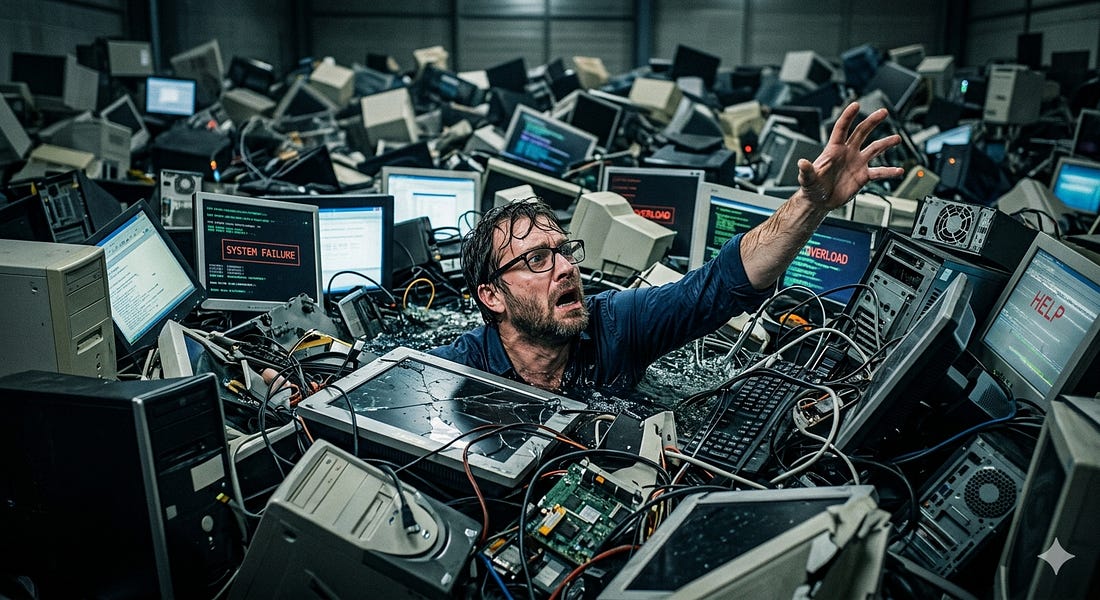
At some point, you must have had as bad a day as I had. My laptop got a virus I couldn’t clean because the manufacturer stopped caring about that model. I wasn’t going to reward Hewitt-Packard by buying a new one, so I picked out an Apple on a store’s website. When I went to pick it up, the website was wrong and they were out of stock. While I was there, I tried to return my mother-in-law’s defective TV, but I had to talk to three people before they’d honor the warranty. I got my new laptop at another store but, when I got home, I discovered I also needed to buy a new mouse, a new power cord, new adapters, and it couldn’t play my music because the files were incompatible. So, I went back to the store to get these things, only to return and face a steep learning curve before I could use the new computer. Maybe you’ve never had all those complications at once, like I did, but you must know what it’s like. Do we really have to put up with all this? No. When I was nineteen, I got some cheap land in western New York, pitched a tent, and built a house with my hands for less than three thousand dollars. My wife and I grew our own food, read by kerosene, and heated with wood we cut ourselves. I was influenced by Thoreau who urged me to live with simplicity. After ten years of that life, I left so I could do more, see more, and be more. But on days like I had the other day, I wish I wasn’t such a willing adopter of technology. I’m reminded of something Thoreau had written, “We do not ride on the railroad; it rides upon us.” There Are Names for ThisIt always helps to know what to call a vexation. A new term I like is enshittification, coined by Cory Doctorow. This is how he says things become shit. First, you get sucked into using a product. At first, it’s great, but it gets worse and worse as the company extracts things of value from you. You’re locked in because leaving costs more than staying. Facebook is a textbook example. Ten years ago you could see what your friends posted, but now all you get are ads as they sell your attention, and you can’t leave because it’s the only place where you connect with some of your friends. Another term is planned obsolescence. I could have kept my laptop for years but HP decided to stop issuing security updates for that model, so I would have to buy a new one. Don’t forget the phenomenon of vendor lock-in which is responsible for the cascade of purchases my new Apple laptop requires. Every incompatibility is a revenue opportunity masquerading as a technical necessity. You can’t leave the HP or Apple ecosystem without losing everything you’ve already paid for. You stay, not out of satisfaction, but because the cost of leaving has been engineered to exceed the cost of endurance. It manufactures a loyalty that is really just captivity. There’s a whole new circle of hell reserved for designers of dark patterns, schemes that deliberately confuse, mislead, and obstruct. The website that shows an item in stock when it isn’t and the warranty hassle are both dark patterns, diabolical designs to lure you into the store and give you a hard time when you want to do something they don’t like. What ties these together is the complexity ratchet. Technological systems accumulate complexity in one direction only, never simplifying, crowding out alternatives until the complicated version is the only version. It’s almost impossible to buy a basic, affordable device of any kind and fix it yourself. The ways in which capitalists capitalize on complexity are numerous and unmistakably evil, but I will leave it to political writers to concoct a political response. I’m just an individual, and a shrink; so my response is individual and clinical, not legislative. It’s Not Only CorporationsTo be fair, it’s not only corporations and technology that bedevil us with complications. The universe itself is complex. Entropy, at the cosmic scale, is complexity ratcheting toward maximum disorder. The universe will end in neither fire nor ice, it’ll end in confusion and aggravation. My own body betrays me with its Byzantine collection of aging conditions, each requiring its own management, each interacting with the others in ways no single specialist fully maps, the whole system opaque to the people nominally in charge of it, which includes me. Bureaucracies that were created to help people become mazes that exhaust them. This happens not through malice but through accretion, each new rule added to address a legitimate problem, each new layer of compliance added to prevent a specific abuse, until the structure meant to serve becomes a structure that must be served. If you doubt me, look at the tax code. There’s also the complexity of other people. Every relationship you have with another human being is a system you cannot fully understand, running on hardware you can’t inspect, producing outputs that surprise you. Finally, there’s the complexity of your own psychological life, which is the most impenetrable system you’ll ever encounter. Psychotherapists like me make big bucks helping people navigate through their own head. No, corporations did not invent complexity, they just take advantage of it. If you need to blame someone, blame God, who seems to revel in it. One guy who complained to Him was old Job, who had lost everything and felt he’d earned an explanation. God’s answer was four chapters of you can’t even begin to comprehend the stars, the wild animals, the foundations of the earth, so who are you to criticize me? God hides behind the same complexity that shields CEOs from my ire. Complexity starts at birth, unless there’s something I don’t remember about the womb. From the moment you get your APGAR score, you’re beset by lights, sounds, and feelings you don’t understand. Fortunately, there are caring adults around who look like they know what’s going on. They teach you how to tolerate ever increasing levels of complexity. Human development can be thought of as a growing mastery of complexity. We soon find the best place to be is right at the edge between what we can master and what we can’t, the zone we call flow, the sweet spot where things are challenging enough to be interesting, but not so comfortable that you get bored. Bored is what happened to me after ten years of simplicity. But, venture too far out into complexity and it’ll drown you like it did me the other day. Drowning men thrash around and sometimes assault lifeguards who try to save them. They make a spectacle of themselves, but thrashing around is not the same thing as swimming. ThrashingI could have done a lot more thrashing around than I did the other day. I might have smashed my laptop, and yelled and screamed at the people at the store. I could have gone postal at the Apple store, but I’ve learned that thrashing is counterproductive. As it was, I swore a little and raised my voice and spoke sharply at the very people who were trying to help me. Then, got grumpy for the rest of the day, and wrote a longer and more colorful version of the rant you read in the beginning of this piece. That was thrashing enough for me. But still, I understand the impulse to thrash, the temptation not to reform, but to take a chain saw to the whole complex world. I get it. Believe it or not, I even understand the motivations behind a Presidential administration utilizing the chain saw method of complexity control: decimating the Deep State, circumventing Byzantine law with illegal executive orders, and bombing the living daylights out of countries that give them a hard time. MAGA is right when it says the complexity of government and international relations is out of control, but an out of control response is not the answer. You end up destroying the hidden parts of the system you most need. Nonetheless, if you want to avoid drowning in complexity, the answer is not to stay on shore and never venture out, like I did when I was nineteen. The answer is to learn how to swim in it. That way, even if a tidal wave comes like it did for me the other day, you can keep your head above water and live long enough for the sea to recede. Swimming in ComplexitySo, how do you swim in complexity? The first thing a good swimmer knows is to read the conditions before you enter the water. Don’t try to go swimming in a hurricane. With this in mind, it should be clear that, now that Facebook is thoroughly enshitified, this is not the right time to sign up for it and depend on it to stay in contact with your friends. Don’t depend on websites to tell you the truth about whether things are in stock. Be wary of the complexity ratchet and don’t buy the first model of anything before the kinks have been worked out. The second thing a swimmer learns is you cannot fight the water. You work with it. The ocean doesn’t care about your schedule, your frustrations, or your rights as a consumer. Neither do corporations. The sooner you stop demanding that complexity does what you say, the sooner you can start moving through it with grace. Third, a swimmer learns how to float. You are naturally buoyant. When you’re out over your head, lay back, relax, and let the water hold you while you paddle gently to the shore. Conserve energy you would spend on self righteousness and finish what you started. Know your limits before you need to know them. Swimmers who drown rarely drown because they can’t swim. They drown because they went out further or longer than they should have, without a lifeguard nearby. Good complexity management is mostly preventive. One should not attempt to solve technical problems when aggravated by said technical problems. Taking a break is not a failure. Work smarter, not harder, as they say on inspiration posters. Finally, swimmers don’t swim alone. The people who navigate complexity best are almost always the ones using the buddy system. They have a friend who knows the tax code, a neighbor who’s good with computers, a wife who will say, gently, you’ve done enough for today, take a break. We didn’t evolve to handle complexity alone. Our greatest cognitive tool isn’t the prefrontal cortex. It’s communicating with each other. None of this makes the complexity go away. The enshittification will continue. The ratchet will keep ratcheting. God will keep hiding behind His four chapters of the inexplicable, but you don’t need to drown. And if you learn to swim, you might even find that the water, difficult as it is, is where you feel most alive. My Report CardSo, how did I do with swimming in complexity that day? Did I take my own medicine? Not even a little bit. I’ve tried writing before there were computers, pounding away on typewriters and doing my research in the library, but I never got much done those days. Therefore, I really didn’t have much choice but to replace my outdated laptop. I had to go swimming in a hurricane, but I should have realized that and been more prepared than I was. I should have been aware that, in switching from HP to Apple, I was not turning away from a rapacious corporation to an altruistic one, but to one that was equally greedy. Preparedness would have put me in a better frame of mind. I would have researched the extras I would have had to buy before taking the new device home and finding I couldn’t make it work. With this in mind, my decision to live like Thoreau for a few years, until I gained in maturity and confidence, made sense as a tactical decision if not as a decision for the rest of my life. I fought the complexity, as evidenced by my raising my voice, speaking sharply, swearing a little, and letting loose a long, colorful rant. Venting is overrated. Yes, it’s good to say what happened, acknowledge my feelings, and name the vexation, but anything beyond that just makes me more angry. Writing this article didn’t help until I realized that complexity is a simple fact of existence. I relish solving problems as long as I don’t overwhelm myself. Did I float? While I am proud to say my thrashing was minimal, I didn’t float at all. I know how to do deep breathing, mindful meditation, and focus on the here and now. I teach it to clients. I even could have prayed, taken a walk, or a nap, or played with my dog and saved the rest of the aggravation for another day. But no, my intent was only on getting a new laptop up and running. I forgot my limits so badly, I even forgot who I am. Every step of the way, deep within my head, I was arguing my case, just as if I was a lawyer, standing before a tribunal that doesn’t exist. My outrage was so great, it didn’t matter that no one was listening. Finally, I tried to do it all alone. No, worse than that. I even took on additional burdens. My mother-in-law could have been the person arguing about the return policy, but I was already wound up from everything else and relished something else I could complain about. In summary, as villainous as the corporations are, I was just as complicit in the bad day I had. I could have done better to manage my own reactions. However, I’m sure I’ll get another chance to swim in complexity. I hope I’ll have a better day. References & Further ReadingHenry David Thoreau, Walden; or, Life in the Woods (1854) The source of two references in this essay: Thoreau’s general philosophy of deliberate simplicity, and the line “We do not ride on the railroad; it rides upon us,” which appears in Chapter 2, “Where I Lived, and What I Lived For.” Cory Doctorow on Enshittification Doctorow coined the term in a November 2022 post on his blog Pluralistic, then expanded on it in a January 2023 post that was republished in Wired under the title “The ‘Enshittification’ of TikTok.” His 2023 book The Internet Con: How to Seize the Means of Computation develops the broader argument about platform lock-in and vendor capture. Tim Wu, The Master Switch: The Rise and Fall of Information Empires (2010) Wu’s account of how communications technologies are captured and consolidated by dominant players. The Complexity Ratchet I don’t remember where I found this term for the one-directional accumulation of technological and social complexity, but I know I didn’t make it up. Samuel Arbesman made a similar point in Overcomplicated: Technology at the Limits of Comprehension (2016), which argues that technological systems grow through accretion until no individual, including their creators, can fully understand them. The economic concept of path dependency, developed by Paul David in “Clio and the Economics of QWERTY” (American Economic Review, 1985), describes the same irreversibility at the level of technological choice. The Book of Job, Chapters 38–41 God’s answer to Job’s demands for an explanation arrives in four chapters of rhetorical questions about the foundations of the earth, the movements of stars, and the behavior of wild animals, all of it designed to demonstrate that the universe is too large and strange for Job to put it on trial. Any translation works. Robert Alter’s rendering in The Wisdom Books (2010) is particularly vivid. Mihaly Csikszentmihalyi, Flow: The Psychology of Optimal Experience (1990) The psychologist who identified and named the flow state, that productive edge between boredom and overwhelm. A genuine classic of psychology written for a general reader. You're currently a free subscriber to The Reflective Eclectic. For the full experience, upgrade your subscription.
|






No comments:
Post a Comment