
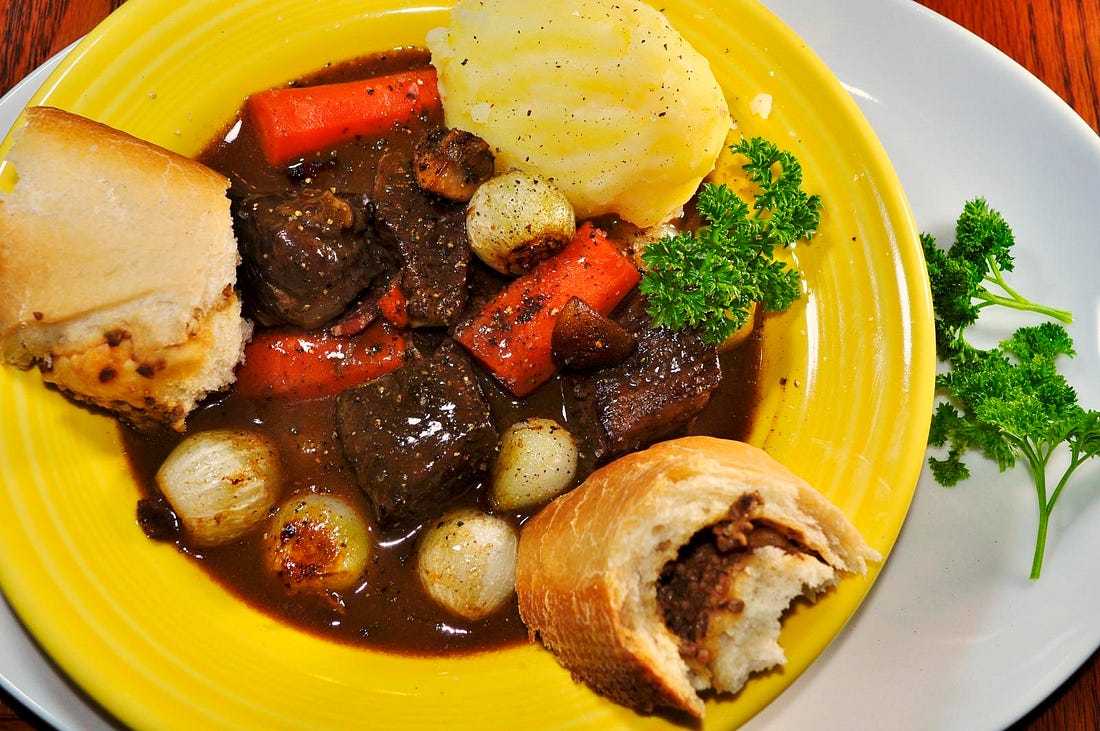
Is cooking anything like personal transformation? In this series, an imaginary chef cooks beef bourguignon for an equally imaginary panel of thinkers: Jung, Campbell, a pair of behavioral researchers, an anthropologist, a management consultant, and St. Augustine. They compare what happens when a human being changes who they are to what is occurring in the kitchen. In this installment, Marcel deglazes the pan and braises on low heat, and the panel discovers that dissolution and resistance are not obstacles to transformation. They are the agents of transformation. [If you’re joining mid-series: Start from the beginning →] Apply the HeatDUPONT: I take some meat from the shoulder. This is the chuck. It’s very tough, but very flavorful when cooked slowly. But first we want a flavorful, brown crust that enhances taste and texture. I sear the meat on a very hot pan, but not too long there, or it will cook the meat too quickly. First, I blot the blood. You see why? Moisture is the enemy of the sear. A wet surface steams. It does not brown. The heat must make direct contact with the flesh, or nothing is transformed. (He lays the chuck into the screaming hot pot. It spits and contracts.) There, it is complaining. That is correct. That is what heat should produce. MODERATOR: Hearing the meat complaining reminds me of many of my clients. In addiction recovery especially, there’s always a lot of resistance early in treatment. They would rather be anywhere else but my office. A lot of people assume an addict must be internally motivated before they’ll stop using drugs and alcohol; but I’ve found that those who are forced into recovery are more often successful. When you voluntarily change, it’s too easy to change your mind when it gets hard, and it will get hard. Is this your experience? Does change have to come about involuntarily? JUNG: The ego will not willingly submit to its own dissolution. Its entire function is self-preservation. What the alchemists understood, and what my clinical work confirmed, is that the heat must often come from outside the ego’s control, from what I call the unconscious, from symptoms, from breakdown, from the thing that goes wrong and cannot be explained away. When a patient comes to me voluntarily, I am sometimes less encouraged than when they arrive in crisis. The voluntary patient only wants an adjustment. The one who arrives inflamed will undergo a transformation. PROCHASKA and DICLEMENTE: I have to push back, and the data is on my side. Coerced treatment, court-mandated programs, forced interventions, they show consistently weaker long-term outcomes than self-initiated change. The heat has to be felt from the inside. What you can do externally is raise the temperature of the environment so the person begins to feel it themselves. A spouse’s ultimatum, a medical diagnosis, these don’t force change, they make the cost of not changing harder to ignore. That is different from forcing someone into a pot. MODERATOR: The data you have is different from my own. I found self-initiated change has a far weaker outcome, but I was working with people drinking themselves to death and doing hard drugs. You were helping people to stop smoking. PROCHASKA and DICLEMENTE: That is a fair challenge and I won’t dodge it. Our primary population was smokers, and nicotine addiction does not occupy the same territory as alcohol or heroin. The stakes are different, the physiology is different, the degree of life disorganization is different. I will grant you this: when the drug is also the person’s primary coping mechanism, their community, and their identity, the calculus of readiness changes entirely. Whether that means coercion works better in those cases, or simply that the crisis itself functions as the internal tipping point we have always said is necessary, I am genuinely not sure. The distinction we’d draw is between the trigger and the process. The trigger can be entirely external. The process cannot be. Nobody completes a stage they haven’t internally moved through, no matter how hot you make the room. CAMPBELL: The call comes from outside, it disrupts, and the first response in story after story is refusal. But notice what happens next. The refusal is always answered by escalation. The disruption returns, louder, more costly. What the myths suggest is that you can delay the fire, but the delay has a price, and the price compounds. The hero who voluntarily answers the call has no idea what it will cost. If he did, he wouldn’t go. TURNER: Among the Ndembu, the boy does not choose his initiation and is not asked whether he is ready. The elders come for him. The community applies the heat because the community understands something the boy cannot, that the self which must be transformed is precisely the self that would, if consulted, vote against it. You cannot ask the caterpillar whether it consents to the chrysalis. BRIDGES: Most of my clients didn’t choose what happened to them. What they had to choose, eventually and painfully, was whether to let it mean something. I’ve seen people survive catastrophic losses and emerge utterly unchanged because they spent all their energy insisting the loss was unjust, which it often was, rather than asking what it was asking of them. The heat is external. What you do with it is not. AUGUSTINE: I consented to transformation a hundred times. Each consent was real and each one failed, because the self doing the consenting was precisely the self that needed to be replaced. It is like asking a drunk to pour out his own wine. He will do it sincerely, and then go looking for more, and not fully understand why. What finally broke me open was not pressure from outside but a moment so quiet I cannot fully account for it. I overheard a child say take up and read, so went to the bible and read a single random passage, Romans 13:13-14. It said, “Behave decently… not in sexual immorality and debauchery… rather, clothe yourselves with the Lord Jesus Christ, and do not think about how to gratify the desires of the flesh.” This could not be just a coincidence. It had to be a message for me. I knew myself well enough to know that a private resolution would not hold. It had not held before. So I resigned my professorship and presented myself publicly to the bishop for baptism. Once I had done that, retreat would have cost me everything. I arranged, you might say, for my own external motivation. DissolveDUPONT: Now I take out the meat and pour off most of the fat. I leave a dark slick at the bottom. I pour the Burgundy into the hot pot. Steam erupts. See all those blackened bits welded to the pan bottom, yes? That is the fond, come loose into the liquid. I add herbs and this will be the sauce. MODERATOR: I’ve found that change is traumatic. That is, everything you were sure about before comes loose, so that you’re not sure about anything anymore. You’ll even change your mind every other day about the very changes you vowed to make. This is the time when you learn to let go and surrender into the process, not because you want to, but because you have no choice anymore. JUNG: The alchemists called this the solutio. The hardened material surrenders to the solvent and releases what it has been holding. What looks like loss is extraction. The blackened residue at the bottom of the pot is not waste. It is the most concentrated form of everything that came before it, and it will become the flavor of everything that follows. PROCHASKA and DICLEMENTE: This is the most dangerous moment in the cycle. The person is in Action Stage but the old structures have dissolved and the new ones haven’t formed yet. Ambivalence returns. They change their minds repeatedly, sometimes daily. This is not weakness and it is not regression. It is what Action actually looks like. CAMPBELL: The hero is now in the deepest part of the journey, the innermost cave. Everything familiar is gone. This is the point in the story where the hero has nothing left to rely on but what they have become through the ordeal. The dissolution is not incidental to the transformation. It is the transformation. TURNER: This is liminality in its purest form. The initiate is neither what he was nor what he will become. He is betwixt and between, and the terror of that state is precisely its power. The Ndembu elders did not try to resolve the candidate’s uncertainty. They held it, and him, until the new identity could form. BRIDGES: I called this the neutral zone, and I want to be honest about how bad it feels. My clients described it as going crazy. Nothing they had believed about themselves seemed reliable anymore. The people who survived it best were the ones who stopped fighting it and accepted, at least temporarily, that not knowing was where they were. Surrender is not defeat. Sometimes it is the only way forward. AUGUSTINE: This is the moment I could not write about while I was in it, only afterward. When everything you were certain of comes loose, including your certainty about the change you vowed to make, it seems like you are being emptied. I did not understand that then. I only understood that I had nothing left to hold onto. That, it turned out, was exactly the point. MODERATOR: Hearing what you all have to say about dissolving makes me think about people I’ve talked to who are in great distress, but reject every suggestion I make. I call this, yes, butting. Often, I feel like a failure at my advice giving, or I conclude they have a perverse need to defeat all attempts to help so they can prove how much of a victim they are. Now, I wonder if yes, butting is a feature of this stage. If there’s something about the process that doesn’t allow them to accept a solution. It’s ironic, isn’t it, that no solution can be arrived at in solutio? BRIDGES: I spent years being frustrated by exactly those clients, the ones who brought me every problem and rejected every answer. I thought it was resistance in the pejorative sense, an unwillingness to do the work. What I eventually understood is that the Neutral Zone is, structurally, a not-knowing, while a solution is a knowing. You cannot pour knowing into a vessel that is in the process of being emptied. The yes, but is not obstruction. It is accurate reporting. They genuinely cannot use what you are offering yet. TURNER: The Ndembu elders did not offer solutions to candidates in the liminal state. They held the uncertainty. The offering of premature resolution would have been understood as a failure of ritual, a collapse of the container before the new form had set. What you are calling yes, butting is the initiate correctly refusing to be prematurely reborn. JUNG: The ego that is dissolving cannot accept a solution because a solution would require a stable self to implement it. The resistance is not pathological. It is the dissolution working correctly. When a patient defeats every suggestion I make, I have learned to take that as a sign we are close to something real, not far from it. AUGUSTINE: I had spiritual directors for years who offered me excellent counsel. I could see it was excellent. I agreed with it entirely. And then I went home and did precisely what I had always done. This was not perversity, though it looked like it from the outside and felt like it from the inside. The counsel was sound. The one receiving the counsel was not yet capable of receiving it. The vessel was cracked. You cannot fill a cracked vessel by improving the quality of what you pour into it. PROCHASKA and DICLEMENTE: We actually have a clinical name for this. We call it the righting reflex, and it is on the therapist’s side as much as the client’s. The practitioner sees a problem and the nervous system reaches for a solution. But the client in this stage needs their ambivalence honored, not resolved. Every time a therapist argues for change, the client almost automatically argues against it. We found that rolling with resistance, sitting with the person inside their ambivalence rather than pulling them out of it, consistently produced better outcomes. The irony the moderator noticed is built into the stage. Pushing solutions when certainties are dissolving is like pushing on a door marked pull. The fond is loose in the liquid. Marcel turns the flame down low. This is going to take a while. Come back for Part Three: Reduction and Garnish. End of Part 2What Beef Bourguignon Can Tell You About Personal Transformation is a four part series. A new installment will be published once a week. However, paid subscribers can read the whole piece right now. You're currently a free subscriber to The Reflective Eclectic. For the full experience, upgrade your subscription.
|





No comments:
Post a Comment