
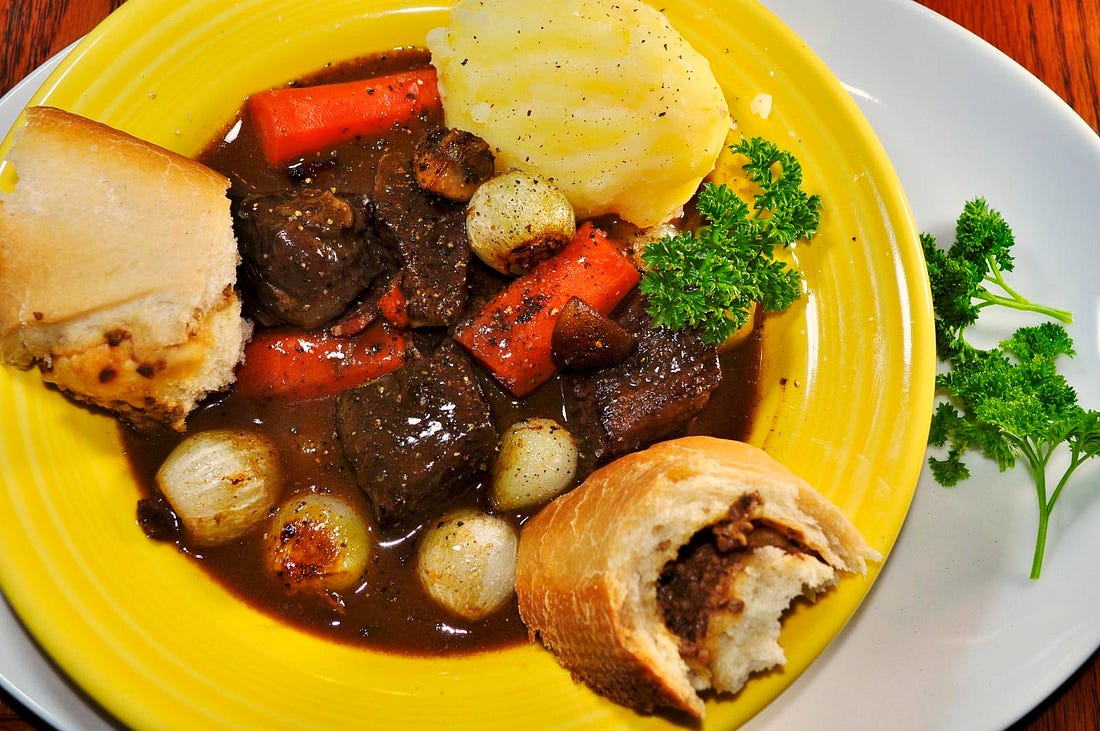
Can cooking serve as a metaphor for personal transformation? In this series, an imaginary chef cooks beef bourguignon for an equally imaginary panel of thinkers: Jung, Campbell, a pair of behavioral researchers, an anthropologist, a management consultant, and St. Augustine. They compare what happens when a human being changes who they are to what is occurring in the kitchen. In this final installment, the dish is finished, and the panel turns to two questions beyond the metaphor: who benefits from a transformation, and who, or what, is actually doing the cooking? [If you’re joining mid-series: Start from the beginning →] SitDUPONT: Now, see how the sauce coats the back of the spoon. It is done, but we do not eat it, yet. We must let it sit. This will allow the flavors to meld and deepen, the wine to mellow, and the aromatics to fully integrate into the sauce, yes? MODERATOR: At last, the changing person settles into their new way of life, with new habits and a new outlook. This stage lacks the drama of the original crisis, so it sometimes feels like a letdown. JUNG: The alchemists called this the coagulatio, the solidifying of what had been dissolved and reduced into a new, stable form. What had been liquid, hardens. What was chaotic, acquires coherence. The ego experiences it as a letdown because the ego is addicted to its own crisis. The quiet of the coagulatio feels like emptiness because the ego no longer has an emergency to organize itself around. The ego is, for the first time, being asked to live without the scaffolding of its own suffering. MODERATOR: (Aside to the audience) I have always been slightly embarrassed by Jung’s insistence on alchemy as his primary metaphor. It requires the reader to learn a discredited pseudoscience in order to understand a profound truth. Marcel is standing ten feet away. Every one of Jung’s stages maps onto the chef’s art without remainder. I have never understood why modern Jungians don’t simply talk about cooking. PROCHASKA and DICLEMENTE: This is the Maintenance Stage, and it is the one our field underestimated for the longest time. We treated it as the finish line. The person had changed, so the work was done. What we learned, the hard way and through the data, is that Maintenance is its own stage with its own demands, and it lasts years, sometimes a lifetime. The new behavior has to become unremarkable. The former smoker stops counting days. The person in recovery stops negotiating with themselves every morning. The change has to become boring, and boring is harder to sustain than drama. The relapse risk doesn’t disappear in Maintenance. It just changes. In the earlier stages, the threat is the old pull. In Maintenance, the threat is complacency. People stop doing the things that got them here because they no longer feel like they need them. That is the most reliable sign that they still do need to be vigilant. CAMPBELL: The hero has returned. He carries the boon, the thing won in the depths, back to the ordinary world. And here is what the stories never quite tell you plainly: the return is not triumphant. It is quiet, and strange, and the hero often does not know what to do with himself. Odysseus has been fighting for twenty years. He does not know how to sit at a table with his wife and eat a meal without looking for the ambush. The myths understand this. They do not end with the hero arriving home. They end with the hero learning, slowly and clumsily, how to be home. TURNER: The anthropological term is reincorporation, and it completes the three-part structure of every rite of passage: separation, liminality, reincorporation. But I want to say something the others have not. Reincorporation is not the end of change. It is the institutionalization of change, the point at which the individual’s transformation becomes legible to the community and the community reorganizes itself around the new reality. The elder who has been through initiation is not simply a man with new habits. He is a new kind of person in a new structural position, with new obligations and new authority. The sitting is not rest. It is the assumption of a new role. BRIDGES: I have to be honest with my clients about this stage because it is the one that surprises them most, and not in the way they expected. They fought their way through the ending and the Neutral Zone and the new beginning, and they assumed that arrival would feel like arrival. Like relief, or joy, or at least resolution. What they often feel instead is a vague flatness. They wonder if something is wrong with them, if they did it incorrectly, if the new life is supposed to feel more like the old life felt when it was good. I tell them that is exactly right and exactly normal. The old life felt vivid because it was yours for so long. This one will feel vivid too, but you have to live in it first. AUGUSTINE: I expected peace, and peace did come, but it was different than I had imagined. I had imagined the absence of conflict. What I found was the presence of something quieter and more demanding: a life that had to be rebuilt from the foundation up, with new loves and new habits and new obligations, and none of the old familiar chaos to hide in. For a man who had spent decades organizing his existence around desire and its frustrations, the quiet was itself a kind of work. I will also confess this: there were mornings, in the early years after my baptism, when the old life presented itself to my memory not as sin but as warmth. As familiarity. That is perhaps the most honest thing I can say about the sitting. The new life is true. But the old life was home for a very long time, and the body does not forget what the mind has renounced. MODERATOR: What strikes me, listening to all of you, is that sitting is not passive. The word suggests rest, but what you are all describing is a kind of active, unglamorous tending. The bourguignon is not eaten the moment it comes off the heat. It is left to become fully itself. ServeDUPONT: And now the dish must be plated. This is where many cooks become careless, thinking the work is finished. It is not finished. You have built something extraordinary inside that pot, but if you just dump it in front of someone, you have failed all your efforts. The presentation tells the guest what they are about to receive before they taste a single bite. I ladle the bourguignon into a wide, warmed bowl. Warmed, you understand, because a cold bowl steals heat from the dish the moment they meet and the guest’s first spoonful is already diminished. I place the pearl onions and mushrooms so they are visible, not buried. I lay a sprig of thyme at the edge, not for decoration, I am not a decorator, but because the flavor arrives at the nose before the mouth. Then I bring it to the table myself. Not because I distrust the servers, but because I want to see the face of the person who is about to eat what I have made. That moment is part of the dish. MODERATOR: I believe change is not complete until you have taught what you have learned to someone else. As surgeons say, “Watch one, do one, teach one”; and, as AA says, “Having had a spiritual awakening as a result of these Steps, we tried to carry this message to alcoholics and to practice these principles in all our affairs.”. However, teaching others must be done as skillfully as Chef has plated his dish. You must pay close attention to how it will be received and not just dump your wisdom on them like a ladle full of glop. Once you have come to this point in your personal transformation, you become an agent of personal transformation. What is the best way to facilitate this? CAMPBELL: The hero who returns with the boon faces what I consider the most underappreciated problem in all of mythology: the gift that cannot be given directly. Prometheus brings fire from the gods and is destroyed for it. Moses descends from Sinai and finds the people worshipping a golden calf. The transformed person who rushes back to share what they have learned almost always shares it too soon, too loudly, and to people who are not yet standing at the threshold. Timing is everything. Your chef brings the bowl himself to read whether the guest is ready to receive what he has made. TURNER: Among the Ndembu, the elder does not lecture the uninitiated. He embodies. His new structural position in the community teaches by its existence, not by its explanations. The initiate who has just returned cannot immediately become the one who holds the ritual space for others. He must first be received, then live into the new role long enough that it becomes genuine rather than performed. Premature teaching is not teaching. It is a man still in the liminal state, using the appearance of wisdom to stabilize an identity that has not yet fully set. JUNG: What the transformed person carries back is not information. It is energy, a new constellation of the psyche that can activate, if the conditions are right, something latent in the other. The analyst does not instruct the patient toward transformation. He sits alongside the patient’s darkness, having been through his own, and that companionship does something that no technique can replicate. You cannot transmit what you have not inhabited. But the inhabiting is not sufficient either. Jung was quite clear on this: the analyst who has not done his own work will, inevitably, use the patient’s transformation to complete his own. That is the most dangerous form of teaching there is. PROCHASKA and DICLEMENTE: We have decades of outcome data on what actually helps people change, and the answer is not wisdom delivered from above. The most effective practitioners we studied did three things. They met the person exactly where they were in the stages, not where the practitioner wished they were. They resisted, almost heroically, the urge to argue for change when the person was not yet in a stage to receive the argument. And they reflected back what they heard rather than correcting what they disapproved of. The most transformative thing you can say to someone in Contemplation is not, “here is what you should do.” It is, “it sounds like part of you already knows something has to change.” That is not a small thing, it’s the whole thing. The model we developed was not a prescription for practitioners. It was a description of what people actually do when they change successfully. The best facilitators we observed were the ones humble enough to let the model be about the client rather than themselves. BRIDGES: I spent years as a consultant being paid to be the expert in the room, and the most useful thing I ever learned was when to stop talking. The people who helped me most through my own transitions were not the ones who had the answers. They were the ones who could tolerate sitting in the question with me without flinching. That is a specific skill and most people are terrible at it, because the other person’s unresolved distress activates your own, and the fastest way to quiet that feeling is to hand them a solution. The facilitator who has genuinely been through the reduction knows the difference between offering what is truly needed and offering what relieves his own discomfort. That distinction is the whole art. AUGUSTINE: I have come to believe that the most powerful thing one transformed person can offer another is not counsel, and not technique, but testimony. When I speak of my own dissolution, not as a cautionary tale or a triumph, but as a true account of what it was actually like from the inside, I give the other person something no advice can provide: permission. Permission to be in the mess they are in without concluding they are uniquely broken. My Confessions were not written as a manual. They were written as a confession, an honest account addressed, first, to God, and only secondarily to any reader who might find themselves somewhere in the pages. The response I have received, across sixteen centuries, suggests that honesty about one’s own transformation is among the most durable gifts one person can offer another. MODERATOR: What I hear you all saying, in your different vocabularies, is that the serving is as demanding as the cooking. The chef who dumps the bourguignon in a cold bowl has squandered the braise. And the person who survived their own transformation and now wants to help others through theirs must learn the same patience, the same attention to timing and readiness, the same willingness to let the other find their own way to the table. You do not feed someone who is not hungry, but you can make them hungry by describing how good the meal is. DigestMODERATOR: We’ve completed our meal and the dog is licking our plates. Chef has done a superb job at transforming the ingredients. The time has come for us to digest both the meal and the metaphor of cooking as a description of personal transformation. Every metaphor falls short somewhere. I know of two places this one does. When Marcel cooks, we benefit from the steer’s loss. Who benefits from personal transformation? The second is, at our conference, it was clear that Marcel was the cook; but who is the cook during personal transformation? What is the agent of change? In my experience, the most profound transformations rarely feel self-directed. They feel like something that happens against the person’s will, from a source they cannot identify. JUNG: I have spent my career arguing that the most profound truths are carried in symbol and image rather than proposition. Marcel has not argued anything this afternoon. He has simply cooked. And yet everything I have tried to say, he has already shown us. I am not certain which of us has been illustrating the other. As for your questions: in personal transformation, unlike in cooking, the one who is changed is also the one who benefits. The steer cannot grow once he is killed, the Self can. As for who cooks: the alchemists knew that the prima materia does not transform itself. When a person transforms, something in them that is larger than them is using the crisis, the breakdown, the symptom as its instruments. The cook is not the therapist. The cook is something the therapist, if he is wise, learns to get out of the way of. PROCHASKA AND DICLEMENTE: We can say, with reasonable confidence and a sample size of one dish, that the outcomes here significantly exceeded expectations. As for your questions: we would mostly agree the person benefits, but not always. People are sometimes transformed into forms more convenient for the systems around them. A difficult employee becomes compliant. A disruptive addict becomes functional. Whether that serves him or the institution is a question the metaphor sidesteps. MODERATOR: I’m glad you said something about that. I have worked in institutions. I know that recovery programs can serve the institution’s need for order as much as the patient’s need for wholeness. PROCHASKA AND DICLEMENTE: I would also like to thank you, Chef, for that fine meal. As for who cooks: we would say the agent is the person themselves, in a specific relationship with their environment, at the moment they are finally ready to change. CAMPBELL: Marcel has not merely fed us, he has engaged in an act of creation. If we had time, I would tell you the many creation stories I have learned. As for the questions: the myths are unanimous that transformation is personal in its ordeal and communal in its purpose. The hero returns with a boon not for himself but for his community. As for who cooks: it is almost never the hero himself. It is the goddess, the mentor, the wound, the road. What the hero contributes is not the transformation but the willingness to keep moving through it. TURNER: Among the Ndembu, the preparation of food for a ritual gathering is itself a ritual act. The cook is the ceremony. Marcel understood this without being told. The community benefits as much as the individual. A successfully initiated elder assumes new obligations and new authority, and the community is enlarged by his transformation. As for who cooks: not any individual. The agent of transformation is the ritual structure itself, held by the community, designed by no one living, belonging to everyone present. BRIDGES: I’ve sat through a great many conferences. The food is usually a sandwich from a cart in the hallway. I want it noted that this is the first time the catering has been more illuminating than the keynote. As for who benefits: the person transforms and the people around them are either enlarged or disrupted, often both. A wife whose husband finally becomes who he was capable of being has gained something real and lost something familiar. As for who cooks: in my experience, it’s a catastrophe. Nobody chose it and nobody designed it. The question of whether it serves the person depends entirely on what they do with it, which is the one variable nobody else controls. AUGUSTINE: I did not expect, at my age, to be surprised by a bowl of stew. This was extraordinary. As for who benefits: my transformation was good for me, but not for the woman I had lived with for years in a state of sin. As for who cooked me: my mother’s prayers were an ingredient. Ambrose’s preaching was an ingredient. The child’s voice in the garden I still cannot explain. What I came to believe, and cannot prove to this table, is that the cook was God; not reaching in from outside, but working through desires that were always oriented toward him, even when aimed at something else. I am told this is not acceptable to say in polite academic company. I say it anyway. It is the most honest account I have. DUPONT: (Quietly, already cleaning his station) It is only beef bourguignon. But it is very good beef bourguignon, yes? I did not argue with the meat about whether it was ready. I kept the heat low, gave it time, and paid attention. In my kitchen, the dish is always for the person at the table. That has always seemed reason enough to cook well. MODERATOR: Everything we have said this afternoon, Marcel said first, in a pot, over low heat, in about three hours. The rest of us have simply been providing the footnotes. And yet the metaphor finally meets its limit here. In Marcel’s kitchen, the cook is sovereign, the ingredients are passive, and the outcome is intended. In personal transformation, none of those things are reliably true. The cook, whether we call it the unconscious, the environment, the ritual, the catastrophe, or God, is not fully in control. And the outcome is not known in advance. What the metaphor gives us is not a blueprint but a new question: What is it all for? Marcel’s culinary skill answers it simply and deliciously. A human life answers it slowly and incompletely, if at all. ReferencesAugustine of Hippo. Confessions. Translated by Henry Chadwick. Oxford University Press, 1991. (Original Latin, c. 397–400 AD.) Bridges, William. Transitions: Making Sense of Life’s Changes. Addison-Wesley, 1980. Bridges, William. Managing Transitions: Making the Most of Change. Addison-Wesley, 1991. Campbell, Joseph. The Hero with a Thousand Faces. Pantheon Books, 1949. Jung, Carl G. Psychology and Alchemy. Collected Works, Vol. 12. Princeton University Press, 1953. Jung, Carl G. The Psychology of the Transference. Collected Works, Vol. 16. Princeton University Press, 1954. Prochaska, James O., and Carlo C. DiClemente. “Transtheoretical Therapy: Toward a More Integrative Model of Change.” Psychotherapy: Theory, Research and Practice 19, no. 3 (1982): 276–288. Prochaska, James O., John C. Norcross, and Carlo C. DiClemente. Changing for Good: A Revolutionary Six-Stage Program for Overcoming Bad Habits and Moving Your Life Positively Forward. William Morrow, 1994. Turner, Victor. The Forest of Symbols: Aspects of Ndembu Ritual. Cornell University Press, 1967. Turner, Victor. The Ritual Process: Structure and Anti-Structure. Aldine, 1969. You're currently a free subscriber to The Reflective Eclectic. For the full experience, upgrade your subscription.
|






No comments:
Post a Comment