
(This post may be too long for your email provider to show it all. If you would like to read it in its entirely, please click on the ‘View entire message’ link) Just when I had begun to come up from air after the deluge of advance copies of books I had, perhaps unwisely, requested at the end of 2025, I was whacked upside the head with more books to read on a deadline thanks to the announcement of the 2026 Hugo Awards nominations on Tuesday. Though I had already read many of the titles on the various lists, I hadn’t read them all, and so I have a bunch of things to read before voting ends this summer. I was sad to see that Stephen Graham Jones’s The Buffalo Hunter Hunter did not make the shortlist for Best Novel, but horror always has an uphill battle when it comes to the Hugos. I have already borrowed or requested most of the books and novellas I haven’t already read from the library, so expect to hear more about my thoughts on the nominees over the next few months. And with that out of the way, here’s a look at some of what I’ve been reading recently: Advance Copies:
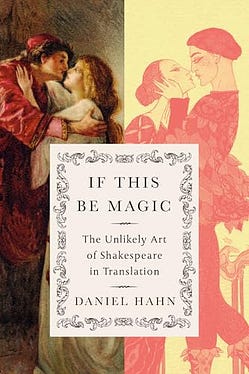
If This Be Magic: The Unlikely Art of Shakespeare in Translation by Daniel Hahn If every word of a Shakespearean play has been changed, then how does Shakespeare remain Shakespeare? That is the question that Daniel Hahn sets out to answer in this delightfully nerdy book about Shakespeare, language, and the fine art of translation. He draws upon his own experience as a translator as well as discussing the subject with more than a dozen other translators from around the world. We see how one deals with the English vagaries around gender in plays like Twelfth Night when putting the play into a gendered language like French, or how to deal with Shakespeare’s rhymes when a language like Japanese doesn’t usually use rhymes. Hahn also points out places where English doesn’t quite have the ability to do certain things that other languages can do with ease. And, of course, we get a taste of Much Ado About Nothing in the original Klingon. Though there were certain technical grammatical points I didn’t quite understand, I thoroughly enjoyed If This Be Magic. Hahn explains the delights and travails of translation and how it can unlock entire realms of understanding of works you thought you knew so well. He also shows that, despite what many might think, AI tools cannot replace a human translator. Sure, you can plug a paragraph or poem into a text box and end up with a transliteration, but it will be a lifeless one. It takes a translator with a love and deep knowledge of language and literature to bring a work to life in a different language. Translation really is a kind of magic. Thank you to NetGalley and Knopf for the free advance copy.
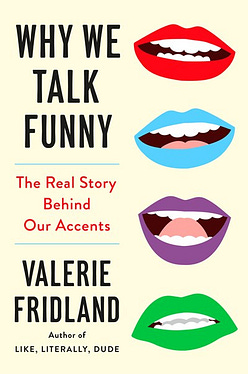
Why We Talk Funny: The Real Story Behind Our Accents by Valerie Fridland Why does a person from Georgia sound different from a person in Brooklyn? What are the forces that really shape our accents, and how do they affect our opportunities in education and the job market? How did a linguistic expert prove a man’s innocence? How and why do our accents continue to change? Valerie Fridland discusses all these questions and more in this deep dive into– mostly American– accents and how they affect our lives. She first became interested in the topic because of her parents, who were French and spoke with French accents, while she grew up in the United States and spoke with a mostly Southern US accent. This helped push her into the field of linguistics, and in Why We Talk Funny, she provides a series of friendly answers to the questions listed above that are both thorough and easy for the layperson to understand. It might be easy to dismiss discussions of accents as somewhat pointless, but Fridland explains how people with accents perceived as working class can lose out on life-changing opportunities if teachers or hiring managers perceive them as less-intelligent because of how they sound. She also shows how the simple act of clarifying one or two words can make a foreign accent sound clearer to the people listening. Though I sometimes thought Why We Talk Funny was a little too casual, I enjoyed the book as a whole and found Fridland’s explanations both fascinating and helpful. Our accents give life and color to our words, so it’s great to read a book by someone who cares so deeply about them. Thank you to NetGalley and Viking Penguin for the free advance copy.
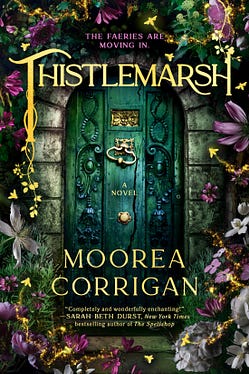
Thistlemarsh by Moorea Corrigan The Faeries disappeared from England over a hundred years ago, but the stories about them live on. When she was growing up, Mouse had wanted to be a Faerie anthropologist so she could spend her life studying the stories she loved, but the outbreak of war ruined her plans and shattered her family forever. Her beloved cousin is dead and her shell-shocked brother is in a permanent care home in France. With the death of her uncle, Mouse has inherited the once-beautiful but now dilapidated manor of Thistlemarsh, which was once host to the Faerie king. By her uncle’s will, Mouse has a single month to repair the house and its grounds, or else she will forfeit the entire estate to her odious cousin and lose her ability to pay for her brother’s care. Faced with an overwhelming amount of work, Mouse strikes a bargain with a strange figure in the garden who says he can renovate Thistlemarsh in the allotted time. But Faerie bargains always come with a price, and even if you think you’re willing to pay it, they will always demand more and the final cost might cost Mouse everything she has and more. I am not opposed to a lightweight story. Not everything needs to have heavy topics and themes, but Thistlemarsh proved to be even lighter than I thought, and for a while I wondered if it had a point and purpose, or if it was trying too hard to be a cozy novel about home renovations, but with extra Faeries. I found myself growing a bit bored on more than one occasion because it seemed like the story was going in circles. A bit of tightening in the editing process would have helped with this. Fortunately, the final twenty percent of the story did pick up and presented some stakes, but overall, I found the book to be a bit aimless in the first half. Corrigan is a capable writer, though, so if you’re looking for a light fantasy novel with cozy elements, Thistlemarsh might be just what you’re looking for. Thank you to NetGalley and Berkley for the free advance copy.
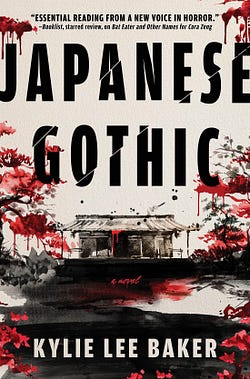
Japanese Gothic by Kylie Lee Baker Baker’s 2025 novel, Bat Eater and Other Names for Cora Zeng was one of my top horror reads last year, so when I heard the title of this one, it immediately went on my list of ‘most anticipated books of 2026’. In Japanese Gothic, two people living in the same eerie house more than 120 years apart meet thanks to uncanny and magical circumstances. In 1877, Sen is the daughter of one of the last samurai. Her father has taught her to be just like him, and though he is abusive, Sen will do anything to win his approval. Meanwhile, in October 2026, Lee has murdered his roommate and fled to his father’s newly-purchased house in Japan. Both Lee and Sen find the house strange enough, but things take an even weirder turn when they begin to see figures through windows that aren’t always there. As each begins to learn more about the other, they begin to uncover the identity of the force that is bringing them together– and to uncover the truth of their existences: one of their stories is real, the other is a lie. Gothic is an ever-popular genre that is hard to pin down and, as a result, we’ve ended up with a lot of books that are labeled ‘Gothic’ because they take place in an old house. Fortunately, Kylie Lee Baker knows what she’s doing. Japanese Gothic is set in an unhomely house that overflows with secrets. Both Sen and Lee are repressing things that force themselves into the open, and the atmosphere is laden with dread and mystery. This was almost a top tier book for me, but there was one plot element that could have been more tightly woven into the story as a whole, but as it was it felt a little like it was tacked on. Overall, though, Japanese Gothic was a compelling novel I didn’t want to put down, and I look forward to whatever else Baker writes. Thank you to NetGalley and Harlequin Trade Publishing for the free advance copy. Recently Read:
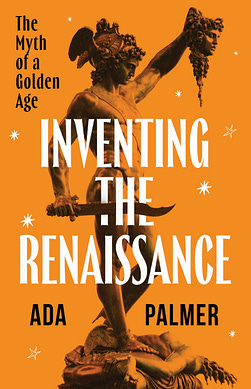
Inventing the Renaissance: The Myth of a Golden Age by Ada Palmer For years, historians and mythmakers have declared the Italian Renaissance to be one of the brightest points in world history, filled with the most gifted artists, the greatest thinkers, and the very best of writers. But was the Renaissance everything it was cracked up to be? Or is there more to the story than Leonardo da Vinci, Michaelangelo, and Machiavelli? This is the main question that historian and professor Ada Palmer sets out to discuss in this excellent work of historiography, which opens with a discussion of how we came to view the Renaissance as a golden age (hint: it has a lot to do with writers in the 19th century) and why the people who actually lived during that time had reason to believe they were the ones living in the worst timeline. Inventing the Renaissance is information dense, full of humor, and explains how the Renaissance was not an era when people woke up from the so-called Dark Ages and decided to be smart, but was instead another time when people continued deloping upon the ideas about medicine, art, literature, and science that came before. Palmer presents her account of the period not as some definitive version, but as merely another version of history with particular biases– just like any other historian’s version, regardless of who they were or when they lived. I spent about two months slowly making my way through this book, and it was worth every page. It was recently nominated for a 2026 Hugo Award for Best Related Work, and I hope it wins.
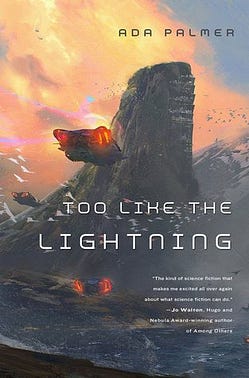
Too Like the Lightning (Terra Ignota #1) by Ada Palmer, audiobook narrated by Jefferson Mays Mycroft Canner is a criminal. To atone for his crimes– as is the way in the 25th century– he is obliged to spend the rest of his life in service to others. He is no ordinary criminal, though, and the people he is obliged to serve are not ordinary, either, for Mycroft is connected to some of the most powerful people in the world. He watches as they pluck the strings of power and to make everyone dance to their tune, even as he hides a secret that will change history as he knows it: there is a little boy who can make miracles happen. I’ve heard good things about Palmer’s Terra Ignota series, but never tried it. After finishing Inventing the Renaissance, I wanted to read more of Palmer’s work so I borrowed the audiobook from the library and had an excellent time with it. I can see Palmer’s insights as a historian coming through, and Mycroft’s perspective on his time period as it compared to previous eras was fascinating. The story had me guessing right up to the end, and left me wanting to continue on with the series. I think it suffered a bit in the audio thanks to footnotes (I think there were footnotes) that didn’t feel as separate from the main narrative as they could have been, but that’s a minor issue overall. I will definitely be reading the rest of the trilogy as a physical book partly because I want to have the footnotes separated from the narrative a bit more, and partly because my library doesn’t have the rest of the books on audio.
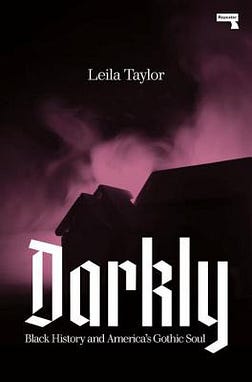
Darkly: Black History and America’s Gothic Soul by Leila Taylor This fascinating book is one part memoir, one part examination of Black experiences in the Goth subculture in the US, and one part discussion of the Gothic in America and how it is intertwined with Black history. Taylor is candid about her own experience as a Black Goth woman and how that has sometimes put her at odds with herself, then goes on to provide insightful takes on how the Gothic in America is different from the Gothic in England, where the genre developed. If you are interested in Gothic tales and the landscapes they spring from, Darkly is an excellent book to pick up. What I’m Currently Reading
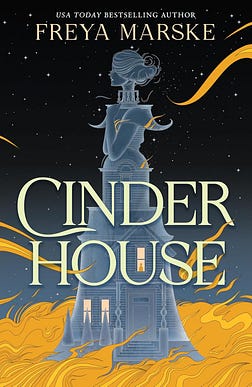
In this take on Cinderella, Ella dies at the age of sixteen, becomes a ghost in her own house, and is forced into drudgery as an undying servant of her stepmother and her two stepsisters. Though she is tethered to the house, Ella does find a way to leave it and explore the city by night. During her nighttime wanderings, she meets a fairy charm-seller in the market and makes a bargain that earns her three nights of existence where she can be seen and touched by people. And of course she goes to the royal ball during these three nights where she encounters a certain prince. This is one of the books I am reading for the Hugos, as Cinder House was nominated for the award for Best Novella. I’m only about a third of the way through it, but so far I’m enjoying it.
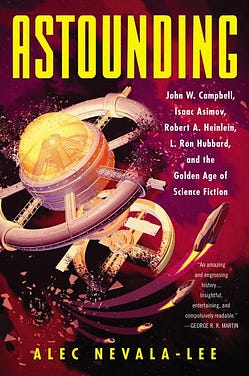
Astounding: John W. Campbell, Isaac Asimov, Robert A. Heinlein, L. Ron Hubbard, and the Golden Age of Science Fiction by Alec Nevala-Lee, audiobook narrated by Sean Runnette I’m not much of a science fiction reader, but with the Hugo Award nominations having been announced this week and with my mind still on Ada Palmer’s Too Like the LIghtning, I borrowed Astounding from the library after happening across it while browsing. I haven’t read very many stories from the authors listed above, but I know how influential they were in many areas. I’ve also heard about how bigoted and misogynistic they could be, which makes me less likely to pick up their books. Regardless, I was interested in learning more about the foundations of a genre I’ve always been at least a little interested in. I’m about two-thirds of the way through, and it’s been an excellent book to listen to. Nevala-Lee’s research seems pretty impeccable, and he balances his praise of these men’s work with their flaws as human beings– particularly their misogyny that, especially in Campbell’s case, kept a lot of women out of science fiction publishing for a long time and erased or diminished the role women played behind the scenes. I’m still not interested in reading more of these men’s works than I already have, but I’m glad to have a better understanding of the history of speculative genres.
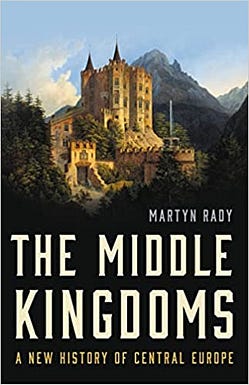
The Middle Kingdoms: A New History of Central Europe by Martyn Rady I’m about a third of the way through this potted history of central and eastern Europe, and I’m learning all sorts of things. I enjoy studying the history of western Europe- particularly that of England in the middle ages- but I don’t know a lot about other parts of European history before WWII. The Middle Kingdoms takes the reader on a journey through the region’s history from Roman times to the fall of Communism in the late twentieth century. As a result, there is nothing super detailed from any one point in history, but so far it’s given me a foundational understanding of the region’s history and given me some people and events to study further later on. I’ve been trying to read a chapter or two each day, but that hasn’t always worked out. That said, it’s another book that’s good to take in slowly so you don’t mix things up in your memory. Traveling in Books is free today. But if you enjoyed this post, you can tell Traveling in Books that their writing is valuable by pledging a future subscription. You won't be charged unless they enable payments.
|




No comments:
Post a Comment