
A Comprehensive Review of Every Book in my American Gothic Classincluding House of Leaves, Haunting of Hill House, The Only Good Indians & more!
American Gothic fiction thrives on the tension between what a culture claims to be and what it tries to hide, and the books in this review series trace that tension across more than a century of storytelling. This collection of reviews introduces how each of these stories approaches the Gothic in its own way, offering a tour through the many ways the American imagination creates its monsters. The Turn of the Screw (1898) by Henry James
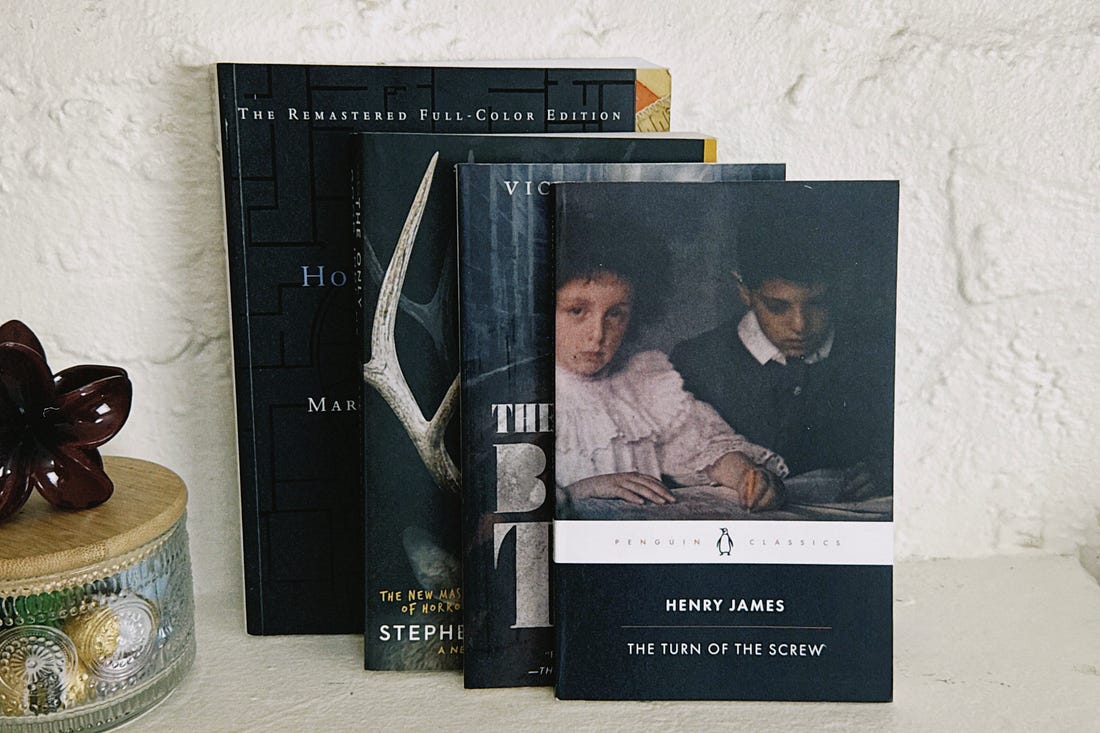
A governess goes out to an isolated estate to look after her employer’s niece and nephew under strict orders never to contact her employer. She becomes increasingly convinced the children are being possessed by ghosts of former employees, Peter Quint and Miss Jessel. As she departs further and further away from reality, the book begs the question of whether the supernatural occurrences actually happen or are strictly the result of the governess’s imagination. ⭐️⭐️⭐️: good depiction of a story driven by a singular point of view, creating ambiguity as the governess lies and/or modifies her tale depending on who she is talking to. However, the opening framing narrative is never circled back to, the ending is abrupt, the writing style characterized by convoluted sentences, and the governess’s apparent repressed sexual desires/longing for her employer is a generous reading proffered by academics to explain the governess’s obsessive behavior. Recommend to: readers of the gothic and lovers of psychological horror who are prepared to closely follow the long, convoluted sentences. A short but potentially difficult read for the average reader. The Haunting of Hill House (1959) by Shirley JacksonDr. Montague, pretty Theodora, Luke, the inheritor of Hill House, and lonely friendless Eleanor arrive at Hill House looking for proof of psychic phenomena. Eleanor forms a close attachment to the house, becoming increasingly influenced by the house and, as the boundary between her and house dissolves, so too does her sanity. ⭐️⭐️⭐️⭐️: beautifully written and primarily character driven. A strong commentary on the role of women within the house in the 50s and 60s, a modality that is often posited as stifling and restricted, without being overt. Recommend to: readers who love a good character-driven story and an engaging female lead. Sentence and plot structure is easy to follow and story is overall crisp and beautifully written. The Stepford Wives (1972) by Ira LevinJoanna, her husband Walter, and their two children move to the idyllic village of Stepford only to discover the women of the town are only interested in housework and their domestic roles. After Walter joins the town’s infamous Men’s Club, the town’s true secrets begin to emerge. ⭐️⭐️⭐️: the story is more satisfying in retrospect once you understand the ticking clock the story cleverly implements from the beginning. While the ending is ambiguous, it is the final epilogue that undermines the work of the story and creates a feeling of dissatisfaction. Recommend to: lovers of psychological suspense and readers who enjoy stories about the pressure society places on women to chase youth and beauty. The Ballad of Black Tom (2016) by Victor LaValle
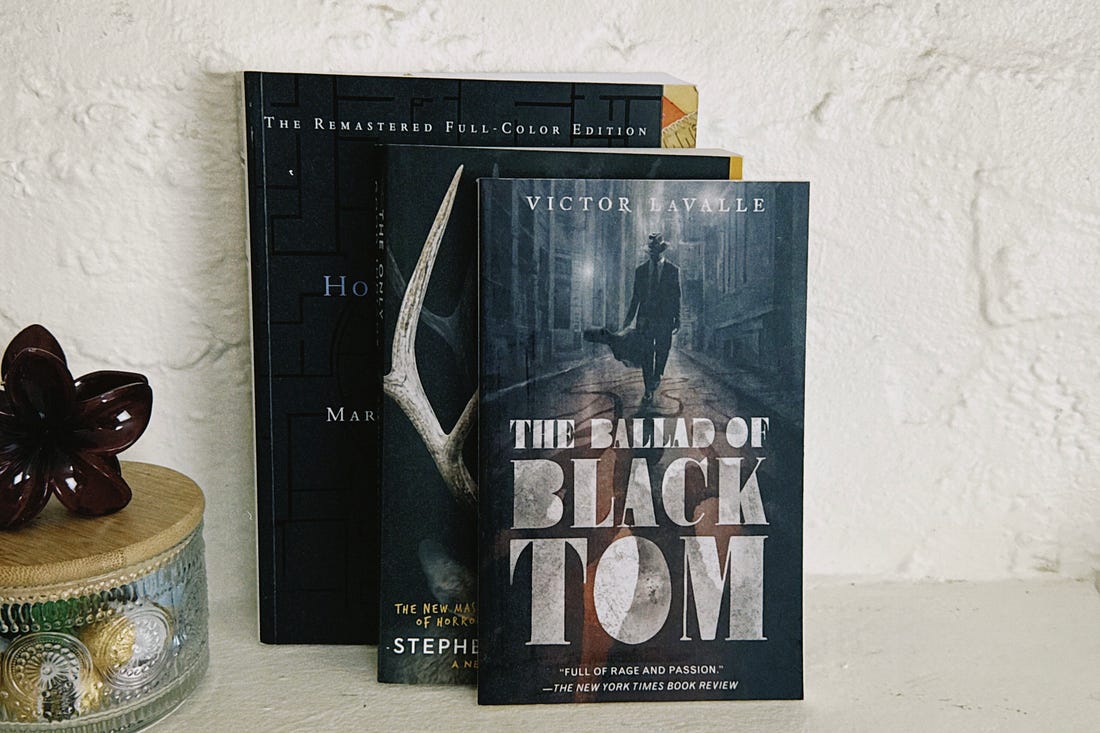
Based on H.P. Lovecraft’s short story, The Horror at Red Hook, The Ballad of Black Tom follows Charles Thomas Tester, a young Black man in 1920s Harlem, who survives through small hustles until a job delivering an occult book draws him into a supernatural world. After police kill his father, Tom’s grief and rage push him toward the arcane powers he once only skirted, and he aligns himself with Ma Att’s plan to summon a cosmic deity. Detective Malone witnesses the terrifying consequences, realizing too late that the true horror lies not only in the supernatural but in the violence that shaped Tom’s fate. ⭐️⭐️: simple writing is easy to read; however, the book is too short to adequately address the themes of racism and police violence that it sets out to discuss. POV shift halfway through the book is sudden and jarring. The story is ultimately meant to subvert Lovecraft’s racist roots, but fails to do so through an overtly simplistic fix. Recommend to: readers of Lovecraft may benefit from reading this book in addition to Lovecraft to gain a well-rounded perspective of how race operates in Lovecraft’s horror. A better example of a book inspired by Lovecraft and that subverts Lovecraftian racism more skillfully is Lovecraft Country (2016) by Matt Ruff. The Only Good Indians (2020) by Stephen Graham Jones
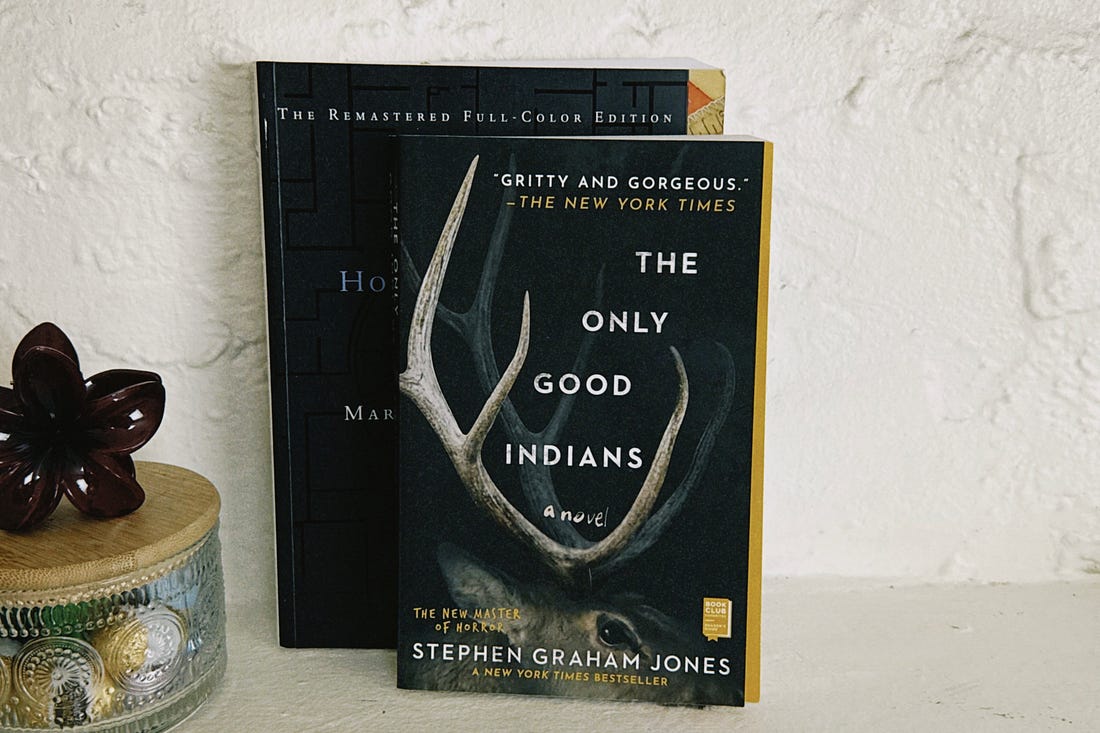
After wrongfully slaughtering a herd of elk, including a pregnant cow, four Indian men are haunted by the figure of an Elk Woman who desires vengeance for herself and her murdered child. ⭐️⭐️: the story is split into sections with each section following a different set of characters. The opening prologue never feels fully connected to the narrative, but the second section is by far the most interesting, setting up a character-driven psychologically intense story that falls apart when the POV shifts abruptly to a different set of characters. Ending fails to deliver on the themes and motives set up in the preceding sections. Recommend to: readers looking for a light horror read. Includes reading guide for easy discussion. House of Leaves (2000) by Mark Z. Danielewski
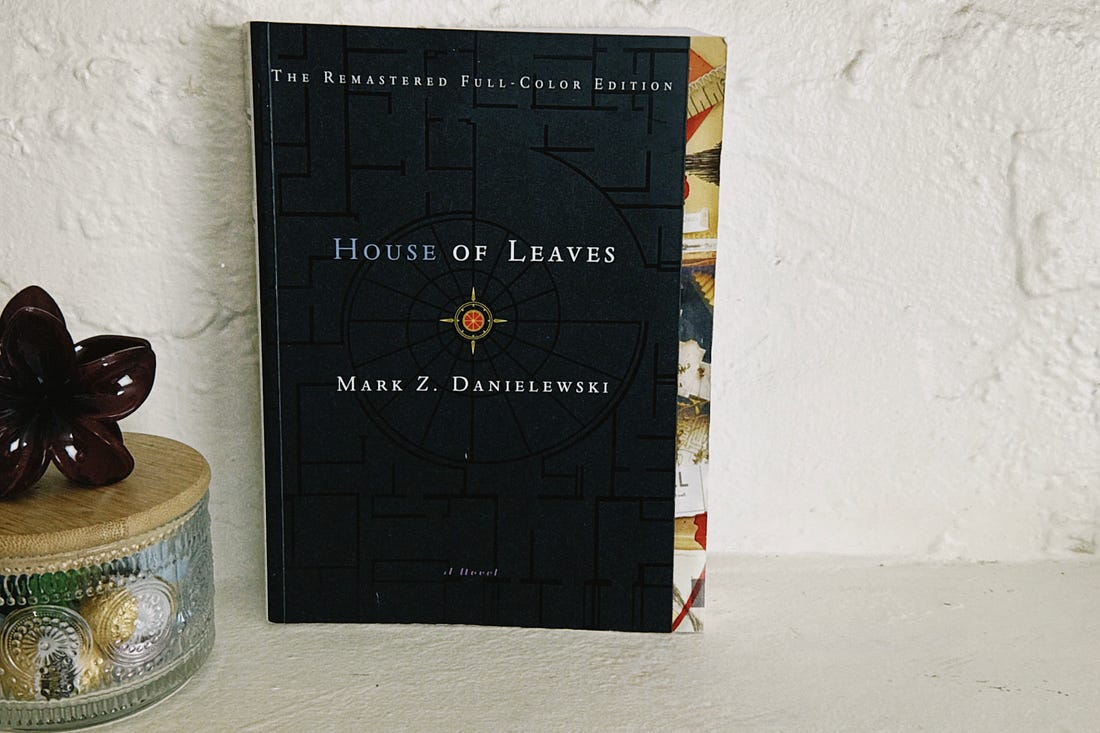
Johnny Truant, a troubled young man, discovers the life work of Zampanó, an elderly blind man found dead in his apartment. Zampanó’s feverish writing forms a heavily annotated piece called The Navidson Record, an academic work about a documentary of the same name by photojournalist William Navidson. The documentary is about the endless black void that appears in Navidson’s house and his subsequent attempts to explore it. According to Zampanó’s analysis, The Navidson Record exists. Traunt, however, cannot find evidence of its existence. Yet he is unable to dismiss it as fiction as he begins to experience strange events, which he documents in his own annotations on Zampanó’s manuscript. ⭐️⭐️⭐️⭐️: a beautiful piece of prose that engages with academia as a form through the use of heavy footnotes, appendixes, and letters. Though it becomes increasyly complicated, it eases the reader into the complexity of the prose and develops depth as the layered stories stack and unstack like a game of Russian dolls. Recommend to: readers who don’t shy away from complex, experimental prose and who enjoy psychologically driven, layered storytelling. On a basic level, this is an exploration novel so if you enjoy stories about cave hunters, explorers, or archeologists (Indiana Jones), you’ll likely be engaged by this book. A Note on Representation
It is not lost on me that the two books by non-white authors did not deliver as structurally sound stories as the rest of the books on this list. As I am choosing to review these books from the perspective of a reader looking for strong characters, solid plot, and an overall logical structure from beginning to end, the historical significance and cultural relevancy of the works reviewed is not taken into account for the purposes of these reviews. From an academic and cultural relevancy standpoint, therefore, both The Ballad of Black Tom and The Only Good Indians may rank much higher on the basis of their ability to represent writers and characters from non-white communities. You're currently a free subscriber to Letters By Layla. For the full experience, upgrade your subscription.
|







No comments:
Post a Comment