What’s Your Plan When Civilization Collapses?A Book Review of The World of Yesterday by Stephan Zweig
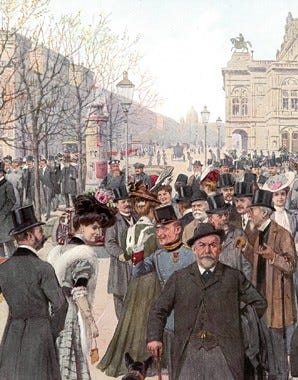
Whenever I prepare to take a trip, I like to acquaint myself with the lore of the place by reading its history and literature. Getting ready for a vacation in Central Europe, I read The World of Yesterday by the Austrian man of letters, Stefan Zweig, published in 1942. His style is characterized by long, sinuous sentences that build through layered clauses, creating a contemplative, almost hypnotic rhythm. At first, I was daunted when I saw his long paragraphs, but he couldn’t have made them any shorter and still circle around an idea or memory from multiple angles rather than stating things directly. Unlike modern writers who radically cut and compressed their writing, Zweig gives himself the space to qualify, add nuance, double back, and refine a thought. However, he does this without the rococo extravagance of a Victorian writer. His long sentences never feel labored or convoluted, you never have to backtrack to figure out what’s happening. It’s prose that values both clarity and depth. The elegance serves the meaning rather than calling attention to itself. I decided I would experiment with it in this book review. Adopting this style goes along with what I need in my life: to take notice of the little, often disregarded sights and sounds around me, and represent the complexity of how I feel about them. This resolution of mine, to pay careful attention to the little things, can’t come at a better time, for the world’s gone mad with wars, divisive politics, thuggish authoritarianism, and a loss of simple civility, all big things that dominate our attention. This brings me to the other reason I loved Zweig’s book. His world of yesterday is similar to my world of yesterday. His was the waning years of the Hapsburg Empire, a time, if he can be believed, of refined stability. Europe had enjoyed relative peace for years and ethnic groups lived together, more or less in harmony, held together by institutions and shared culture. Aesthetic life flourished, it spawned great music, great art, and splendid architecture. Intellectual developments bloomed, Jewish thinkers such as Freud, Wittgenstein, and Herzl, as well as Zweig moved freely through Viennese society. Most importantly, there was optimism about progress, about reason, and about European civilization becoming more enlightened. Zweig was honest about the Hapsburg Empire’s problems, its resistance to change and growing nationalistic aspirations that would ultimately split it asunder. Compared to newly formed, neighboring Germany, it was economically and militarily weak. He was critical of Viennna’s repressive sexual morality and stagnant, joyless educational system; but he loved what the city allowed, a mixing of different peoples, languages, and cultures under one umbrella that artfully managed simmering fanatical nationalism. I see many parallels between his world of yesterday and our own, what may come to be known as the waning years of the American Century, characterized by relative peace among major powers, free trade, and respected institutions. The United States is as multi-ethnic and multi-lingual as the Hapsburg Empire had been, held together by institutions and shared aspirations rather than blood-and-soil ideology. We were finding a way to respect identities and not leave anyone out. We assumed that liberal democracy was the direction history moved and the arc of the moral universe would bend toward justice. Zweig tells how quickly and catastrophically his world of yesterday vanished in August 1914, with the start of World War I. Another, much worse world began. Not only did the war kill millions, he thought it killed the possibility of that kind of world existing again. What replaced it was nationalism, paranoia, hatred, the drawing of hard borders where there had been permeability. For instance, before World War I, no one even needed a passport to travel the world, nor permission to migrate. Zweig tried to save his world of yesterday by advocating for pacifism and a shared European identity, but he had to flee Germany for Switzerland because of his views. He returned to Austria when World War I ended, only to find conditions far worse than when he left. His books were banned and burned throughout the German speaking world. Finding himself unwelcome in his native land, both for being cosmopolitan and a Jew, he fled a second time. Zweig wrote The World of Yesterday in 1941 from Brazil, grieving not just his beloved home but the idea that civilization could be stable, that progress was inevitable, that reason and culture could hold barbarism at bay. Its collapse showed how fragile those things really are. Both he and his wife killed themselves after its publication. The World of Yesterday shows what it feels like to live through the end of civilization from the inside, before you know how it ends. You see him trying to hold onto his ideals, trying to believe reason will prevail. It feels just like I feel today. Was Zweig too attached to his world of yesterday? Could he have navigated the decline differently? Was his despair a clear-eyed assessment of reality or a failure of imagination? Will we have to flee our native land and kill ourselves, also? We know what came after Zweig left us in 1942. The war continued for three more years, murdering millions, and destroying much of Europe and Asia. We obliterated two cities with atomic bombs and many others by more conventional means. Millions more died in the Holocaust which Zweig was spared from knowing anything about. Then everything began to turn around, which he also never witnessed. The Marshall Plan treated enemies with kindness. Europe united exactly the way Zweig advocated by establishing NATO and the European Union. The whole world came together in the United Nations. Exhausted European countries released their colonies and the standard of living rose exponentially, across the globe; due, largely, to peace and cooperation. The United States took a leading role in guaranteeing that peace and held the world together by honoring its alliances. Perhaps, we can take a lesson from the book that was not clear to its author. Things come around, civilizations cycle between periods of self destruction and reconstruction. Some things are lost that can never be recovered, but new institutions emerge, new possibilities open up, new forms of stability are constructed. Zweig couldn’t imagine the golden age we now are destroying. He died because he thought the darkness was permanent. Our question now is: what can you do when everything is going to hell? Zweig tried to preserve culture, he bore witness and maintained his ideals. That mattered, even if he didn’t live to see its value. We can plant seeds for what might grow later, even if we never see the harvest. We can refuse to give in to the worst impulses when civilization collapses. You're currently a free subscriber to The Reflective Eclectic. For the full experience, upgrade your subscription.
|
Monday, 2 March 2026
What’s Your Plan When Civilization Collapses?






Subscribe to:
Post Comments (Atom)
New post in Shine Magazine
Philippians 4:8 ...

-
Rex Sikes posted: " Take this quote of William Atkinson Walker's to heart. Understand it and apply it in your life. ...


No comments:
Post a Comment