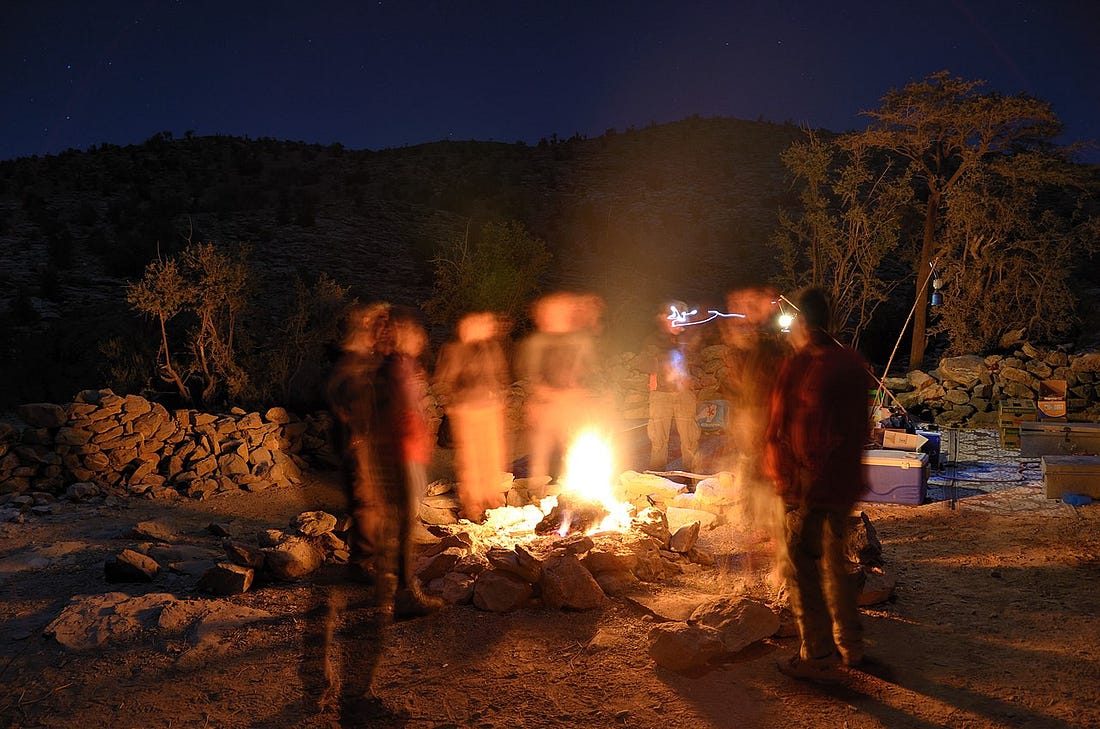
Who gets to belong to a group? A fence and a campfire are two ways of thinking about membership. The problem is they disagree, and neither considers itself wrong. The FenceOne way to define membership is by building a fence. Draw a line, a perimeter. People inside it are members, people outside aren’t. Credentials, certifications, cultural markers, or admission fees determine who gets in. This is how professional licensing works. To practice medicine, you need a medical degree, a passed board exam, and state certification. It doesn’t matter how much you know or how many successful procedures you’ve informally performed; without the credential, you’re not supposed to practice. And even if you earned all three qualifications in another country, you still might not be permitted to call yourself a doctor in this one. The same logic shows up everywhere, at every scale. You’ll never sit with the cool kids in high school if you dress like a geek. To participate in class discussion, you raise your hand. Arrive at a formal dinner without an invitation and you’ll be asked to leave. Some religions work the same way; no baptism, no confirmation, no membership. You’re either in the Kingdom of Heaven or you’re out, crying and gnashing your teeth. Contemporary immigration policy is the starkest version of all this. A nation draws legal boundaries around citizenship, and those boundaries don’t bend easily for lived experience. An immigrant might raise children, pay taxes, and contribute to civic life for thirty years, and the fence will still say no. Every fence has two sides, but the people who build them are usually only thinking about one: keeping the wrong people out. What they don’t account for are the good things it also keeps out, the new perspectives that never arrive, the ideas that might have solved problems no one inside could crack, the humbling reminder that yours is not the only right way. A profession that credentials its members gains consistency and protection, but it also grows insular. The longer a fence stands, the more what’s inside it starts to look like the only way things could ever be. The CampfireThe second way to define group membership doesn’t use a fence; it’s about shared interest and orientation. Picture people gathered around a campfire. Those oriented around the fire are in the same group, tuning into the same frequency. These are communities of practice: groups that form around shared work, shared learning, or shared purpose. Open-source software communities work this way. Nobody certifies you as a member. You become a member by contributing code, joining discussions, learning how the community does things. A self-taught programmer who submits patches belongs; a computer science PhD who doesn’t contribute doesn’t. The center is the shared work. You belong by sharing in it. Similarly, you’re in on an inside joke the moment you get it. Nobody certifies you as a Swiftie; you belong the moment you love the music of Taylor Swift. The only requirement to belong to Alcoholics Anonymous is a desire to stop drinking, you could be stinking drunk when you go, as long as you wish you weren’t. Nobody admits you to these groups, you admit yourself. With a campfire, you can choose the extent you want to be involved. You belong to the circle by toasting marshmallows, or watching those who do; by singing songs, or just listening; by being close enough to singe your shoes, or so far that you see the light without feeling the heat. It’s possible to be partly tuned in and still be tuned in. There’s no place anyone can draw a line. Which is Better? The Fence or the Campfire?Neither system is inherently superior; each serves different purposes. A fence is what you need when you’re collecting dues, certifying safety, keeping secrets, or defending hard-won prerogatives. A campfire is what you need when you want people who actually care. Many groups use both, which is where the trouble starts. Universities build fences with their admissions requirements, course requirements, and the limits of academic disciplines; but the best learning happens in informal bull sessions, debating after class over beers, comparing lab results with colleagues, or crossing disciplines. When you put up no barriers against them, the best people can get in. You get the most passionate and effective involvement in a group where the only requirement is tuning in. Many groups form when people spontaneously gather around a shared purpose, only to make it formal by putting up a fence later. Families are formed this way. When two people fall in love, they’re forming a group of two by tuning in to each other. Later, they make it official by co-signing a lease, getting married, or making some other kind of promise. Then they’re building a fence, in this case, to both fence in and fence out. If the couple have children, the kids are admitted by blood; although exceptions can be made through foster care arrangements or formal adoption. There may still be people outside the fence, watching the campfire within, like close friends; but because they’re not blood, they can’t get in to toast marshmallows. When the Fence Comes LateSerious conflicts about belonging happen when someone tries to build a fence to define a group that has gathered around a campfire. My own profession is an example. I began my career as a psychotherapist before there were licensing requirements. You could be a therapist just by calling yourself a therapist and someone hiring you to be one. All you needed was an absorbing interest in the psychological workings of other people. If you were insightful enough, people would come to you for advice. If they were happy, they’d come back and tell their friends. Some of us therapists got a lot of education anyway, but it was because of that absorbing interest, not because someone told us we had to have it. Then around 2000, the New York State Legislature wrote laws to licence us. These were designed to protect the consumer from uneducated therapists and give them a way of kicking the bad ones out. It also gave us a way to protect the investment we made in our education from competitors who didn’t make that investment. I welcomed it when it came; it gave us dignity and recognition. But the State made the educational requirements so rigid, I was lucky that the law had a provision that temporarily grandfathered in people like me who already practiced the profession. If I had to apply now, even after advanced degrees and thousands of people putting their trust in me for forty years, I would be fenced out. In fact, I may choose to give up my license when it expires in 2027 because the continuing educational requirements are so inflexible. Even though I live for continuing education, unless I take the approved courses all over again, I will not meet their requirements. I’m far from the only one who is fenced out of a group to which they belong by virtue of the campfire. The pattern repeats in almost every creative and intellectual field. In most universities, you cannot teach your subject at the college level without a PhD, regardless of what you know or what you’ve done. Take David McCullough, for instance. He won two Pulitzer Prizes for history, wrote books that defined how Americans understand John Adams, Harry Truman, 1776, the western pioneers, the Wright Brothers, the Panama Canal, and the Brooklyn Bridge, but he has no PhD. Consequently, most colleges would not hire him to teach history. A PhD in history certifies how you came to know it, not what you know about it. If you came to know it the wrong way, there’s no getting through the fence. The people inside it will read your books, cite your work, and teach your methods; they just won’t let you in the room. When You’re on the Wrong Side of a FenceWhen someone fences you out of your campfire, you have five basic options: defer, earn, push, wait, or circumvent. Defer: Most people, most of the time, don’t storm fences or look for gaps in them. They see a boundary, assume it’s there for a reason, and adjust their behavior accordingly. This is not weakness; it’s how societies function. You don’t walk into a restaurant kitchen, lay down on the couch in a stranger’s home uninvited, or submit your article to a journal that publishes only credentialed researchers. You recognize the fence and route around it without being asked. The problem is that this same instinct, so useful in most situations, quietly closes doors that were never locked. For instance, the kid who stops raising their hand after saying something wrong in class and the writer who never submits because rejection would make the failure official. Deference feels like good manners; sometimes it is. But fence builders count on it, because a fence that people respect without question is far cheaper to maintain than one you have to actually enforce. Earn: The most straightforward response when you want to get in is to meet the gatekeeper’s requirements. Get the credential, pay your dues, pass the exam, put in the years. This is what the fence was designed to encourage, and it works, assuming the requirements are achievable and the fence is operated in good faith. When they are, earning is the cleanest solution; you come out the other side with the membership and the legitimacy that goes with it. There’s another way past the gate that doesn’t require earning the usual way. It’s the way that ushers get to watch the show. They don’t pay the admission fee, they make themselves useful. Suppliers, translators, fixers, critics, and consultants all occupy this position. They never get a membership card, but they’re at every meeting anyway; their calls get returned, their opinions get solicited, their invoices get paid. The fence is still there, but it has stopped mattering in any practical sense because the people inside it need you to function. Push: You don’t even acknowledge a fence or you test its strength. Often, pushing triggers resistance, the group closes ranks, you end up more excluded than before, and now everyone knows you tried and failed. But many fences give way if the people who patrol them lack the authority to enforce their limits. Pushing has subtler variations. You can infiltrate: get in by disguise or by finding a gap in the fence. Some women entered male-dominated professions this way, by adopting the dress, manner, and speech of men. You can appeal to others for help: challenge the legitimacy of the fence itself through courts, public opinion, or moral argument. The civil rights movement was, among other things, a sustained appeal to lawmakers against the fences of Jim Crow. Or you can befriend the bouncer: cultivate someone who controls access rather than trying to earn membership from the group as a whole. A bribe, a well-placed mentor, a sponsor in a closed industry, or a well-timed introduction can work, but they depend entirely on finding the right person and making it worth their while. Wait: You park yourself at the threshold until they let you in. You’ll have to tolerate uncertainty for a long time, while being visible and vulnerable, neither in nor out, hoping. Sometimes it works. Sometimes you outlast the fence. Gatekeepers retire, fashions change, institutions collapse, and suddenly the credential that excluded you no longer exists or no longer matters. Gay people were once excluded from marriage until the laws and customs changed. Now they can all get married, even if they were never activists, pushing to be let in. Circumvent: If they won’t let you into their party, throw your own party. Create a new group outside the fence, defined by the same shared interest. When licensing requirements are too rigid for some therapists, many call themselves coaches. When publishers ignore certain writers, they self publish. Once you throw your own party, two more moves become available. You can poach: draw people away from the original group until it hollows out, which is what independent podcasters have done to legacy radio. Or you can reframe: argue that your group is the authentic one and theirs is the imitation. Punk made exactly this argument against arena rock. Protestant reformers made it against the Catholic Church. Open-source developers made it against proprietary software. The reframe doesn’t just start a rival party; it contests the legitimacy of the original group. Most people default to one or two of these choices across situations, so they become a habit. I make a good living as a therapist by helping people identify overused methods and encouraging them to try something else. I’ve worked with a lot of folks who flee at the glimpse of a fence, vanishing before anyone can say no. There’s also a lot of chronic pushers who demand inclusion everywhere, as well as tireless earners who never stop proving themselves, even after the goalposts are moved on them. My personal favorite is circumvention; I tune into whatever I want, heedless of fences, even when I might have been admitted, had I applied. The more useful approach would be to diagnose which choice fits which situation; because the wrong move, made mindlessly, often gets you more firmly excluded. Cultural AppropriationAfrican-American musical genres of jazz, rock and roll, the blues, funk, and rap began as the purest possible expression of the campfire. There were no gatekeepers to these musical genres; if you loved the music, it was yours. The communities that created these forms happened to be largely African-American, but they were defined entirely by shared attention, with no fence limiting who could participate. When white musicians gathered around that campfire, they did it with genuine devotion, sitting with the originators, learning the music on its own terms, absorbing it until it became something that had become part of them. African-American music spoke to Jewish musicians and poor whites in particular because, while their skin was not black, their experience of exclusion from society was similar. But when white musicians began to perform and record and profit, the African-American community put fences up. You couldn’t be an authentic jazz, rock and roll, blues, or hip hop artist if you weren’t Black. By this logic, no amount of sitting around the campfire, or personal suffering, could get a white musician through the gate. They were fenced out not by how well they played, what they experienced, or how hard they had listened, but solely by the color of their skin. Those white musicians, and their defenders, had the standard responses to being fenced out. Many deferred and kept to their own traditions of klezmer and bluegrass. Some pushed, arguing that the fence was arbitrary, that devotion and craft were the only legitimate membership requirements. Some earned, by technical virtuosity. Others became genuinely useful by working alongside musicians from the originating community or supporting causes connected to them. Some circumvented and went on playing the same music, by calling it rockabilly instead of blues, disco instead of funk, and trap instead of rap. In the end, fencing white musicians out simply could never work. A fence around a musical tradition has no posts and no wire; it runs only through the willingness of people to honor it, and the people most eager to cross it were under no obligation to honor anything. It violates the most fundamental feature of musicianship, to be influenced by what you hear. The African-American community could declare the fence, but it had no way to enforce it. A fence can’t stop people who don’t recognize its legitimacy from walking straight through it. Sometimes all it does is piss people off. But there was another fence involved, one that had more to do with money than music. Black musicians couldn’t play the same venues, negotiate the same record deals, or reach the same radio stations. The commercial infrastructure that would reward the blues for being the blues was legally and commercially closed to many of the people who created it. So when white artists carried black music to mainstream audiences, they passed through a door that had been locked against the ones they learned it from. From this perspective, the question was never whether white musicians had tuned in sincerely; it was that sincere appreciation of the music and commercial access were available to them simultaneously, while the people who created the tradition had been fenced out of one even as they remained inside the other. The responses from Black musical communities followed the same taxonomy, but the target was different. Most deferred and never attempted to play to a larger audience. Pushing took the form of legal action; artists like Little Richard and Chuck Berry fought for songwriting credits and royalties that had been taken from them, sometimes successfully, more often not. Waiting meant persisting till the fence around the commercial infrastructure would eventually come down. Earning meant some exceptional musicians were accepted. Many mentors of white artists became genuinely useful. And circumvention, the most consequential response, meant building entirely new campfires. Bebop was a deliberate act of circumvention; music harmonically dense, rhythmically complex, and technically demanding so that casual appropriation was harder. It also created new institutions: independent record labels, club circuits, and critical vocabularies that Black musicians controlled. Funk and hip hop repeated this pattern in different eras and different ways; not just as artistic innovation but as a recurring attempt to build a fence around something new before the old sequence could repeat itself. Each time, the fence was porous; the music traveled anyway. And each time, the argument about who belonged, and who had the right to profit, started again. ConclusionSo here we are, back where we started: wanting to belong, and fighting over what the word even means. The fence and the campfire serve different purposes, answer different questions, and produce different kinds of community; and because they measure membership differently, they will keep producing different verdicts about who’s in and who’s out. We can see the fight more clearly when it starts. Most arguments about belonging are not really arguments about whether someone deserves to be included; they’re arguments about which system should be doing the measuring. The credentialed historian and the popular writer aren’t disagreeing about history, so much as they’re disagreeing about whether history is a fence or a campfire. The licensing board and the experienced practitioner aren’t disagreeing about competence; they’re disagreeing about whether competence is something you can certify. The argument about cultural appropriation isn’t really about music; it’s about which fence was there first, whose fence it was, and who was already on the wrong side when the music started. Neither system is going away. People will keep building fences because fences do real work, and people will gather around the campfire because the joy of involvement doesn’t need credentials. The collision between them is not a problem to be solved. It is a condition of belonging itself. For Further ReadingThe academic sources behind this piece are Michèle Lamont’s Cultivating Differences (1992) and Etienne Wenger’s Communities of Practice (1998), but neither is written for a general audience. Here are books that are. On belonging and exclusion Richard Sennett, The Fall of Public Man (1977). Sennett examines how modern life eroded the shared public spaces where belonging once formed without credentials or gatekeepers. Tara Westover, Educated (2018). A memoir that is, among other things, a precise account of what it costs to earn your way through a fence, and what you leave behind when you do. On communities of practice and how knowledge actually travels Michael Polanyi, The Tacit Dimension (1966). Short and accessible; the best account of why so much of what makes someone belong to a tradition cannot be written down in a credential. Matthew Crawford, Shop Class as Soulcraft (2009). Crawford, a philosopher who left a think tank to open a motorcycle repair shop, makes the case for knowledge that fences cannot certify and cannot contain. On cultural appropriation and American music Elijah Wald, How the Beatles Destroyed Rock ‘n’ Roll (2009). A music historian’s account of how American popular music has always traveled across racial and cultural lines, and what gets lost and gained each time it does. The title is deliberately provocative; the argument is scrupulous. Ted Gioia, The History of Jazz (1997). The clearest single-volume account of how a tradition built by one community became, repeatedly and controversially, everyone’s. Nelson George, The Death of Rhythm and Blues (1988). George makes the commercial fence argument with precision and without sentimentality; essential for understanding what Black musical communities were actually responding to. On credentials and who they serve Randall Collins, The Credential Society (1979). Collins argues that educational credentials function primarily as social fences rather than as measures of competence. Academic in origin but readable; the central argument has only become more relevant. You're currently a free subscriber to The Reflective Eclectic. For the full experience, upgrade your subscription.
|
Monday, 9 March 2026
Two Ways to Belong






Subscribe to:
Post Comments (Atom)

-
Rex Sikes posted: " Take this quote of William Atkinson Walker's to heart. Understand it and apply it in your life. ...


No comments:
Post a Comment