I love finding fragments of Elliot, startling winks that insistently pierce the thin veil between now and eternity. I found this poem, “Light Waters,” earlier this week in a stack of “important” papers haphazardly stored in a white wicker basket under my desk. Buried in the prosaic clutter of a year gone by, I discovered profound poetry, a potent reminder of Elliot’s presence and brilliance. It saved me, diverting my attention as I struggled to make sense of the senseless—the overwhelming chaos of our disordered world. LIGHT WATERS by Elliot Wright embroidering the fabric of the miasmic nothing, the unknowable one unspools, a triploid embryo ensconced among four aeonic choirs, again, the gap between divine perfection and entropy is inexplicably bridged— in the shadow of four luminaries, there, Sophia, drifting in defiance, all platypus, or seahorse, bears that strange fruit Yaldabaoth, The second innermost husk In a Matryoshka doll, decaying. Saying goodbye and hello, it’s that time of year when we reorganize the old stuff to make room for the new. In this year’s transition, I felt a little precarious and uncertain, navigating another liminal space as murky as a miasma. I’m still not sure what’s next, but I am finding glimpses of peace in the nooks and crannies. Turns out, space is an extremely valuable commodity, filling the void where choices and discomfort coexist. Maybe that’s the point. That’s where we face our demons head-on and learn why we often hide them under the covers of busyness and digital addiction. However, I contend our most persistent demons cannot hide in the great wide open. That’s why I carved out some year-end space to write, read, and carefully consider what I genuinely want, a new muscle for me that I hope to strengthen. No matter the day, month, or year, space comes in many different shapes and sizes. Case in point: my cranky Gmail account. It is constantly chiding me, “You are almost out of space,” the ultimate digital disaster. By what measure, I ask? Since when did cyberspace become finite? Ah, when it becomes a revenue opportunity. The Google gods tell me incessantly, “Clean it up or else.” Yikes. The “or else” is that I will be unable to send or receive emails. Therefore, I will be forced to buy more space, to add yet another monthly subscription to my vast digital wallet. Space is expensive.And it’s painful. I think of my heartbreaking space debacle: Amazon Web Services (AWS) elimination of Elliot’s business account while I was serving as executor of his estate. Although I went to court to secure the small estate affidavit they required to prove I was his heir, they still denied access. It was like presenting the witch’s broom to the Wizard of Oz, as the corporate overlords summarily deleted his account anyway. I do not understand this realm of digital providence, especially since much of the data was mine—my business’s ElaineGantzWright.com email box and web files, which Elliot managed. But AWS’s law firm claimed that they “needed the server space,” and Elliot had not paid his monthly subscription. Elliot was dead, and they knew it. I told their customer service rep he was deceased—when I called the first time, fighting back the avalanche of tears. Saying those words: “I am calling because my son is dead” is like swallowing an icepick, and the pain becomes almost unbearable when the call center agent responds as if I am telling them I am out of milk. AWS had his death certificate. He could no longer pay anything. To anyone. This massive, heartless corporate behemoth could not “make space” for the concept of subscriber mortality and next-of-kin grief, and I could not find an attorney who would even attempt to sue Amazon on my behalf. Space was the final frontier.There were obviously too many miles (of space) between the lawyers who litigate estate concerns and those who handle intellectual property cases. Precedent is everything, and some spaces are sacrosanct, like fighting the demise of my late son’s digital footprint. As you can see, I am still not over this one. But some spaces are bitter and sweet.Like the necessity to create ample space for the endless ache. Grief never goes away, and that’s OK. We learn to carry both the joy and the pain of our memories, stored for safekeeping in the depths of our marrow. Kahlil Gibran teaches: “The deeper that sorrow carves into your being, the more joy you can contain.” I guess that’s the yin and the yang of grief. Likewise, sorrow does not pass through us; it reshapes and reconfigures us from the inside out, like an emotional makeover. Dr. Robert Neimeyer says, “grief is a reconstruction process.” We rebuild ourselves and our identities around our losses, as they become inextricable parts of our being. We never get over them. So, we must consciously allow the space without pushing the pain away. We integrate it.
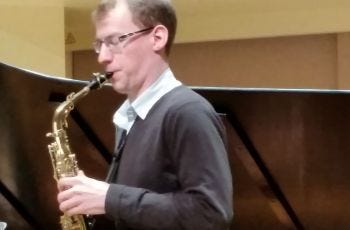
In an NPR interview this year, actor Mark Rylance likened the “hollow space” of grief to the air cavity in a musical instrument. He said, “There’s an enormous amount of soul in a brass instrument’s empty, hollow space. That’s where the music is.” I immediately thought of Elliot’s saxophone. I remembered how the precision and mastery of his breath filled his horn with such glorious bravado. There was the bore, the internal cavity of the saxophone’s body, and the mouthpiece chamber where air resonated after passing the reed. The size of the space in the mouthpiece significantly impacted the sound quality. Space made it art. So, I’m thinking the hollow space of grief within me could yield a sacred song or a meaningful melody. I can be an instrument of his memories ... filling some of the space in my broken heart. As does Elliot’s exquisite poem, artfully untangling the tendrils of time and creation. It reminds me that despite the raging turmoil that confines us in these darkest of days, we can hold space for each other—for grief, for grace, and for good. You're currently a free subscriber to Grief Matters. For the full experience, upgrade your subscription.
|
Saturday, 10 January 2026
Making Space for Good






Subscribe to:
Post Comments (Atom)
Ghost Homesteads of the Blue Ridge Mountains
What remains after the forests reclaim the homes and lives that once filled them ͏ ͏ ͏ ͏ ͏ ͏ ͏ ͏ ...

-
Rex Sikes posted: " Take this quote of William Atkinson Walker's to heart. Understand it and apply it in your life. ...


No comments:
Post a Comment