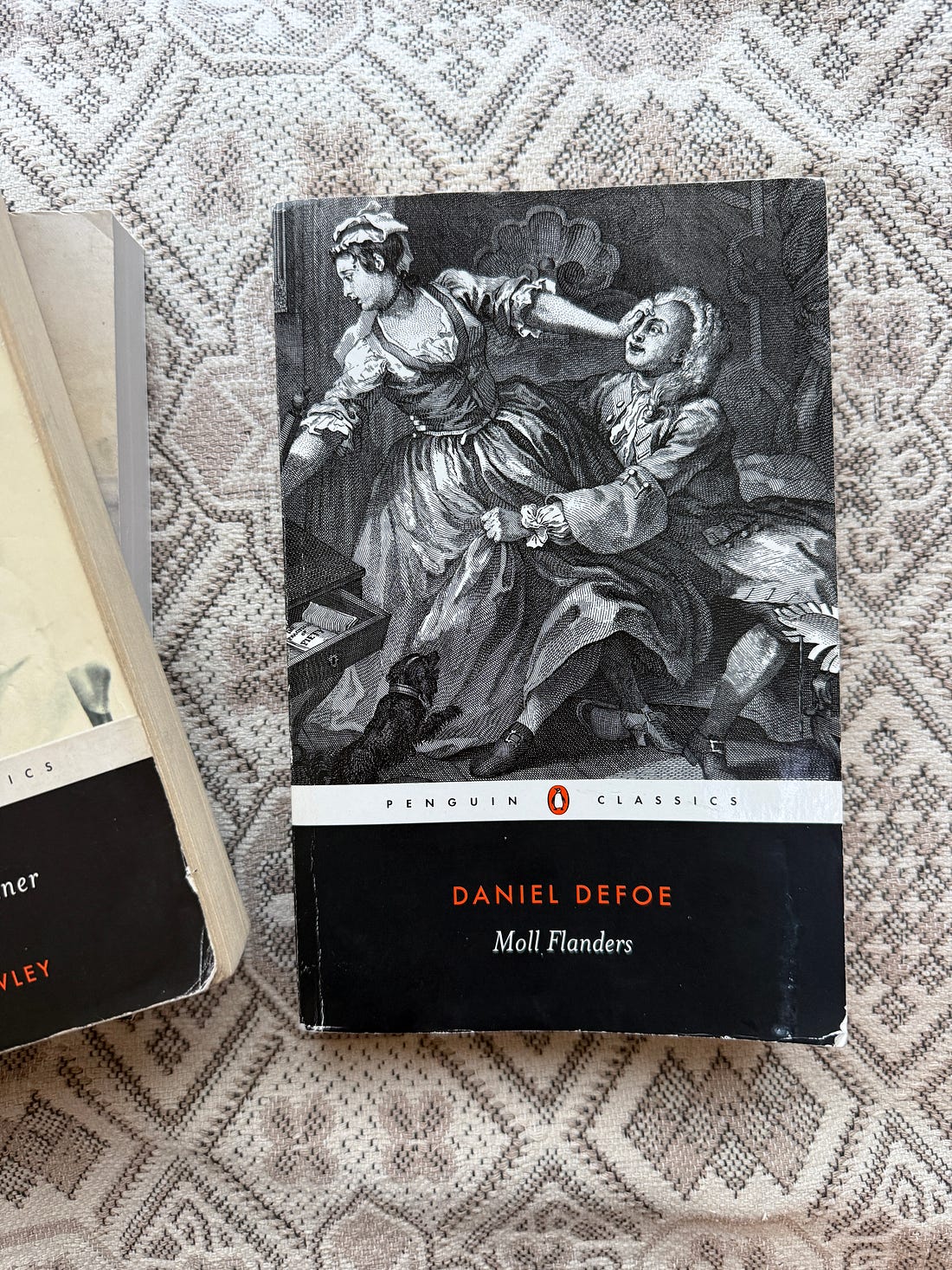
One of the best learning possibilities in taking a class is learning about books and histories that otherwise go unnoticed. One such book I am discovering in my English novel class is Daniel Defoe’s novel Moll Flanders published in 1722. The novel promises to be scandalous and potentially at odds with the moralities of its 18th century readership. The novel is named after its titular character and is about a woman to whom life deals a hand of mishaps. Yet at every turn she perseveres in a society where the obtaining of a quality husband is every woman’s chief concern. In the interests of my own learning, I am writing weekly pieces that reflect back on the current happenings of the novel and how it accomplishes what it accomplishes, starting with the Author’s Preface and continuing on in roughly 100-page sections for the novel has no chapters.
The Author’s Preface: Who is the Author?The author’s preface to Daniel Defoe’s Moll Flanders functions as a foil for it is not written by the author at all, but rather by the author’s editor. This is perhaps the first deception in the novel and is made known when the narrator of the preface writes “the pen employed in finishing her story, and making it what you now see it to be, has had no little difficulty to put it into a dress fit to be seen, and to make it speak language fit to be read.” This reveals that the narrator of the preface was instrumental in reshaping Moll’s original tale into a story suited to publication and is effectively the editor of her work perhaps in a more invasive way than is fitting. The story has been tidied up; “some of the vicious part of her life, which could not be modestly told, [are] quite left out, and several other parts are very much shortened.” Further, Moll herself was instructed to “tell her own tale in modester words.” This raises the question of whether this is Moll’s story as intended to be written by herself, thus an autobiography, or whether the editor’s indicated substantial changes make this instead a biography where the editor instead of the author largely shapes the narrative. Thus, the reader is aligned to potentially expect two voices throughout the coming narrative: the voice of Moll herself and the voice of the editor. However, it is advisable to exercise caution. If the preface already calls into question the identity of the author and editor, perhaps this is merely another foil employed by the writer to pacify us. Purpose & AudienceThe reader is further told to keep an open mind to the novel’s alleged morals; lessons thus embedded into the tale to combat the social acceptability of it. The narrator recommends the book to people who “know how to read it, and how to make the good uses of it which the story all along recommends to them.” The narrator then is expecting reactions to the events of the novel but defends each event as necessary; the ‘vicious’ nature of certain events instead used as an entryway to impart ethical commentary. Curiously, Moll is not punished for her alleged immorality and condemned to a life of destitution nor is she paraded as an example of how not to behave. As the novel admits to its “lewd ideas”, every effort has been made to defend the necessity of such writing, especially as the editor tells us Moll goes on to live quite a successful life despite her less then proper dallying’s. ConclusionAlready the preface lays out a sense of self-censorship, of a story adjusted to fit the sensibilities of the reader. Yet what is true and what is altered is ultimately left to the judgement of the reader. You're currently a free subscriber to Letters By Layla. For the full experience, upgrade your subscription.
|
Tuesday, 27 January 2026
Introduction to Moll Flanders by Daniel Defoe






Subscribe to:
Post Comments (Atom)
New post in Shine Magazine
Keys to Strengthening Your Marriage ...

-
Rex Sikes posted: " Take this quote of William Atkinson Walker's to heart. Understand it and apply it in your life. ...


No comments:
Post a Comment