The “Guess Who?” Test for Instructional DesignDoes my app utilize high-mileage, general-case strategies?
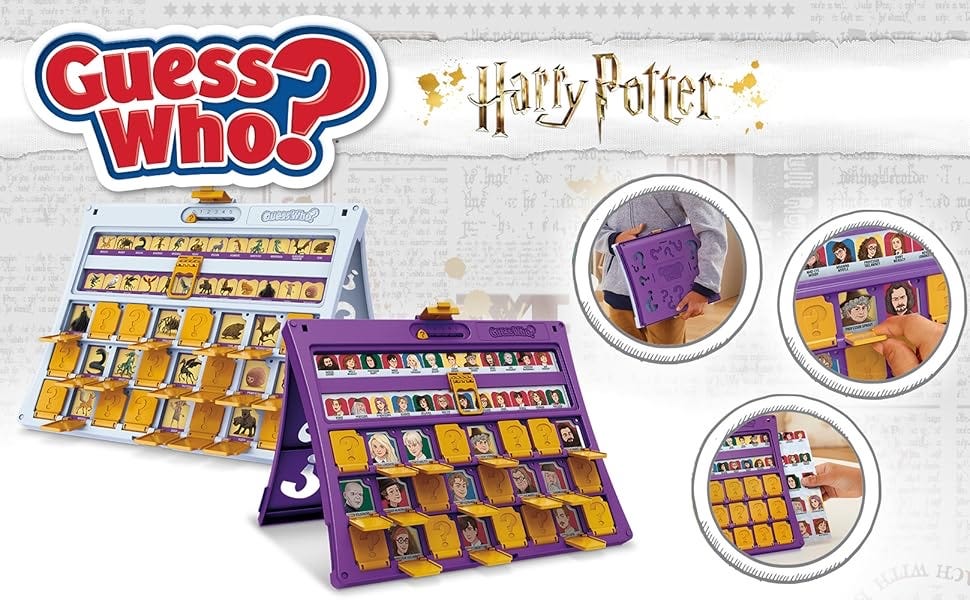
I’m sure you’ve played the game Guess Who? In my family, we’ve been playing the Harry Potter version. It’s a game with a very simple strategy that makes perfect sense for adults, but is surprisingly challenging for kids. You’re given a grid of possible characters, and you get one yes/no question at a time. As a starting point, you want a question that gets you the most mileage—one question that applies to (and eliminates) the greatest number of possible characters. So a question like “Is it a girl?” is a decent move. It covers a lot of ground without being a random shot in the dark. But if you’re a ruthless strategist (like everyone in my family), you’ll notice the details matter. A “girl” is technically an underaged female, so “girl” might only apply to about a quarter of the characters (assuming an even spread across adults/children and male/female). A better question is “Is it female?” because it cuts the board in half. Ultimately, you want to minimize the number of questions you have to ask by selecting questions that apply to the greatest possible number of cases. There are two kinds of questions you basically never want to ask: 1) Questions that are too broad“Is your character alive?” is a bad move because it usually applies to everyone on the board. It’s fundamentally useless: it doesn’t narrow the search space. 2) Questions that are too narrow“Is it Harry Potter?” applies to exactly one case. It’s the opposite problem—too specific. You’re basically playing the whole game one character at a time. Kids do this in Guess Who? all the time—naming individual characters—because they haven’t internalized where the power lies: generalizability across the greatest possible number of cases. That “kid strategy” is also what a lot of developers unintentionally bake into their educational apps, which produces fragile, inefficient learning. Let me explain. Understanding high-mileage, general-case strategiesEducational apps often lack real instructional design intentionality and end up teaching a random, practically limitless set of rules, concepts, and procedures. Some of what’s taught—what I’ll call strategies for the sake of simplicity—is too broad to be useful (“Use your prior knowledge to understand what the problem is asking.”) Other strategies are too narrow to transfer (“Do this thing that only applies to this exact format.”) This is why selecting high-mileage, generalizable strategies matters. When we decide to teach students something, we want that choice to eliminate the greatest possible portion of the curriculum in one go. In other words: teach the fewest things that unlock the most content. The goal is instruction that applies to a whole family of related problem types—and keeps paying off vertically as the content becomes more complex. A familiar example is phonics. Learning a limited set of phonemes and patterns enables students to decode huge swaths of text. Without that leverage, students are forced into memorizing words one-by-one forever—as they were under Whole Language approaches. Instructional time and memory are limited, so investing in teaching that goes far reduces the need for students to memorize countless discrete bits of knowledge. The idea is simple, but it requires careful content and task analysis—something that’s often missing in educational software. Example 1: How most programs teach additionA lesson demonstrates how to solve a problem like 3 + 2 = ☐ by counting 1, 2, 3 and then counting on: 4, 5… and writing 5. It looks like the job is done, but the details matter. This strategy doesn’t work for the following equations: · ☐ = 3 + 2 · 3 + ☐ = 5 · 5 − 3 = ☐ · 5 − ☐ = 3 So the program ends up teaching “new strategies” for each new format—like we’re going character-by-character in Guess Who? What would a more generalizable alternative look like?Direct Instruction (See Stein et al., 2017) does it more like this: · Teach that operating on an equation means both sides must be made the same. · Teach that when you add, you draw lines, and when you subtract, you cross out lines. · Teach that you always start on the side without the ☐, and that the ☐ doesn’t tell you how many lines to draw. The result is that students can make quick work of missing addend and missing subtrahend problems as early as kindergarten! A high-mileage strategy eliminates the need to teach completely new—and potentially confusable—strategies when one strategy for the whole family exists. As a side note, this kind of math can feel “weird” if you were taught a different way. That’s sort of the point: most of us weren’t taught with particularly efficient instructional methods based on a careful analysis of the content. We were taught a collection of local tricks passed down from whoever taught the person before them. Example 2: How most programs teach fractionsA common approach is to show a circle divided into fourths and say: · “The shaded parts are the top of a fraction.” · “The total number of parts are the bottom of a fraction.” So far, so good… except this only works cleanly for fractions less than one. Wait until improper fractions show up and the kid can’t apply the strategy. No wonder fully grown adults still feel shaky about what a fraction really is. Inefficient. Confusing. Avoidable. A higher-mileage strategyStart with more than one circle and teach: · “The shaded parts are the top of a fraction.” · “The parts in each whole are the bottom of a fraction.” Now the same picture-to-symbol routine can represent any fraction, including improper fractions, from day one. You can vary two circles, three circles, and one circle and kids can identify fractions less than one alongside fractions greater than one. You’re teaching a strategy that carries them forward—not one that collapses as soon as the material gets more advanced. Example 3: “Strategies” that are too broadOn the other hand, sometimes instructional designs lean on overly broad heuristics like: · “Figure out what the problem is telling you.” · “Look at the picture.” · “Use guess and check.” Those aren’t strategies so much as vibes: they’re so generic that they offer little procedural guidance. They sound rigorous—and they’re often treated as “teachable” by people who blindly follow standards lists—but they fail to reliably teach anything. A crow can guess and check, by the way. So can a dolphin. I once saw an app “teach” kids to “identify characteristics of an object” with steps like: · Hold it · Turn it and feel it · Scan it with your eyes · Name the characteristic (opaque, brittle, sticky, sweet, transparent…) Can you spot the problem? To identify an object’s characteristics, students have to actually know the characteristics. The app was trying to teach something that’s basically innate— “When I’m told to look at something, I look at it”—and it’s too hollow to improve performance on future tasks where students need actual knowledge to drive their identification. Good instructional design is playing Guess Who? like a beastIf you build instructional programs, here are the questions I’d use to evaluate the generalizability of the rules, concepts and strategies that are being taught: · Is the strategy explicit, efficient, and teachable (clear behaviors a student can actually do)? · What family of problem types does it cover (not just one format)? · Is it grounded in underlying structure/relationships (not just a trick)? · Does it survive surface changes (numbers, contexts, representations, layouts)? · Does it reduce the need for future instruction (fewer new, confusable “strategies” later)? Or… is my app accidentally teaching the way a kid plays Guess Who?—one problem at a time? Reference Stein, M., Kinder, D., Silbert, J., Carnine, D. W., & Rolf, K. (2017). Direct Instruction Mathematics (5th ed.). Pearson. Zach Groshell is free today. But if you enjoyed this post, you can tell Zach Groshell that their writing is valuable by pledging a future subscription. You won't be charged unless they enable payments.
|
Saturday, 20 December 2025
The “Guess Who?” Test for Instructional Design





Subscribe to:
Post Comments (Atom)
Invaders From Earth- The Terrestrial Forces Behind the UFO Deception
On Sunday December 15, 2024, investigative journalist and independent researcher Paul Collins elucidated the intelligence circles and dee...

No comments:
Post a Comment