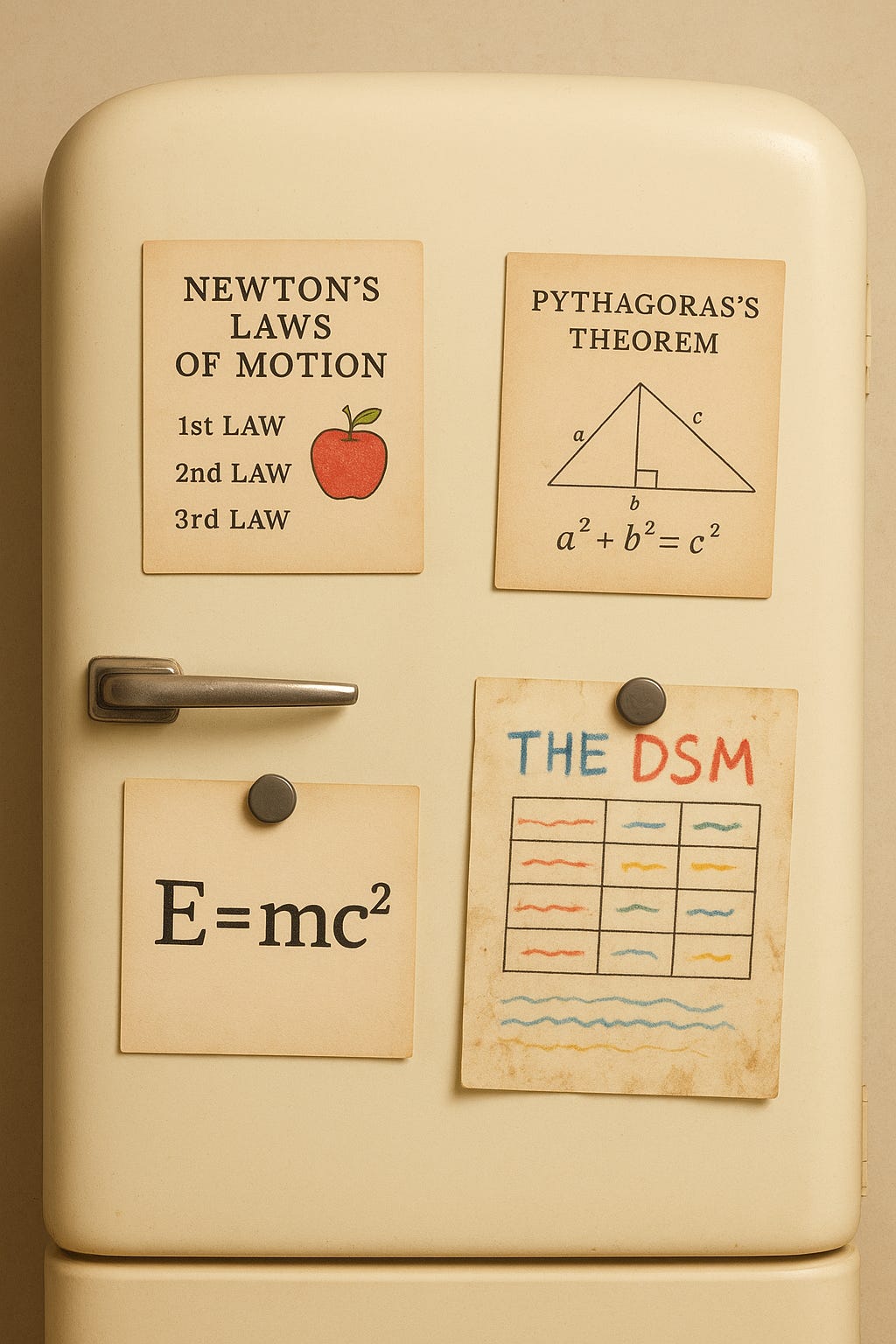
The origins of the Diagnostic Statistical Manual of the American Psychiatric Society (The DSM) lies in the inferiority complex Psychology has when it compares itself with its big brothers of the Sciences: Biology, Astronomy, Physics, and Chemistry. They all used to tease Psychology. “You’re not a real science,” they said. “You’re not even adopted. You’re really a Religion.” None of the Sciences like being called a Religion. The Religions were that family down the street that didn’t mow the lawn. They were once the richest family on the block, but, since Papa Religion lost his job, his only occupation was to volunteer at election time. Mostly he just ran after young boys. Momma Religion baked bread. It smelled good, but it never rose because she wouldn’t use yeast. The Religions were always fighting and you could hear them inside the house going at it, arguing about who was better. Whenever they went out, they’d wear their Sunday best, but that didn’t fool anyone. That’s why Psychology didn’t like being called a Religion. Psychology decided it would classify all the mental conditions, just as Biology had with all the living things. He specified the criteria for each condition as Chemistry had when it recorded how many electrons were in each element. He constructed a table of the conditions and gave each one a number, similar to the Periodic Table of the Elements. He wrote all this in the DSM and proudly showed it off to the Sciences. The siblings sniggered, but Mama Science taped it to the refrigerator along with Newton’s Laws of Gravity, Pythagoras’s Theorem, and Einstein’s Theory of Relativity, because, even though it looked like scribbling, she felt Psychology needed to be encouraged. That night, Papa Science argued that the unsightly scratchings should just disappear like Ptolemy’s Solar System had, or at least they should put it away where it couldn’t hurt anyone, along with Occam’s Razor. Mama Science said wait for a few days. Psychology will just forget all about it and go back to playing with its pet rats. He won’t even notice it when it’s gone. Then one day their neighbors, the Businesses, visited while the DSM was still up on the refrigerator. They offered to buy it. The Sciences sold it without much negotiation because they always needed the money and were glad to see it out of the house. However, they regretted the sale when they saw that the Businesses displayed it in their storefront window with Psychology’s name right on it. If they had just kept it on the refrigerator, eventually it would’ve been covered up when Physics drew its Theory of Everything. Nonetheless, they used the money to put up a stockade fence between them and the Religions. The Businesses, of course, didn’t buy the DSM for its aesthetic or scientific value. They bought it because they knew how to make more money off it. Just as a movie producer will distribute a movie so he can sell action figures, Aunt Pharmaceutical Business was interested in the DSM so it could sell drugs to people. She made a mint, doing so. She knew that if people could be convinced that their wayward thoughts were an illness, they could sell those people drugs for that illness. Just the fact that a person’s thoughts or behavior was described in the DSM convinced people that they had a mental illness. After all, the book had to be scientific because Psychology was a Science. Wasn’t it? It was OK to take drugs for an illness, but if you took drugs when you didn’t have an illness, you were just a drug addict. Aunt Pharmaceuticals didn’t want to sell drugs to drug addicts because then she would become disreputable, like that black sheep of the Businesses, the Mob, and she never would be able to sign a lease in the best locations. Aunt Pharmaceuticals even hoped to get some money out of the Governments, who are so cheap they borrowed everyone else’s tools and acted like they were theirs when you asked for them back. Psychology, learning a thing or two from the Businesses, kept on making new versions of the DSM and adding to the numbers of conditions that could be called an illness. Having created these illnesses, millions of people started coming to Psychology for medical advice. He pretended he was a doctor and gave it to them. No one could say he was a Religion, now. Pharmaceuticals visited a lot and really took to Psychology’s son, Psychiatry. She would bring him pens, post it notes, and other trinkets. It was inevitable that Pharmaceuticals and Psychology would end up in bed together. The Sciences welcomed her as part of the family and everyone expected they would be married soon. After a while, the most conservative of the Business siblings: Insurance, began to suspect that Psychology had made up all these illnesses. Insurance must have been reading his actuary tables too much and been scared to come out of the house because, by the time he found out, it was too late to do anything about it, and he almost had a heart attack. He couldn’t die of a heart attack, of course, because he was low risk. It did cause him to retire a little earlier than he planned, though. He left his firm to his son, Managed Care. The Businesses were glad to see that Managed Care was very different from his fretful father. Managed Care knew he was powerful and wasn’t afraid to throw his weight around. He told Psychology straight away that he would only pay for so many sessions of its therapy and he was lucky that he got anything at all because, it was rumored, Psychology was not a real Science. Psychology cried and complained that Managed Care was bullying him, but his big brothers: Biology, Chemistry, and the rest, never came to his aid. As far as they were concerned, it was about time the little brat got what he deserved. Managed Care told Psychology, “You’re really good at writing,” He said, “Since you’re good at writing, and since I want to know what the money I spend on peoples’ therapy is going for, I’m going to want you to write down which diagnostic category each person you treat is in. Furthermore, if there are all these diseases, we can’t have the same therapy for every disease. I will only pay for whatever therapy most helps each disease. You’ll have to write that up, too.” Psychology complained some more. He wanted to be a doctor, not a writer. All the time Managed Care made him spend on writing, he couldn’t spend on seeing patients. The ultimate indignity came when, behind Psychology’s back, while he was writing, Managed Care started to woo Pharmaceuticals. He whispered in her ear, “Your drugs are so much more effective at treating people than Psychology’s therapy. Join with me and leave Psychology behind. We will make more money together than you have ever dreamed.” It wasn’t really true; drugs weren’t more effective; they were just cheaper; but Pharmaceuticals loved being told these sweet lies, so she started to cheat on Psychology. This was all too much for Psychology. Deep within his heart he knew that the DSM was just a bunch of made up lies; but he could barely admit it to himself, much less to the world. He knew the truth. Those are all just arbitrary categories in the DSM. People suffer. Their suffering is real. The categories we use to describe that suffering? Fiction. People are more complicated than they seem in the DSM; they cross diagnostic lines, they have co-occurring disorders; their problems, thoughts, and behavior changes over time. They could be ADHD as a child and bipolar by the time they become an adult. One psychologist could give a diagnosis one week and, if the person sees another one the next week and says different things, he will get a different diagnosis. He also knew, but would never admit there is no objective test for any mental condition. No blood work will tell you have schizophrenia. No MRI detects depression. There’s not an x-ray that shows anxiety. It all just goes by what people say. Psychology wanted to scream. Those drugs Pharmaceuticals makes aren’t going to work by themselves. It takes a skilled clinician to sort out the tangled mess that people make of their lives. Science can only take you so far. Psychology is more than a science. No, it’s not a Religion. It’s an Art. In the dusty, cobwebby closet of his brain, Psychology knew the truth. Papa Science was not his father. Mama Science had slept with a neighbor and she became pregnant by him. This was why Psychology was so different from his siblings, the hard sciences. The neighbor that impregnated his mother was not Religion, as they all suspected. Mama Science had more pride than to sleep with Religion. The neighbor was Art. Psychology was the product of the union between Science and Art. When regarded as a work of Art, the DSM was a thing of beauty. Oh, it’s not like an impressionist’s painting or a Mozart Symphony, or anything quite as expressive. It’s more like a Mondrian Abstract or a Star Wars episode. In the library, it should be filed under Science Fiction. It’s one of the greatest works of science fiction ever written. Imagine a world, says Psychology in the DSM, in which thoughts, behaviors, and personalities could be perfectly categorized in detail. A world in which we knew why people act the way they do and knew clearly the difference between sane and insane. Psychology imagined this world and wrote a book about it as if it were true. He wrote it so convincingly that everyone thought it was true. That’s not the work of Science; it’s a work of Art. Psychology wanted to shout these things from the rooftops and be free of the secret, but, of course, he couldn’t. He had too much riding on the status quo. He would lose face if he went back now. And so, there you have the predicament Psychology is in, but don’t worry. You see, Psychology is not a real person. It doesn’t exist. It’s an abstraction. There is no Psychology, there are only psychologists. Even though Psychology can’t tell the truth, they can. And now, so can you. Tell them you’re not a statistic in a manual. Remind them you’re a person, clothed in mystery, in possession of a soul. Invite your friends and earn rewardsIf you enjoy The Reflective Eclectic, share it with your friends and earn rewards when they subscribe.
|
Monday, 15 December 2025
The DSM




Subscribe to:
Post Comments (Atom)
Ghost Homesteads of the Blue Ridge Mountains
What remains after the forests reclaim the homes and lives that once filled them ͏ ͏ ͏ ͏ ͏ ͏ ͏ ͏ ...

-
Rex Sikes posted: " Take this quote of William Atkinson Walker's to heart. Understand it and apply it in your life. ...


No comments:
Post a Comment