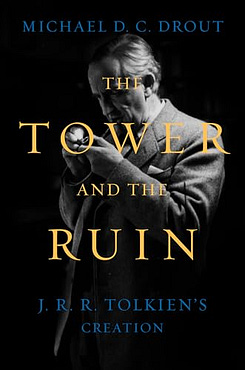
The Tower and the Ruin: J.R.R. Tolkien’s Creation J.R.R. Tolkien’s book The Lord of the Rings is cited as a favorite by readers all over the world. It is a book we return to over and over again, with many reading it at least once or twice every year. People read it to their children, and often they end up reading it to their own children in turn. While it’s common to reread favorites, few books inspire as much love as The Lord of the Rings. It feels different from other fantasy novels, with many finding it inspires a nostalgia for a place that never existed, and a longing for a world that can never be. Though other fantasy writers have attempted to build worlds as complex as Tolkien’s Middle-earth, they have all fallen short of the mark (though some like Susan Cooper and Ursula K. Le Guin come close). So what is it about Tolkien’s work that makes it stand head and shoulders above so many others? Why do we return to it seasonally or in times of personal hardship? In his new book, The Tower and the Ruin: J.R.R. Tolkien’s Creation, Dr. Michael D.C. Drout sets out to explore potential answers to these questions. Drawing upon a love of Tolkien that goes back to his childhood and his own experience as a professor of English who specializes in medieval literature, Drout discusses the sources of Tolkien’s inspirations and how they influenced his work. Drout also builds on the work of other Tolkien scholars such as Verlyn Flieger and Tom Shippey to help explain his ideas and occasionally refuting some of theirs. The textual analysis is straightforward and presented clearly so, even if the reader isn’t familiar with Anglo-Saxon poetry, they’ll understand what’s going on. What, exactly, is going on with all this textual analysis? Quite a lot. Drout explains how Tolkien built his metaphorical tower using stones from the ruins of medieval literature to give Middle-earth its extraordinary depth of history. When you read The Lord of the Rings, you get glimpses of a deeper history: Elrond mentions heroes such as Húrin and Túrin; Aragorn tells a brief story of Beren and Lúthien though he says there is much more to their story that the hobbits aren’t told; Gimli speaks of the wonders of Moria in its glory days, while Legolas tells sad tales of Elves who disappeared from the world an age ago. These ‘broken references’ or ‘pseudo-references’ help give Middle-earth a weight of internal history. If you then delve into The Silmarillion, you get a greater sense of that world’s history– but even then, it feels as though there are even more stories left untold. The reader gets only hints of certain things: what happens to Beren and Lúthien in the end, for example? Much as we want to know, we never find out. But where other authors would dig down to find some sort of answer, Tolkien left a lot of questions unanswered, which reflects the realities of the medieval texts he studied for most of his life. In our real histories, we don’t have all the answers. Someone will be mentioned in an ancient story and the writer will say “everyone knows about this man, so I won’t explain it here”, but in the intervening years that story was lost. Now, we only have hints and vague suggestions. In his grand histories of the three ages of Middle-earth, Tolkien did the same thing, which gave his stories a feeling of depth and history that has gone unmatched ever since. The Tower and the Ruin isn’t entirely about textual analysis, broken references, and other literary devices, however. Drout continuously returns to the beauty of Middle-earth– to Tolkien’s landscapes in The Lord of the Rings, the gorgeous lost Elven cities of The Silmarillion, and the starlight through the cloud wrack that reminds Sam, and us, that there is beauty in the world that no darkness can touch. Despite all the heartbreaking los, there is always beauty to be found. There are many themes to find in Tolkien’s work, but this is one of the most important ones to remember. Though he cannot speak for all readers, Drout can certainly speak for himself as a lifelong Tolkien fan. Throughout the book, he tells deeply personal stories of how Tolkien’s stories have helped him find a way through the darkest parts of his life, from his parents’ divorce when he was a child to the loss of his own son in 2022. While he admits that The Lord of the Rings or The Silmarillion has never provided a simple answer to the problems of his life, it has reminded him of a simple truth: that no matter how dark the days seem, and no matter how heavy grief can be, there is always hope. Thank you to NetGalley and W.W. Norton and Company for the free advance copy for review Traveling in Books is free today. But if you enjoyed this post, you can tell Traveling in Books that their writing is valuable by pledging a future subscription. You won't be charged unless they enable payments.
|
Wednesday, 3 December 2025
Book Review: The Tower and the Ruin




Subscribe to:
Post Comments (Atom)
Two spots for July
Now is the time. ...

-
Rex Sikes posted: " Take this quote of William Atkinson Walker's to heart. Understand it and apply it in your life. ...


No comments:
Post a Comment