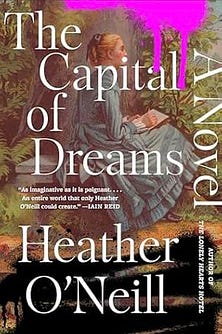
The Capital of Dreams When the tiny country of Elysia is invaded by its neighboring country (known solely as the Enemy), the famous artist and writer Clara Bottom puts her fourteen-year-old daughter Sophia on a train heading out of the country, along with her last manuscript, which is hidden in a book of fairytales. When the train is intercepted by a force of the Enemy’s troops, Sophia escapes into the forest, only to discover that her mother’s manuscript has gone missing. Though she and her mother have had their differences, Sophia vows that she will do whatever it takes to find the manuscript and so she and a talking goose embark on a journey through the woods where creatures out of myth haunt the trees. But the monsters Sophia spies out of the corner of her eyes aren’t nearly as dangerous as the people she encounters. Though Heather O’Neill is a respected literary figure with books like The Lonely Hearts Hotel and Lullabies for Little Criminals, I hadn’t read any of her books before I picked up The Capital of Dreams so I didn’t know what to expect. Honestly, I’m still unsure of what to expect from O’Neill’s writing. Is The Capital of Dreams typical of her work, or is it an outlier? See, the story is written with fairytales in mind. Sophia grew up on fairy stories and is reluctant to let them go- understandable, as such tales provide plenty of consolation in hard times. What threw me off was O’Neill’s prose: though Sophia is fourteen and reaching toward adulthood, the book is written as though it is meant for a younger audience (for nine to twelve, perhaps) when it is definitely an adult story. It makes for a very disjointed reading experience when, on one page, Sophia is chatting away with the Goose about childish things, and then a few pages later, Sophia has a series of very frank thoughts about sex and sexuality. Still other times, Sophia comes face to face with death and descriptions of horrendous violence, but the prose sets all of this violence at a distance- until it doesn’t. There seems to be little rhyme or reason to it. And yet it all feels like O’Neill did it all on purpose. Sophia’s only defense mechanism to stay sane amidst the extreme violence she witnesses is to escape into a world of fairytales. With that in mind, it’s easy to understand why O’Neill’s prose is written the way that it is, with children’s stories in mind. For all that, I can’t say that I liked this book or found it compelling. Part of it had to do with the prose, which I quickly found irritating every time I picked it up again, and part of it had to do with the flashbacks. Nearly every other chapter flits away from Sophia’s journey through the forest and back in time to Sophia’s life with her mother before and during the war. Do those chapters help the reader understand Sophia’s choices by the end of the book? Yes. Did I find them completely aggravating? Also yes. I’m not a fan of flashbacks in general, though, so your mileage will vary based on whether or not you find them as annoying as I do. Overall, I can’t say The Capital of Dreams is a bad book. It’s not. O’Neill clearly knows what she is doing with her work, but it is not a book that I liked or enjoyed though I can understand why others would. Thank you to NetGalley and Harper Perennial for the free ebook in exchange for an honest review. Receipt of the ebook did not affect my opinions. Traveling in Books is free today. But if you enjoyed this post, you can tell Traveling in Books that their writing is valuable by pledging a future subscription. You won't be charged unless they enable payments.
|
Sunday, 5 January 2025
Through the War-torn Woods





Saturday, 4 January 2025
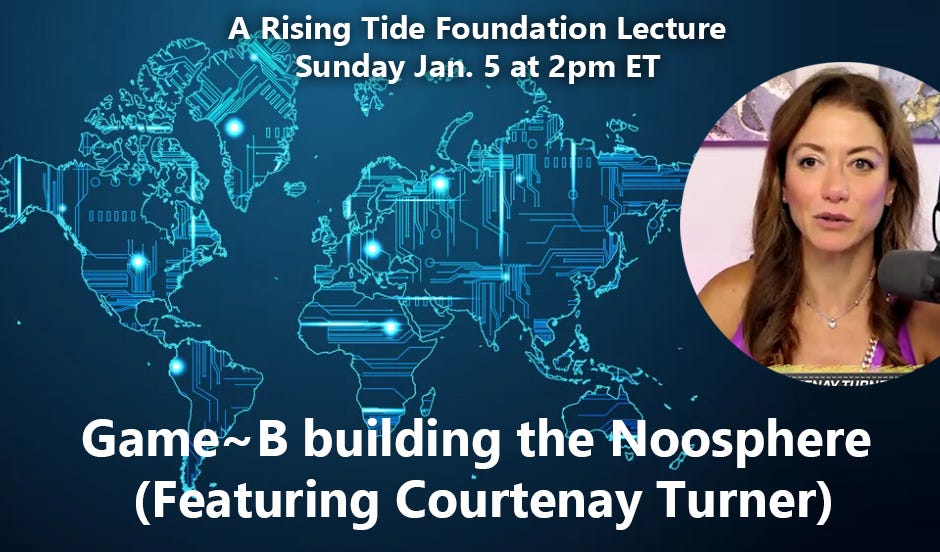
Invitation: Game~B building the Noosphere with Courtenay Turner (Jan 5 at 2pm ET)
This Sunday January 5 at 2pm ET, Courtenay Turner will deliver an RTF lecture on the topic of the transhumanist/Silicon Valley agenda to re-wire human civilization following a program called ‘Game B’. Access this live lecture by clicking the Zoom link below:... Subscribe to Rising Tide Foundation to unlock the rest.Become a paying subscriber of Rising Tide Foundation to get access to this post and other subscriber-only content. A subscription gets you:
|

Friday, 3 January 2025
Frailty, Thy Name is Humerus
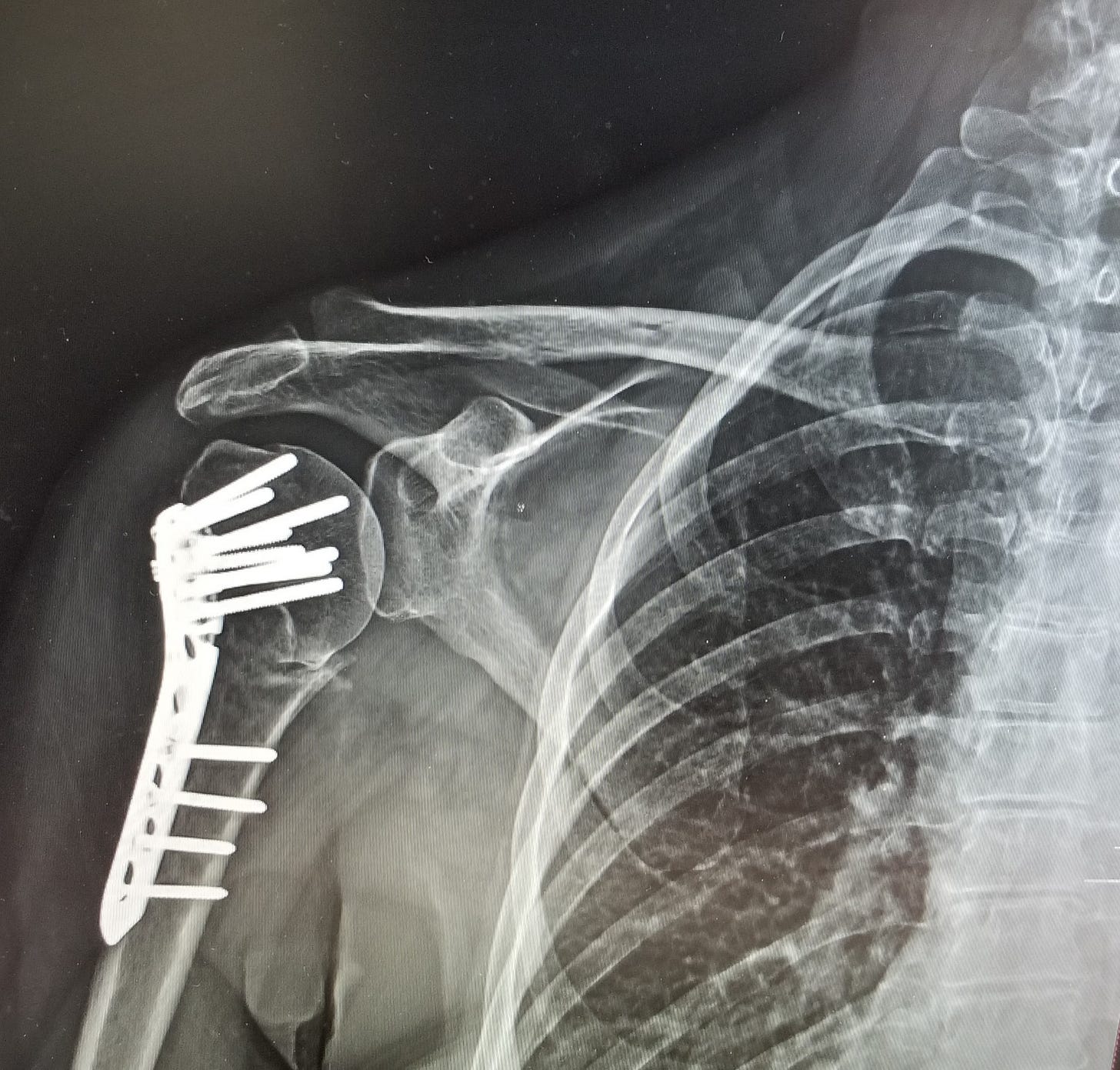
My mother always insisted on waiting until Twelfth Night, the Christian Epiphany, to take down the Christmas tree and decorations. For her, January 6 was the official end of Christmas and the final day of her annual galaxy of glitter. I must admit that I was always a little embarrassed by the lingering decor because it felt like we were staying a little too long at the party. We were not religious at all and did not attend church, so the incongruity of the requirements, sacred and secular, confused me. Biblically, Twelfth Night marks the arrival of the Magi, who traveled hundreds of miles from Persia (now Iran) to pay homage to the baby Jesus, but we never really discussed that part of the story. Even though I now put away the decorations on New Year’s Day, these twelve days still feel like an uncomfortable limbo — a nebulous abyss between Christmas and Epiphany, between the past and what’s next. As we look to 2025 with some trepidation, I’ve been feeling that familiar anxiety. Perhaps, it might have something to do with the number 12. Here is a baker’s dozen: 12 drummers drumming 12 eggs (or donuts) in a dozen 12 apostles 12 months in a year 12 signs of the zodiac 12 hours on the clock 12 angry (people) on a jury 12 Greek gods on Mount Olympus 12 function keys on the keyboard 12 hues on the color wheel 12 inches in a foot 12 days of Christmas and 12 pins in my shoulder Yep, that last one is the kicker — 12 pins in my shoulder. This Christmas and the four months that preceded it have been all about my upper-humerus fracture, subsequent surgery, and continuing recovery. This course of events is not something I would recommend to you — or anyone. One of the worst parts is that I now cringe when I think of my beloved New York City. On a September jaunt with girlfriends last year, I fell and fell hard while walking down the street in Midtown Manhattan at the end of a festive night. It was a freak splat on the concrete and curb that managed to break my arm, my glasses, and my cool-girl facade — while harshly revealing the precariousness of my existence. First, let me assure you: A high-humerus fracture is no joke. And it’s particularly lacking in amusement when it happens away from home at a time in your life with no personal support — and insurance coverage that’s an HMO Marketplace policy valid only in Texas. Frailty, thy name is humerus. Though I did get to test my metal, I discovered I am way over the metal-testing phase. I am maxed out, thank you very much. I’m already shouldering what can never be fixed — the death of my first-born son, Elliot, as well as the traumatic end of a toxic relationship last year, a professional betrayal, and my son Ian’s move to Austin . . . The list is exhausting. Physically, this has been one of the most excruciating experiences of my life. It’s tough to negotiate life in constant pain with only one working arm — my left in this case. Plus, I am right-handed, and I live alone. It’s a brave new world of vulnerability. The surgery was like part two of the same agonizing attack — down, out, and unable to move all over again for several weeks. Fixing my hair, opening the refrigerator, getting dressed, taking a shower, opening a jar — everything was harder, slower, and more agonizing. And I was housebound. No driving. Some did not fully understand what I was experiencing. I guess they didn’t have to. Until it happens to them, it’s hard to fathom, and of course, they had their own fish to fry. But you learn who your friends are in dire situations like this. With the fair-weather type, you’ll always be carrying your own umbrella. But then, some folks surprise you and step up in astonishing ways. It’s very similar to my journey of grief. For example, my dear friend Laura of almost forty years, who now lives in Austin, did not skip a beat in offering to come to Dallas to stay with me for the surgery. “You’d do it for me, “she assured me. That I would. She brought yummy homemade food, fresh and frozen, and made me laugh — the best medicine. My son Ian tag-teamed with her. Though I could tell the visit was not his favorite activity, I appreciated his presence so much. My beautiful neighbors, “the Judys,” saved my bacon, though I believe one of them is practically a vegetarian. They say community is built through compassionate acts, and they personify that ideal. Judy S took me to countless post-op doctor’s appointments in Plano, shopped for me, and ran errands. Judy L took my cat Vivian to the vet and was always ready to help. My dear neighbor Tracy offered to shuttle me to my therapist just as I was about to call a Lyft. This experience renewed my faith in people and reminded me of what is most valuable in life — the glimpses of grace and the unexpected acts of spontaneous kindness that sustain us. When I took the awful tumble, I felt so alone, stupid, and miserable, but I needed to recognize my own humanity and the fact that we all teeter on the edge of disaster most of the time. That’s why we all need a hand to grab as we extend the other — I’ll get here soon enough. I had lived more than half a century without breaking a major bone. Was that luck or random grace? Maybe the emotional intensity of this event is my soul’s recognition of the latter. I’m also reminded of the raw fragility of life, like that horrible Sunday six years ago when a tragic motorcycle mishap we may never fully understand took the life of my bold and brilliant Elliot. The hard truth is that these moments of extreme wobbliness can defy our ability to control them. So, on this 2025 Twelfth Night, I will remember how my mother clung to every last glimmer of Christmas sparkle; I will be grateful for the generosity of the precious angels in my midst; I will embrace the 12 pins that permanently reinforce my brittle, high-riding humerus, and I will do my best to notice every bittersweet moment of random grace. You're currently a free subscriber to Grief Matters. For the full experience, upgrade your subscription.
|

May FilmFreeway Festival Discount Codes – 50% off codes!
Submit to the top festivals in the world today. ͏ ͏ ͏ ͏ ͏ ͏ ͏ ͏ ͏ ͏ ͏ ͏ ͏ ͏ ͏ ͏ ͏ ͏ ͏ ͏ ͏ ͏ ͏ ͏ ͏ ͏ ͏ ͏ ͏ ͏ ͏ ͏ ͏ ͏ ͏ ͏ ...

-
Rex Sikes posted: " Take this quote of William Atkinson Walker's to heart. Understand it and apply it in your life. ...


